
Missiles hit Israel after Iran snubs Trump talks, Knesset pauses

Iran launched a new and extensive wave of missile attacks on Israel early Tuesday, marking a sharp escalation in the ongoing conflict, even as US President Donald Trump claimed that negotiations to end the war were showing “very good” progress – claims firmly denied by Tehran.
Israeli media reported powerful explosions across multiple locations, including Tel Aviv, Bir al-Sabe' (Beersheba), the western Negev and Arad, following what was described as the largest missile barrage since the war began. The strikes reportedly caused injuries and widespread damage.
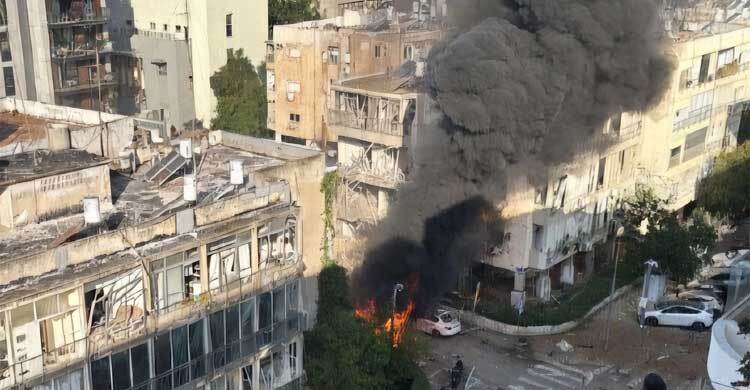
In northern Tel Aviv, an Iranian cluster missile reportedly struck, prompting the deployment of large emergency response teams. Around 10 strong explosions were heard across central regions, intensifying fears of a broader escalation. Sirens were activated in nearly 180 locations, particularly in northern areas, amid reports that cluster munitions fell across multiple sites.
Search and rescue teams were dispatched to several affected areas in southern Israel, while local media reported a direct missile hit on a building and damage in at least seven additional locations from missile fragments. A key road connecting Tel Aviv to northern regions was also closed following the strikes.
According to the Israeli newspaper Haaretz, Iranian attacks have continued unabated into the 25th day of hostilities, underscoring the sustained intensity of the conflict.
Missiles struck several areas in central Israel, including the Tel Aviv region, early this morning, with at least one direct hit reported. According to Israeli media, the barrage resulted in at least four impact sites, including a direct strike on a building.
Israel’s emergency medical service said six people were lightly injured at the impact sites. One missile landed on a busy street in Tel Aviv, setting several cars on fire and causing severe damage to at least three buildings. Police said the missile carried a warhead weighing close to 100kg.
Missile debris also fell in the central Israeli town of Rosh HaAyin, causing only minor damage, police added. Meanwhile, Israeli media reported that a large fragment of an Iranian missile landed near a Palestinian town in the occupied West Bank.
Knesset session suspended amid air raid alert
The escalating situation disrupted political proceedings, as a session of the Israeli parliament, the Knesset, was halted following an air raid warning issued by the military’s Home Front Command.
Israel’s Health Ministry said a total of 5,047 people have been injured since the conflict began, highlighting the growing human toll.
IRGC claims new phase of ‘Operation True Promise 4’
Iran’s elite Islamic Revolutionary Guard Corps (IRGC) confirmed launching the 78th wave of its ongoing military campaign, dubbed Operation True Promise 4. The operation targeted multiple sites across Israel, including Eilat (Umm al-Rashrash), Dimona and areas north of Tel Aviv, as well as US military bases in the region.
The IRGC said the attack involved precision-guided Emad and Qadr multi-warhead ballistic missiles, along with suicide drones, signalling an increasingly sophisticated and coordinated offensive.
Conflicting signals over diplomacy
Despite the intensifying conflict, Trump said his administration was engaged in talks with a senior Iranian figure and suggested a breakthrough could be possible within days. He warned, however, that failure to reach an agreement would result in continued US military action.
US media outlet Axios reported that the interlocutor could be Mohammad Bagher Ghalibaf, Iran’s parliament speaker. It also said US envoy Steve Witkoff and Jared Kushner might meet an Iranian delegation in Pakistan, potentially joined by Vice President JD Vance.
However, both Tehran and Iranian officials rejected the claims. Ghalibaf said “no negotiations” were underway, accusing Trump of attempting to manipulate global markets. Iran’s foreign ministry spokesman Esmaeil Baqaei also denied any direct talks, though he acknowledged receiving messages via intermediary countries.
Israeli Prime Minister Benjamin Netanyahu said he had spoken with Trump and acknowledged Washington’s belief that a deal might be possible, but vowed Israel would continue its military operations against Iran and its allies.
Regional escalation and economic risks
The conflict has widened beyond Israel and Iran. Lebanese state media reported fresh Israeli airstrikes on southern Beirut, as Israel expands operations against Hezbollah.
Meanwhile, tensions around the Strait of Hormuz, a critical global oil shipping route, continue to rattle markets. Iran has previously threatened to disrupt traffic through the strait, which carries about one-fifth of the world’s crude oil.
International Energy Agency chief Fatih Birol warned that a prolonged conflict could trigger an energy crisis surpassing both the 1970s oil shocks and the economic fallout from the Ukraine war.
Oil prices, which surged above $100 per barrel amid the conflict, dropped sharply following Trump’s remarks about potential negotiations. Global markets in Asia, Europe and the US responded positively to the possibility of de-escalation.
War toll rises, uncertainty deepens
Since the war began, Iran has retaliated against US-Israeli actions by targeting regional energy infrastructure, US-linked facilities and Israeli cities. At the same time, Israel has intensified strikes on Iran and expanded its campaign in Lebanon.
According to the US-based Human Rights Activists News Agency, at least 3,230 people have been killed in Iran, including 1,406 civilians, though these figures could not be independently verified.
As both sides continue military operations while sending mixed signals on diplomacy, the situation remains volatile, with fears growing of a prolonged regional war and its far-reaching global consequences.
Source: AFP, Al Mayadeen