
Chaos reigns as gunfire and illegal arms take over

The night of February 21 crackled with gunfire in Ramchandrapur of Shailkupa in Jhenaidah, as a brutal clash between two extremist groups erupted at a crematorium ground. By midnight, the toll was grim: three men lay dead, their bodies riddled with bullets.
Among them was Hanif, 50, a former top leader of the Purba Banglar Communist Party, already a wanted figure in multiple murder, extortion, and robbery cases. This wasn’t a lone outburst—it’s part of a chilling surge of firearm-fueled crime sweeping Bangladesh, where looted weapons and escaped convicts have turned everyday streets into battlegrounds.
Just days earlier, on February 19, a land dispute in Rupganj of Narayanganj, took a terrifying turn when a man brandished a pistol in public, menacing a woman and reportedly injuring someone with a shot. The video went viral, stoking public fear.
That same morning, armed robbers stormed a moving bus in Dhaka’s Uttara, holding passengers at gunpoint in broad daylight. A woman’s harrowing Facebook post detailed the ordeal, amplifying the panic online.
These incidents are no anomalies. Across the country, reports pour in of criminals wielding firearms—often looted from police stations, boxes, and units during the chaos following the Awami League’s fall on August 5.
From Chattogram’s Kalarpool, where gunmen practiced openly after demanding ransom, to Mohammadpur’s Geneva Camp, where a man was shot dead, and Cumilla’s Preeti Jewelers, where robbers fired and lobbed crude bombs during a heist, the pattern is clear: illegal arms are fueling a crime wave that threatens public safety.
In a brazen attack, criminals dared to target Joint Forces—comprising army and police—on February 10 at 11:00pm in Hatiya, Noakhali. Assailants hurled crude bombs at a patrol vehicle, sparking a tense standoff. The joint forces fired 24 blank rounds in self-defense, then chased down and arrested two suspects. The haul? Four firearms, six sharp weapons, eight bullets, and 20 crude bombs—proof that even the boldest goons are arming up against the law.
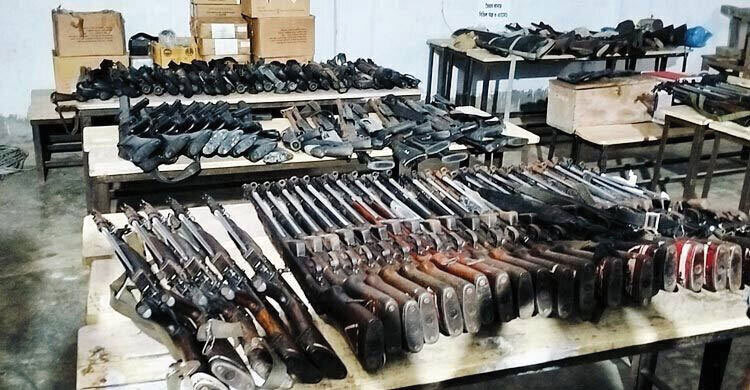
The numbers are staggering. Police Headquarters reports 5,750 weapons and 651,969 rounds of ammunition were stolen in the post-August unrest. By September 3, a recovery deadline set by the interim government, 3,880 weapons and 286,353 rounds were returned. Since then, a nationwide joint force operation—ongoing and now bolstered by “Operation Devil Hunt,” launched February 8—has recovered 4,366 weapons.
Yet, 1,384 firearms and 260,531 rounds remain unaccounted for, potentially in the hands of terrorists, extremists, or opportunists.
Lieutenant General (retd) Abdul Hafiz, Special Assistant to the Chief Adviser, warned at a February 18 conference of deputy commissioners that these missing weapons—1,400 guns and 2,50,000 bullets—could fall into terrorist hands, fueling anarchy. “Autocrats and their allies are regrouping, plotting instability,” he cautioned.
Meanwhile, Awami League leaders and activists, who held 7,549 licensed weapons among the country’s 50,310 legal arms, have surrendered many but not all. Their past use of firearms in political violence, coupled with unrecovered illegal caches, heightens the security risk.
The human toll is stark. From September to December last year, 56 people were killed and 2,419 injured in political clashes, according to the Law and Arbitration Center. More recently, crimes like the January 24 rape at gunpoint in Manikganj, the February 11 molestation and forced marriage attempt in Faridpur, and a February 10 grenade attack on a joint force vehicle in Noakhali underscore the weapons’ deadly versatility. Even as police recover arms—like two looted from Bogura Sadar Police Station or a former home minister’s pistol in Dhaka—the threat persists.
Operation Devil Hunt, targeting both weapons and fugitives, has its work cut out. Of 2,200 convicts who escaped jails during last year’s unrest, 1,500 are back in custody, but 700 remain at large—70 of them high-risk, including death-row inmates.
Criminologist ABM Nazmus Shakib of Dhaka University warns, “Illegal weapons in the wrong hands—be it ordinary citizens or terrorists—pose a grave risk. Incentives for recovery and targeting ‘big brothers’ shielding juvenile gangs could help, but the challenge is immense.”
Asif Mahmud Shojib Bhuiyan, Adviser to the Ministry of Local Government, vows renewed action: “We’ll ramp up Operation Devil Hunt, targeting smuggled and looted arms to protect the people.” Yet, with gunfire echoing from villages to cities, the question lingers: can Bangladesh rein in this unbridled arsenal before it claims more lives?