
Endless commissions, elusive reform: The public admin saga

Since Bangladesh’s independence in 1971, at least a dozen commissions have been established to reform the country’s public administration.
Yet, despite their efforts, successive political governments have shown little appetite for implementing sweeping changes, leaving the administrative system largely stagnant.
While recommendations have piled up over decades, the bureaucracy remains mired in inefficiency, partisanship, and internal conflicts.
The ousting of the Awami League government on August 5, following a mass uprising led by students and citizens, reignited calls for reform across various sectors, including public administration.
In response, the interim government formed the Public Administration Reform Commission on October 3, chaired by Abdul Muyeed Chowdhury, a former advisor to a caretaker government.
The commission delivered its report on February 5, offering over 200 recommendations within four months—a swift turnaround that has sparked cautious optimism.
A glimmer of hope amid scepticism
Many see the interim government’s lack of political baggage as a unique opportunity. “The government’s goodwill is key to implementing reforms,” observers note, pointing out that unlike elected administrations, the current leadership has no partisan interests to protect. This, they argue, could enable bold steps previous governments avoided.
However, scepticism persists. Critics argue that the interim government, unelected and reliant on political party support for major changes, may lack the legitimacy or time to enact meaningful reform. “Past experience shows little hope,” said one analyst, echoing doubts about the administration’s capacity to break from historical patterns.
A legacy of stalled efforts
The Ministry of Public Administration and the Reform Commission list a string of past initiatives: the Civil Administration Restoration Committee (CAR) of 1971, the Martial Law Committee, the Administrative Reform and Reorganisation Committee (CARR), the Administration and Services Reorganisation Committee (ASRC), the Pay and Service Commission (P&SC), the Civil Administration Reform Commission (CARC), the Administrative Reorganisation Committee (ARC), and the Regulatory Reform Commission (RRC). Each produced detailed proposals, yet most gathered dust.
The CAR, formed days after independence under MM Zaman, aimed to rebuild a war-torn administration but saw limited success. The ASRC, led by Professor Muzaffar Ahmed Choudhury in 1972, called for decentralisation and merit-based systems—recommendations that remained unpublished. The P&SC of 1976, under MA Rashid, proposed a four-tier civil service and 28 cadres, but key reforms like a senior service pool never materialized. Later efforts, like the CARC (1982) and ARC (1993), pushed for efficiency and accountability, yet political shifts and bureaucratic resistance stalled progress. Even the Public Administration Reform Commission (PARC) of 1997, which saw some interim successes like judicial separation, couldn’t fully transform the system.
The Regulatory Reform Commission (RRC) of 2007, led by Dr Akbar Ali Khan, offered bold ideas—such as simplifying regulations—but faded after a government change in 2009. Across these efforts, a common thread emerges: a lack of political will and institutional coordination.
The Muyeed Commission’s vision
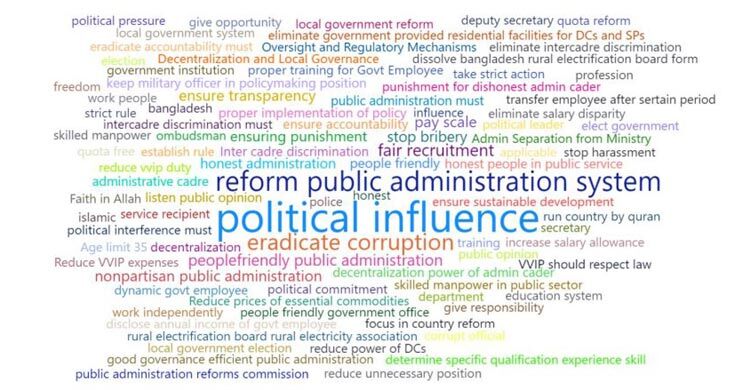
The latest commission’s survey paints a stark picture: 84.4 per cent of Bangladeshis believe public administration needs reform, 80 per cent find it unfriendly, and 64.4 per cent feel government employees act like rulers. Its 200+ recommendations, spanning 17 chapters, are categorised as short-term (6 months), medium-term (1 year), and long-term. Key proposals include reducing ministries, clustering them into five groups, creating two new departments, dividing the country into four provinces, establishing a Delhi-style capital city government, renaming deputy commissioners and upazila officers, restructuring the civil service, abolishing the OSD system, and appointing an ombudsman.
Dr Md Hafizur Rahman Bhuiyan, a former additional secretary and commission member, told Jago News, “We’ve studied 50 years of administrative history, analysing past commissions to address real problems, not personal agendas.”
He acknowledged imperfections but urged the public to judge the report’s merits. On implementation, he stressed political commitment: “If leaders prioritize collective good over party interests, this can work. Otherwise, it’s just talk.”
Why reforms falter
Experts point to two culprits: political reluctance and bureaucratic inertia. Dr Sadiq Hasan, a public administration professor at Dhaka University, told Jago News, “Without political will, reform is impossible. Bureaucrats also resist, fearing a loss of power.”
He noted that post-independence governments, consumed by partisan agendas, side-lined reforms, while officials guarded their influence.
Hope vs reality
Professor Hasan offered a mixed outlook. “The interim government might manage short-term fixes, but impactful changes need a political mandate,” he said. He doubted the feasibility of proposals like four provinces, citing a lack of provincial governance experience among politicians. “Implementation hinges on future leaders’ goodwill. With no democratic decision-making in our parties, I’m not overly optimistic.”
Still, Hasan praised the report’s potential: “It has good ideas. If acted upon, it could bring positive change.” Dr Bhuyan echoed this, lamenting the four-month timeline: “More time would’ve helped, but the nation can’t wait.”
A persistent challenge
From the CAR’s post-war reconstruction to the RRC’s regulatory overhaul, Bangladesh’s reform journey reflects ambition thwarted by execution. The Muyeed Commission’s report now joins this lineage, its fate resting on an interim government’s resolve and the political landscape ahead. As Dr Hasan put it, “Reform isn’t just policy—it’s a process needing commitment and participation.” Whether this latest effort breaks the cycle remains an open question.