
Aftermath of crash: Sabir trembles at planes, resists return to Diyabari campus

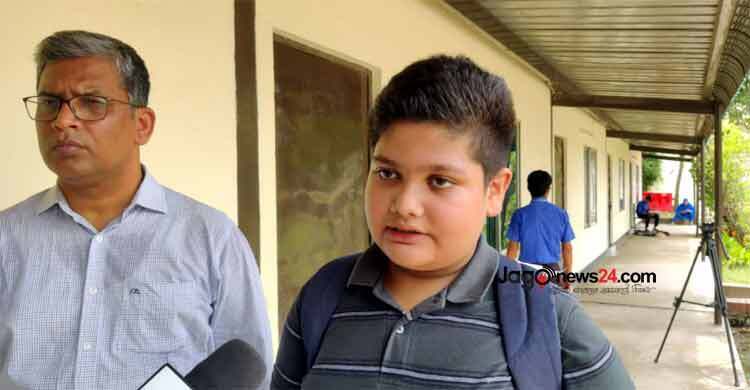
On Sunday, July 27, the gates of Milestone School and College in Uttara stood open – not for lessons, not for laughter, but for loss.
Among the quiet stream of students and parents collecting belongings, Shahid Sabir, a Class V student, walked in with his father and elder brother. His backpack, charred at the edges, was handed back to him from a room where dozens of others like it now wait for their owners.
But no bag, no textbook, no uniform can carry the weight of what Sabir survived.
“I’ve come to school twice since it happened,” the 11-year-old said, his voice barely above a whisper. “Every time I come, I hear the sound of a plane in the sky… and my heart trembles. I feel like it’s going to fall on my head again. I want to run. I want to hide.”
He looked down. “Even if I stay in Milestone, I will never come back to this campus. I don’t want to study here anymore.”
The last day of innocence
On July 21, at around 1:30pm, the sky turned violent.
Sabir was in Haider Ali Bhaban, the same building that would be torn apart by a fighter jet moments later.
“School was over,” he recalled. “My classroom was on the left side. I had left my bag in the coaching room on the right – the side where the plane crashed.”
He had stepped away, chatting with friends in the corner.
Then – a deafening explosion.
“At first, we thought a transmitter had blown up,” he said. “But then I saw fire… something else. We panicked. We hid under the benches.”
Smoke filled the room. They couldn’t breathe. Couldn’t see.
“We went to the window and stood there,” Sabir said. “Some older students saw us. They shouted, ‘Stay there!’ Later, they broke the grill and pulled us out. They took us to Building 6.”
He survived. But the fear didn’t leave with him.
A father’s agony, a son’s cry
Sabir’s father, Rabiul Islam Sohel, an official at Healthcare Pharmaceuticals, was in Cox’s Bazar for a work conference when the crash happened.
His phone buzzed with calls from the school’s scholarship WhatsApp group. He missed them – busy with meetings.
Then came a call from an unknown number.
He answered.
And heard his youngest son’s voice.
“Baba, I'm Sabir. A plane blast happened in our school. My hair and shoes are burnt. I’m in the library in Building 6. Where are you? Come now…”
Rabiul froze.
“I was shattered,” he said, eyes welling up. “Their mother… she passed away on June 28. Just weeks ago. Sabir was already struggling. He would cry at school. Maherin Madam (who succumbed to 100% burns after rescuing dozens of children) would comfort him. The teachers loved him. They looked after him.”
Now, the boy who once ran to school with a smile carries a new pain.
“He doesn’t want to come back here,” Rabiul said. “And who can blame him? If he doesn’t feel safe, I will talk to the authorities. I will try to transfer him to another branch. A child’s fear is not something you ignore.”
A campus haunted by memory
Standing near the counselling centre, a small room where psychologists now sit with trembling students, Sabir’s elder brother Sajid Sahik, a Class X student, watched over him silently.
The Diyabari campus, once a place of dreams, now echoes with trauma.
34 people have died.
36 burn victims still remain hospitalised, four in critical condition at the National Institute of Burn and Plastic Surgery.
And hundreds of children, like Sabir, are trying to unsee what they saw.
Sabir adjusted his bag on his shoulder and looked up at the sky.
A plane passed overhead – distant, harmless.
But his body tensed. His breath caught.
“I don’t want to come here again,” he said. “Not ever.”
But the real loss isn’t in the building.
It’s in the child who survived – who walks away not just with burns on his shoes, but with the sound of a falling jet forever echoing in his heart.