
‘Strong foreign policy requires political consensus at home’
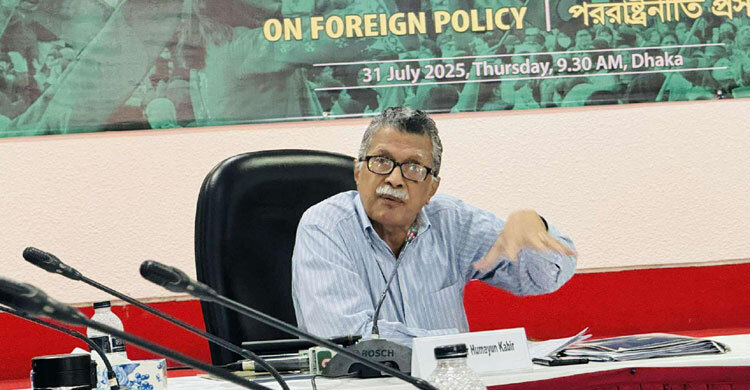
Bangladesh’s foreign policy can only become effective, timely, and respected on the global stage if it is built on a foundation of internal political consensus, former Ambassador Humayun Kabir said on Thursday.
Speaking as the chief guest at a dialogue titled “Dialogue for Democratic Reconstruction: Foreign Policy” organised by the Centre for Governance Studies (CGS) at the CIRDAP Auditorium in Dhaka, Ambassador Kabir stressed that no nation can have a strong foreign policy without national unity.
“Foreign policy is not solely the task of the Ministry of Foreign Affairs,” he said. “Its direction comes from the head of government. But when political divisions and conflicts dominate the domestic scene, that guidance weakens. And when leadership is uncertain, diplomacy abroad falters.”
Unity at home, strength abroad
Kabir pointed to two defining moments in Bangladesh’s history, the 1971 Liberation War and the 2024 student-led uprising, as powerful examples of national unity that generated deep public confidence.
“But we have failed to project that confidence internationally,” he said. “Why? Because we lack a sustained political consensus. The most complex challenge in Bangladesh’s diplomacy is not in Washington, Beijing, or Delhi. It is here – in Dhaka.”
He warned of a dangerous trend: using external actors for partisan political gain.
“This practice undermines the state’s foreign policy and threatens national security. As long as our parties see foreign powers as tools for domestic advantage, our diplomacy will remain weak.”
A ministry left behind
Highlighting institutional neglect, Kabir noted that Bangladesh has undertaken comprehensive reforms of its Ministry of Foreign Affairs only twice in 54 years, in 1982 and 1995.
“In contrast, countries like the United States, India, and China regularly review and modernise their foreign and defence policies. While Bangladesh is reforming every sector, from law enforcement to education, the Ministry of Foreign Affairs has been left behind.”
He urged that the ongoing reform wave must include the foreign ministry.
“As long as our foreign policy remains outdated and reactive, our voice in the world will remain weak.”
Consensus on India, clarity in a bipolar world
On relations with India, Kabir emphasised the need for bipartisan agreement on the framework of engagement.
“India is our close neighbour. Geography is destiny. But we must decide, collectively, how to manage this relationship. Not based on party interest, but national interest.”
He cited Nepal as an example: after its civil war, all major parties agreed that decisions about the country’s future would be made internally, not dictated by outsiders.
“That spirit of self-reliance is instructive for Bangladesh.”
In the current global landscape, Kabir warned, the world is drifting back into a bipolar order, with the United States and China locked in strategic rivalry.
“In this uncertainty, it’s hard to know who is a friend and who is an adversary. Bangladesh must chart its course with clarity and confidence.”
A people-centred foreign policy
In his closing remarks, Kabir returned to the heart of diplomacy: “Bangladesh is a country of people. Our foreign policy must serve their dignity, security, and economic well-being. It is half about our own development, half about our role in the world.”
He concluded: “Internal unity is not just a political ideal. It is the bedrock of a strong, independent foreign policy. Without it, we cannot stand tall among nations.”
The event was attended by policymakers, academics, civil society leaders, and diplomats, all calling for a new era of consensus-driven, strategic, and people-centred diplomacy for Bangladesh.