
A diplomatic standoff: Palestine rejects AUW placements over Israeli ties
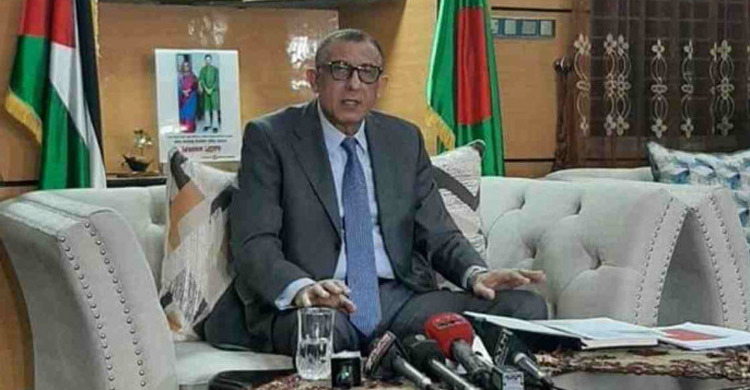
The Embassy of the State of Palestine in Dhaka has issued a strong statement clarifying its position on the placement of Palestinian female students from Gaza at the Asian University for Women (AUW) in Chattogram, citing serious concerns over the institution’s affiliations with entities linked to Israel and its leadership’s alignment with policies that undermine Palestinian sovereignty.
In a press release dated 14 August 2025, Yousef SY Ramadan, Ambassador of the State of Palestine to Bangladesh, refuted recent media reports that misrepresented the embassy’s role and decisions regarding scholarships for Palestinian students.
Contrary to claims of only “two dozen” scholarships being arranged, the embassy revealed it has secured over 200 full scholarships for Palestinian students across more than 20 public and private universities in Bangladesh, facilitated by the generous support of the current Bangladeshi government, including visa-on-arrival access for nearly 200 students.
The embassy firmly denied allegations that delays in processing applications led to the deaths of 30 students.
It clarified that those students had voluntarily withdrawn from AUW and were successfully placed in alternative institutions through the Embassy’s efforts.
The decision to oppose further placements at AUW, the embassy explained, stems from a combination of security concerns and ethical objections tied to the university’s governance, funding sources, and international partnerships.
Ambassador Ramadan highlighted several key issues:
Cherie Blair’s role as chancellor: AUW is the only university in Bangladesh with a foreign chancellor—Cherie Blair, wife of former UK Prime Minister Tony Blair. The Embassy noted that Tony Blair has been associated with Donald Trump’s controversial “Riviera” project for Gaza, which aims to redevelop the Strip through mass displacement—widely seen as a form of ethnic cleansing.
Board and donor affiliations with Israel: Several members of AUW’s Board of Trustees and major donors—including the Bill & Melinda Gates Foundation, Bayer AG, and Direct Relief—have documented links to Israeli state institutions or corporations operating in occupied territories.
Partnership with COGAT: AUW’s collaboration with COGAT (Coordinator of Government Activities in the Territories), a unit of the Israeli Ministry of Defence responsible for civilian affairs in occupied Palestinian territories, was described as “deeply troubling.” COGAT has been directly involved in policies leading to the forced displacement of Palestinians.
Funding pressure from Western governments: The Embassy revealed that five Western nations, including the United States, pressured the Palestinian Ambassador to accept AUW placements. However, these countries neither recognise the State of Palestine nor have ceased arms supplies to Israel during the ongoing genocide in Gaza. “Their humanitarian argument is hollow,” the Ambassador stated.
The Embassy also pointed out that Dr Dipu Moni, former Bangladeshi Education Minister and Chair of AUW’s Board of Trustees, sought $15 million in funding from Qatar for 200 Palestinian students. While such support is acceptable, the Embassy stressed that accepting funds from any organisation linked to Israel is not.
“The safety and dignity of Palestinian students, especially women, are our highest priority,” Ambassador Ramadan said. “We cannot send our daughters to an institution whose affiliations contradict the very struggle for Palestinian survival and statehood.”
He added that all female students previously enrolled at AUW are willing to transfer to other Bangladeshi universities where they can study in a secure and politically neutral environment.
The Embassy has formally communicated to the Bangladeshi Ministry of Foreign Affairs that it has no objection to Palestinian students studying in Bangladesh, provided they are not placed at AUW.
The statement placed the issue within the larger context of the ongoing crisis in Gaza, where over 2.2 million people face siege, bombardment, starvation, and forced displacement. The Embassy warned that initiatives like the “Riviera of the Middle East” serve only Israeli expansionist goals and threaten the permanent erasure of Palestinians from their homeland.
“Our message is clear,” the Ambassador declared. “Palestinian students are not commodities. They are not for sale. We will not compromise on institutions that, directly or indirectly, support the ethnic cleansing of our people.”
Currently, more than 70 Palestinian students are pursuing higher education in Bangladesh, and the Embassy is actively working to bring more students from Gaza through safe and dignified channels.
The Embassy reaffirmed its gratitude to the Government of Bangladesh for its unwavering solidarity with Palestine and called for continued support in building educational opportunities that uphold Palestinian identity, sovereignty, and human rights.