
No charge for expatriates despite Tk 700 cost per postal vote: EC

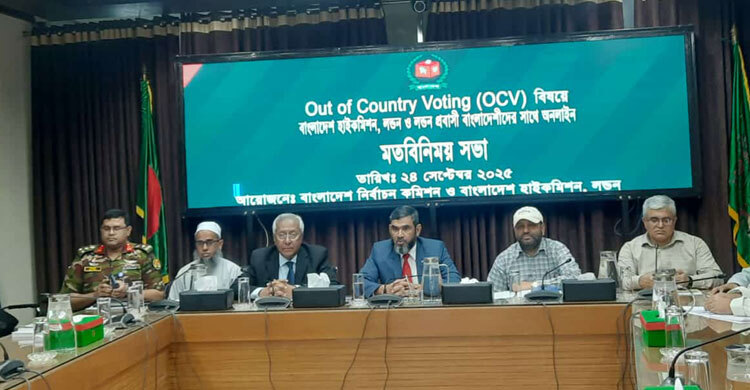
Expatriate Bangladeshis will be able to cast their votes from abroad without bearing any cost, even though each postal ballot is estimated to cost Tk 700, Election Commissioner Brigadier General (Retd) Abul Fazal Md Sanaullah confirmed on Wednesday.
Speaking after a meeting with officials from the Bangladesh High Commission in London and members of the Bangladeshi diaspora at the Election Commission headquarters in Dhaka, Commissioner Sanaullah said the entire expense for out-of-country voting will be covered by the government treasury. “Postal voting is definitely a costly matter,” he acknowledged. “We think it is a reasonable expense for expatriates. Now let’s focus on how they can vote or get registered.”
He outlined the two-tier registration process required for expatriates to participate in elections. “First, one must be a registered voter meaning they must hold a National Identity Card (NID). According to the law, no one can vote unless they are already on the electoral roll. We have received proposals suggesting alternative pathways for those not currently registered, and while these may be discussed in the future, at present, inclusion in the voter list is mandatory.”
The second step, he explained, is “passive registration” specifically for out-of-country voting. “We are developing a dedicated mobile application for this purpose, and InshaAllah, it will be launched in the third week of November,” he said.
Once live, the Election Commission will roll out a phased global registration campaign, informing expatriates through circulars, social media, and national media about designated registration windows for each region.
“Generally, we will allocate seven to 10 days for each region, followed by an additional three to seven days as a final opportunity for those who may have been missed,” Sanaullah added.
Despite logistical and financial challenges, the Election Commission remains committed to inclusive participation. Sanaullah noted that global voter turnout for postal ballots typically remains below 30 per cent, but expressed confidence in the enthusiasm of Bangladeshi expatriates. “We know that the interest in voting among our country’s expatriates is higher than that of any other nation,” he said.
Citing estimates that 14 to 15 million Bangladeshis live abroad, he stressed the democratic imperative: “Inclusive elections are not possible without such a large segment of our population. We have to start this. We must ensure the votes of expatriates, no matter the scale.”
The commissioner linked the initiative to the broader political context following the events of “July 36th”—a reference to the August 5, 2024 political transition. “One of the possibilities that July 36th has created for us is the right to vote,” he said. “Until recently, we could not even discuss voting within the country, let alone for expatriates. Now, fulfilling their just demand has become a priority.”
He highlighted the significant contributions of the diaspora to Bangladesh’s economic and diplomatic standing. “Expatriates are deeply involved in our national life. The opportunity has come before us to implement their rightful demand—the right to vote. Therefore, we want to fulfill it.”
Sanaullah recalled that on 16 December 2024, the Chief Advisor, in his national address, made three key commitments regarding expatriate voting: first, that the government intended to ensure their voting rights; second, that this was not mere rhetoric but a firm promise to be implemented; and third, that an effective method must be devised.
“In continuation of that commitment, we began working on expatriate voting from December onward,” he said. The Commission studied global best practices, consulted research institutions including Dhaka University, engaged with all 44 Bangladeshi diplomatic missions, and held discussions with political parties and other stakeholders.
The Electoral Reform Commission had previously proposed two methods: IT-supported postal ballots and online voting. After thorough evaluation, the Election Commission opted for postal voting as the chosen mechanism.
“We have chosen postal voting,” Sanaullah confirmed, underscoring the balance between security, feasibility, and accessibility. “This is a historic step toward ensuring that every eligible Bangladeshi, wherever they reside, can exercise their democratic right.”