
Felling endangered trees could attract Tk 1 lakh fine

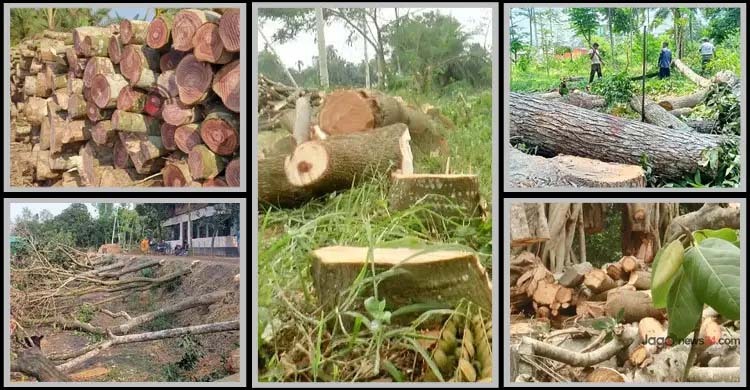
In a move to safeguard its vanishing green heritage, Bangladesh is set to enact a landmark piece of environmental legislation, the Forest and Tree Conservation Ordinance, 2025, that will impose fines of up to Tk 1 lakh for cutting down endangered or ecologically vital trees.
The draft ordinance, currently under public consultation by the Forest Department, introduces a three-tier classification system for trees across the country, clearly defining which can be felled, which require permission, and which are strictly off-limits under any circumstances.
A new legal shield for Bangladesh’s forests
“This is a completely new law,” said Md Amir Hossain Chowdhury, Chief Conservator of Forests, in an exclusive interview with Jago News. “Until now, we had no unified legal framework that combined forest land management with tree conservation. This ordinance fills that gap—and no existing law will be repealed.”
For the first time, the ordinance explicitly outlines the duties and responsibilities of the Forest Department, addresses long-standing ambiguities in forest land surveying and recording, and introduces flexible yet firm mechanisms to balance industrial development with ecological preservation.
The three schedules: Know your trees
At the heart of the ordinance are three carefully curated schedules:
Schedule 1: Lists endangered, rare, and biodiversity-critical tree species—such as Sundari, Garjan, and Champa—that cannot be cut under any circumstances. Violators face a maximum fine of Tk 1 lakh and may be ordered to carry out compensatory afforestation.
Schedule 2: Includes century-old and ecologically significant trees (e.g., Banyan, Peepal, and certain fruit-bearing giants). These can only be felled with prior written permission from designated authorities—either the district administration or the Forest Department. Unauthorized cutting attracts a fine of up to Tk 50,000, plus possible reforestation orders.
Schedule 3: Covers common commercial species like Eucalyptus, Acacia, and fast-growing timber trees planted for agroforestry. No permission is needed to cut these on private land.
“The schedules will be dynamic,” assured the Chief Conservator. “We plan to finalise the initial lists within a week, but they can be updated as new data on species vulnerability emerges.”
Protecting forest land, even when it’s just one acre
One of the ordinance’s most innovative provisions tackles a real-world dilemma: industrial projects inadvertently overlapping with small patches of forest land.
“If an industrial plant in Gazipur, for example, finds a single acre of isolated forest land within its plot, it can’t proceed,” explained Amir Hossain. “Rather than forcing illegal encroachment or project abandonment, we’re offering a legal exchange mechanism.”
Under the new rules, companies may swap up to one acre of forest land for double the area (two acres) of undeveloped land adjacent to existing forests. The government will then declare the new parcel as reserved forest, ensuring net ecological gain.
“This isn’t a loophole, it’s a pragmatic conservation tool,” he stressed.
Fixing flawed surveys, securing boundaries
The ordinance also tackles chronic issues in land records. Currently, forest lands in areas like Gazipur, Bhaluka, and Cox’s Bazar are often misrecorded or lost during cadastral surveys due to outdated procedures.
The new law mandates that all land gazetted or historically recorded as forest, regardless of current tree cover, must remain under the Forest Department’s name. Any khatian (land record) issued in another party’s name over such land will be deemed invalid.
Going forward, the Forest Department will conduct priority surveys to demarcate boundaries, often in joint operations with land settlement authorities, especially where forest and khas (government) lands intermingle.
Enforcement with teeth
To ensure compliance, the ordinance empowers forest officers, from beat guards to conservators, to investigate violations, collect evidence, seize illegal timber, and even represent the state in court.
For Schedule-1 and Schedule-2 violations, trials will follow the Criminal Procedure Code, and aggrieved parties can appeal decisions within 15 days to the Conservator of Forests.
Crucially, anyone granted permission to fell a Schedule-2 tree must plant replacement saplings of the same species in the same area—a built-in mechanism for sustainable regeneration.
A turning point for green governance?
Environmentalists have welcomed the move as a long-overdue step toward institutionalising tree protection beyond symbolic gestures.
With public feedback being collected and the draft soon heading to the Ministry of Environment, Forest and Climate Change and ultimately the Council of Advisers for final approval the Forest and Tree Conservation Ordinance, 2025 could soon become the green backbone of Bangladesh’s environmental policy.
For citizens, developers, and conservationists alike, one message is clear: Not all trees are equal, and cutting the wrong species could cost one dearly.