
Dhaka-Sylhet Highway: A national lifeline turns into a corridor of suffering
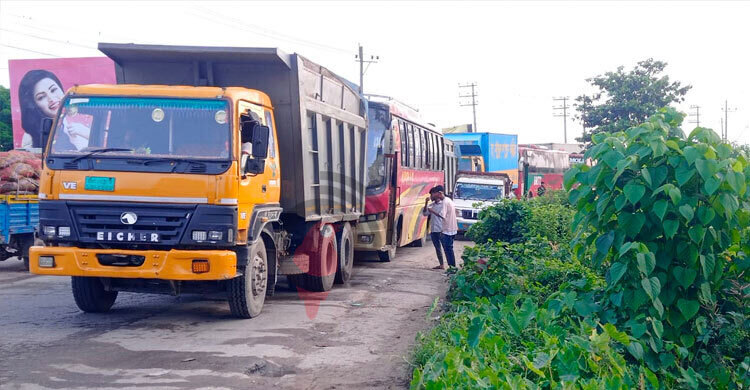
The Dhaka-Sylhet Highway, one of Bangladesh’s busiest and most vital transport routes, has become a corridor of misery.
Once a relatively smooth five-hour journey, the route can now take as long as twenty-four hours to traverse, paralysing trade and testing the endurance of everyone who travels it.
The Brahmanbaria section, stretching from Ashuganj to Sarail, has become a bottleneck of national proportions where long tailbacks, crumbling asphalt, and rainwater-filled craters have turned daily travel into an ordeal.
The situation has reached such an extent that industrial production, domestic commerce, and export logistics are being severely disrupted. Trucks carrying goods from Dhaka or Chattogram are often stranded for hours on end, while raw materials destined for factories in Habiganj and other industrial zones are arriving late or spoiling on the road.
The once-thriving flow of trade along the highway has been replaced by queues of motionless lorries, smoke-belching engines, and drivers waiting helplessly in scorching heat or heavy rain.
The damage to vehicles has become routine. Buses and trucks regularly break down as they hit large potholes that stretch across entire lanes. During rainfall, the situation worsens when water fills these holes, turning them into hidden traps that slow traffic even further. The conditions have also caused repeated accidents, leaving many vehicles stranded and worsening congestion.
The roots of the crisis lie in the long-delayed four-lane expansion project of the highway. In 2015, the Executive Committee of the National Economic Council approved a Tk 5,791 crore project to widen the 50.58-kilometre stretch from Ashuganj River Port to Akhaura Land Port via the Sarail Bishwa Road Interchange. The Indian construction firm AFCONS Infrastructure Limited was awarded the contract and began work in 2017.
The project was divided into three sections. Work began on the first two packages, but progress slowed almost immediately due to design complications, disputes over land acquisition, and poor coordination between local authorities and the contractor.
The third section, from Tantar to Akhaura Land Port, faced even more severe delays and was eventually suspended altogether under the interim government’s decision to halt work on the package.
What remains of the project is a patchwork of half-finished work zones, temporary repairs, and open trenches. At several points along the Brahmanbaria section, potholes the size of small ponds have appeared, and in some places the road surface has crumbled entirely.
In the Khatihata Bishwa Road area, workers can often be seen filling holes with sand, bricks, and loose gravel. These makeshift repairs rarely last beyond a few weeks.
The condition of the highway has crippled regional transport operations. Freight movement between Dhaka, Chattogram, and Sylhet has slowed to a crawl, creating a domino effect across the supply chain. Factories dependent on imported raw materials have reported production delays and rising costs. Exporters, particularly those dealing with perishable goods, are facing serious losses as shipments to Chattogram Port fail to arrive on time.
The transport sector is also in turmoil. Many buses that once made two daily round trips between Dhaka and Brahmanbaria can now barely complete one. The cost of vehicle maintenance has soared as axles, suspensions, and tyres are damaged repeatedly. Transport companies, struggling to meet delivery schedules, are losing revenue and facing growing frustration among drivers and passengers alike.
Private businesses, especially those in the agro-industrial and construction sectors, are counting heavy losses. Fertiliser and cement shipments are delayed, increasing operational costs and market prices. Traders in Brahmanbaria complain that goods sent from Dhaka often take two days to arrive, and traffic congestion near the Bishwa Road intersection has virtually paralysed local commerce.
The suffering is not limited to business. Commuters endure long hours in the gridlock, often without food, water, or access to basic amenities. Ambulances carrying patients are trapped in endless queues, and in several tragic cases, lives have been lost before reaching hospitals. For local residents, the highway has become a symbol of broken promises and official neglect.
The crisis deepened after August 5, when Indian engineers and staff of AFCONS Infrastructure Limited abruptly left Bangladesh, citing security concerns.
Their departure brought construction to a complete standstill. In the months that followed, the unfinished road began to deteriorate rapidly, with large potholes forming and drainage systems collapsing. Although around seventy workers have now returned and resumed work, progress remains slow and sporadic.
The Road Department maintains that the project complications have been resolved and that work will resume in full force soon. Officials have stated that a revised design and budget have been approved, and the permanent repair and widening works will begin within days. They insist that visible improvement will be achieved within the next few months.
For those who depend on the highway daily, these assurances have become familiar but hollow. Years of missed deadlines, temporary fixes, and bureaucratic excuses have eroded public confidence. Meanwhile, businesses continue to bleed losses, vehicles continue to break down, and the people continue to suffer in silence.
The Dhaka-Sylhet Highway, intended to strengthen trade links between Bangladesh and India, now stands as a painful reminder of mismanagement, inefficiency, and the heavy human cost of delayed infrastructure. Until genuine repairs and sustained work are completed, the road will remain less a symbol of connectivity and more a monument to the country’s unfulfilled promises.