
Dhaka, Kuwait pave way for enhanced labour and strategic ties
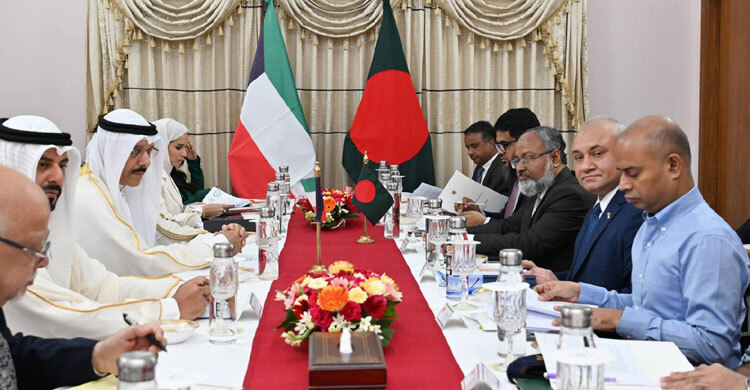
In a landmark step toward deepening bilateral relations, Bangladesh and Kuwait held their first-ever Foreign Office Consultation (FOC) at the foreign secretary level in Dhaka on Sunday, marking a significant milestone in over five decades of diplomatic engagement.
The high-level political consultation—held at the State Guesthouse Padma in Dhaka—was co-chaired by Dr MdNazrul Islam, Secretary (East and West) of Bangladesh’s Ministry of Foreign Affairs, and Sami Isa Johar Hayat, Kuwait’s Assistant Foreign Minister for Asian Affairs, who led the Kuwaiti delegation.
The meeting, long envisaged since a 2006 agreement to institutionalise such dialogues, finally materialised after nearly two decades, underscoring renewed momentum in bilateral ties. Both sides described the talks as “fruitful” and “forward-looking,” with a shared commitment to transform their longstanding friendship into a multi-dimensional strategic partnership.
Labour cooperation at the forefront
Central to the discussions was the renewal and expansion of labour cooperation, a cornerstone of Bangladesh–Kuwait relations. Over 120,000 Bangladeshi expatriates currently work in Kuwait, primarily in construction, domestic service, and technical sectors. Recognising their vital contribution, both nations agreed to finalise a new bilateral labour agreement during an upcoming high-level visit.
“The welfare, protection, and dignified employment of Bangladeshi workers remain a top priority for us,” said Dr. Nazrul Islam, noting that the new framework would include stronger safeguards against exploitation, streamlined recruitment processes, and mechanisms for grievance redressal.
Kuwait’s Assistant Foreign Minister affirmed his country’s appreciation for Bangladeshi manpower, calling them “an integral part of Kuwait’s development story.”
Broadening the partnership
Beyond labour, the FOC agenda spanned a wide array of sectors, reflecting the evolving nature of bilateral cooperation:
Food Security: Both sides explored opportunities for Bangladeshi agricultural exports—including rice, vegetables, and processed foods—to Kuwait, a nation heavily reliant on food imports.
Cybersecurity: Recognising growing digital interdependence, officials agreed to initiate technical dialogues on cyber resilience and information-sharing.
Education & Academic Exchange: Plans were discussed for teacher and student exchange programmes, as well as collaboration between universities and vocational training institutes.
Defence & Military Ties: The Kuwaiti delegation acknowledged Bangladesh’s historic role in post-liberation Kuwait, particularly the deployment of over 5,000 Bangladeshi peacekeepers for mine clearance and humanitarian operations after the 1990 Iraqi invasion. Both sides expressed interest in expanding defence training and joint exercises.
Civil Aviation: To boost people-to-people ties and trade, the countries agreed to increase direct air connectivity. Currently, Kuwait Airways operates seven weekly flights, Al Jazeera Airways 14, and Biman Bangladesh Airlines three. New routes and additional frequencies are expected to be announced soon.
A relationship forged in solidarity
During his meeting with Foreign Affairs Adviser Md Touhid Hossain at the Ministry of Foreign Affairs later in the day, Sami Hayat conveyed a personal letter from Kuwaiti Foreign Minister Abdullah Ali Yahya, reaffirming Kuwait’s commitment to deepening strategic cooperation.
He also reiterated Kuwait’s enduring gratitude for Bangladesh’s principled stance during the 1990 Gulf crisis. “Bangladesh stood with us when it mattered most,” he said. “Our relationship is not built on transactions, but on 36 years of trust, solidarity, and mutual respect.”
For his part, Adviser Touhid Hossain welcomed Kuwait’s proactive engagement and emphasised Bangladesh’s desire to move beyond traditional labour-centric ties toward a comprehensive partnership encompassing trade, technology, and regional stability.
Institutionalising dialogue
Diplomatic sources confirmed that both nations have agreed to institutionalise the FOC mechanism, holding consultations regularly through diplomatic channels. This move is expected to provide sustained momentum to bilateral cooperation and ensure timely resolution of emerging issues.
As Bangladesh and Kuwait mark 52 years of diplomatic relations in 2025, Sunday’s historic meeting signals a new chapter—one defined not just by shared history, but by a shared vision for the future.