
Yunus finds disinformation biggest challenge, IRI confirms election observers

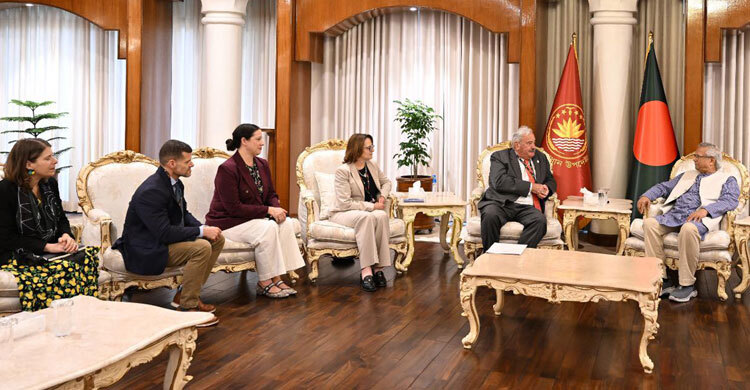
Chief Adviser Professor Muhammad Yunus on Tuesday said disinformation has emerged as the biggest threat to democracy, warning that false narratives are being deployed in a “well-planned and well-funded” manner to incite unrest.
“It creates tension immediately. By the time the truth comes out, people have already reacted,” Yunus said during a meeting with a delegation from the US-based International Republican Institute (IRI) at the state guest house Jamuna.
The IRI delegation confirmed it will deploy at least 10 international observers to monitor Bangladesh’s national election in February, describing the upcoming polls as a test of transparency and credibility.
“We will have robust election observation in February,” said Christopher J. Fussner, IRI Board Member and head of the delegation. “International presence can help reduce the risk of violence and promote public confidence.”
Fussner said the political climate ahead of the polls appeared “more open and positive” than in past cycles.
“All parties want elections. From our experience of the previous election, we can see a positive atmosphere this time. We can tell the difference,” he said.
The IRI team – which includes senior officials from the National Democratic Institute (NDI) and the Center for a New American Security (CNAS) – is in Bangladesh to assess the pre-election environment and will meet major political parties, civil society representatives, and election officials.
The delegation raised concerns about the growing use of artificial intelligence and social media platforms to manipulate information during election periods. Fussner noted that AI-generated content poses “a new frontier of risk” for democratic processes.
Professor Yunus acknowledged the scale of the challenge, describing disinformation as a destabilising force that undermines trust and accountability.
“Disinformation is the biggest threat to democracy today,” he reiterated. “It spreads faster than the truth and divides people before facts can catch up.”
Yunus assured the delegation that his interim administration remains committed to ensuring a peaceful and inclusive election.
“Half of our population is under 27. Many will be voting for the first time,” he said. “We want to make sure they are satisfied. We will have a peaceful and festive voting.”
He also referred to the July Charter, a reform framework endorsed by most major political parties, as a key milestone in the country’s democratic transition.
“This puts us another step ahead of the election,” he said, adding that remaining parties were expected to sign on soon.
The delegation praised Yunus for his leadership during what they described as a critical phase of Bangladesh’s political transition.
“You are doing a great job during the transition,” one delegate said. Another called his efforts “absolutely remarkable.”
SDG Coordinator Lamia Morshed was also present at the meeting.