
Bangla Teslas rule as one in three rely on them

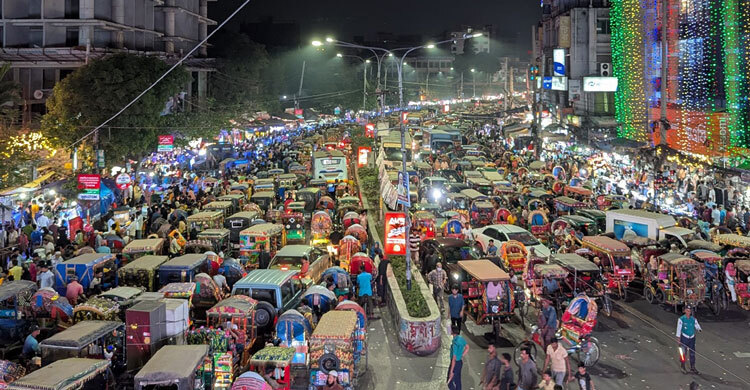
Nearly one in three road passengers in Bangladesh now rides on a battery- or-CNG-run auto-rickshaw, according to new data that captures the country’s dramatic transport transformation.
The Bangladesh Bureau of Statistics (BBS), in its latest Household Income and Expenditure Survey (HIES) released Wednesday, reports that 32.65 per cent of passengers now depend on these three-wheelers – leaving behind buses (2.69%), taxis (0.76%), and even the once-iconic pedal rickshaw (5.71%). Only 0.85% passengers ride their own cars.
The finding confirms what anyone standing at a Dhaka intersection already knows: the so-called “Bangla Tesla” has taken over.
Despite the electric boom, 47.41 per cent of Bangladeshis still walk to their destinations, revealing a sobering reality, millions remain bound to footpaths due to unaffordable or unreliable motorised transport.
The survey found 6.76 per cent of passengers travel by rickshaw-van—another form of cycle-rickshaw. On waterways, 0.41 per cent of passengers use country boats, while 0.25 per cent rely on engine boats. Only 0.20 percent of people reported travelling by ambulance, and 1.52 per cent use other miscellaneous means of transport.
In that gap between necessity and aspiration, the humble battery-run rickshaw has emerged as both an economic engine and a social equaliser—cheap, omnipresent, and distinctly homegrown.
When Elon Musk speaks of an electric revolution, he probably doesn’t imagine a workshop in Narayanganj welding a rickshaw frame around a recycled Chinese motor. Yet that is precisely where Bangladesh’s real EV revolution hums to life—one clang, one spark, one battery at a time.
Dubbed the “Bangla Tesla” by locals and hailed by The Economist as a grassroots electric phenomenon, the battery-powered rickshaw has quietly become the country’s most-used form of public transport, reshaping urban mobility from the ground up.
In less than a decade, Bangladesh’s e-rickshaw fleet has exploded—from around 200,000 units in 2016 to nearly 4 million today, making it the largest informal electric vehicle fleet on Earth.
Built in backyard garages and small-scale workshops in Dhaka, Chattogram, and Sylhet, these vehicles use imported Chinese motors and lead-acid batteries. They’ve transformed thousands of manual rickshaw pullers into self-employed drivers, powering a quiet yet profound social shift.
“I used to pedal all day and earn Tk 200,” says Shakilur Rahman, a driver in Mirpur. “Now, my ‘Tesla’ brings me Tk 1,500. That’s food, school fees, and dignity.”
A full charge costs about Tk 50 and lasts nearly 80 kilometres—a lifeline of affordable mobility for millions of low-income families.
But this new electric era carries heavy costs. In 2024 alone, 870 people died in e-rickshaw-related accidents, with another 378 fatalities reported by April 2025, according to local NGOs.
Most of the vehicles lack basic safety features—no seatbelts, fragile brakes, unstable frames—and drivers receive little or no training. Helmets are virtually unseen.
Environmental costs are just as grim. The widespread use of lead-acid batteries has spawned a toxic recycling crisis. Discarded batteries are often melted or dumped in open-air yards, releasing lethal pollutants into the air and soil. UNICEF estimates that 35 million Bangladeshi children have elevated lead levels in their blood—the highest figure globally.
Whether the “Bangla Tesla” becomes a symbol of innovation or an emblem of unchecked chaos depends on what happens next.
For now, these buzzing three-wheelers remain the pulse of the nation’s roads—filling the void left by poor public transport, fuelling millions of families, and redefining what an electric revolution looks like in the developing world.