
What will the govt do if you take such a role, Asif Nazrul asks political parties

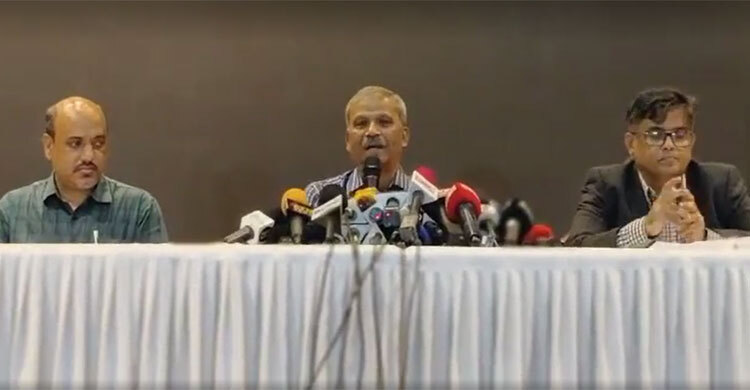
Law Adviser Asif Nazrul has voiced frustration over the widening divisions among political parties concerning the passage and implementation of the July Charter.
He questioned how the government should proceed when parties that once stood united in favour of reform are now taking sharply opposing positions.
“The political parties that were in favour of the mass uprising have now taken such a strong and contradictory role. If you take such a role, what will the government do? We don’t understand,” Professor Asif Nazrul said. “If consensus cannot be reached even after so much discussion, we now have to seriously think about what steps to take.”
He made the remarks while speaking at a press briefing organised at the Foreign Service Academy on Bailey Road in the capital on Thursday, October30. The briefing followed a meeting of the Advisory Council, held earlier in the day under the chairmanship of the Chief Adviser.
Professor Nazrul said that although progress had been made in reform discussions, “some vital questions” remained unresolved.
“Earlier, we knew there was a dispute over the content of the reforms,” he said. “Now, I see two new disputes have emerged — one about the method by which the July Charter will be passed, and the other about when the referendum will be held.”
The law adviser said the National Consensus Commission has submitted two distinct options regarding the implementation of the July Charter.
“The first option is the July Charter Implementation Order, under which the constitution will be automatically amended if the referendum is not held within 270 days,” he explained. “We will examine whether such a provision has any precedent and whether it is even legally possible.”
“The second option,” he added, “is to leave the responsibility to the newly elected members of parliament. There is now a strong disagreement among political parties over which of these two options is more acceptable.”
According to him, the debate has now reached its most intense stage – not only over the process but particularly over the timing of the referendum.
Asif Nazrul clarified that the final decision on these unresolved matters would be taken by the Chief Adviser, after due consultation with members of the Advisory Council.
“At some point, we must take a decision on these matters,” he said. “The decision will be taken by the Chief Adviser. We will assist him in that process, under his leadership.”
He further emphasised that no individual would take the decision unilaterally.
“This decision will not be taken by any one person – you can be sure of that,” Asif Nazrul assured. “The Chief Adviser will take the decision in consultation with us.”