
Integrate transport growth without harming rivers, nature, orders Yunus

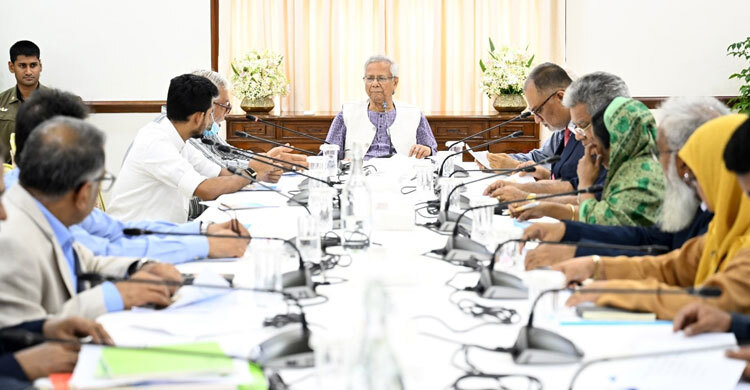
Chief Adviser Professor Muhammad Yunus on Sunday called for an integrated and environmentally balanced development of Bangladesh’s transport network, emphasising that progress in roads, railways, airways, and waterways must not come at the expense of nature or the country’s rivers.
“Our transport system is in a very fragile state,” he warned at an inter-ministerial meeting on the Central Integrated Multimodal Transport Sector Master Plan of Bangladesh, held at the State Guest House Jamuna. “If we do not bring it under proper order soon, it could become a serious impediment to the economy.”
The Chief Adviser underscored that economic growth and environmental stewardship must go hand in hand, saying, “We cannot damage the rivers. Water must remain calm. We must remember that water is a tremendous resource for us.”
Coordinated plan for national connectivity
At the meeting, the Roads and Highways Department presented a preliminary strategic plan formulated in coordination with officials from multiple ministries. The plan proposes a unified framework that connects all modes of transport – road, rail, air, and waterways – to improve efficiency, reduce costs, and promote sustainable logistics growth.
According to the plan, Bangladesh could achieve substantial improvements in connectivity with limited expansion and better utilisation of existing infrastructure. It highlights that optimising current road, rail, and waterway networks, rather than pursuing massive new projects, would bring faster and more cost-effective results.
Prof Yunus praised the collaborative effort behind the draft, calling it a “strong preliminary framework” and urging swift, coordinated implementation. He emphasised that the master plan must focus not only on domestic connectivity but also on regional and global linkages, positioning Bangladesh as a logistics hub in South Asia.
“When we consider rivers as a transport mode, we must remember that rivers are our lifeline,” he said.
Advisers stress regional connectivity and planning reforms
Planning Adviser Wahiduddin Mahmud said that in certain underdeveloped areas, a few targeted road projects could dramatically improve national integration. “Sometimes constructing just a few small roads can connect entire regions to the national network. We need quick and effective planning for that,” he noted.
LGRD Adviser Asif Mahmud informed the meeting that the ministry has established a planners’ wing to make local government projects more structured and strategically aligned with national goals.
Meanwhile, Bangladesh Investment Development Authority (BIDA) Executive Chairman Chowdhury Ashik Mahmud Bin Harun said that three new ports in Chattogram are expected to become operational by 2030, stressing that efficient road connectivity from these ports must be ensured to support trade and investment.
Multimodal coordination at policy level
Advisers to the Ministries of Road Transport and Bridges, Railways, Civil Aviation and Tourism, and Shipping including Muhammad Fouzul Kabir Khan, Sk Bashir Uddin, and Brigadier General (retd) Sakhawat Hossain also attended the meeting. They agreed on the need for institutional coordination to synchronise investments and avoid overlap among ministries and agencies.
Experts present at the meeting observed that integrating the country’s four main transport corridors – Dhaka-Chattogram, Dhaka-Khulna, Dhaka-Sylhet, and Dhaka-Rangpur – would reduce congestion, lower logistics costs, and improve trade competitiveness.
Balancing growth and green priorities
Prof Yunus reiterated that transport modernisation must not erode Bangladesh’s natural heritage. “Development should not mean the destruction of rivers or ecosystems,” he said. “Our rivers are not just waterways — they are part of our history, economy, and environment.”
Officials said that once finalised, the Central Integrated Multimodal Transport Sector Master Plan will guide long-term infrastructure investments, aligning them with climate resilience, regional trade corridors, and green growth objectives.
The Chief Adviser concluded by directing all ministries to synchronise their infrastructure plans under the multimodal framework and ensure that development projects are both economically productive and environmentally sustainable.