
Where childhood turns to dust: Climate change and Bangladesh’s brick kilns

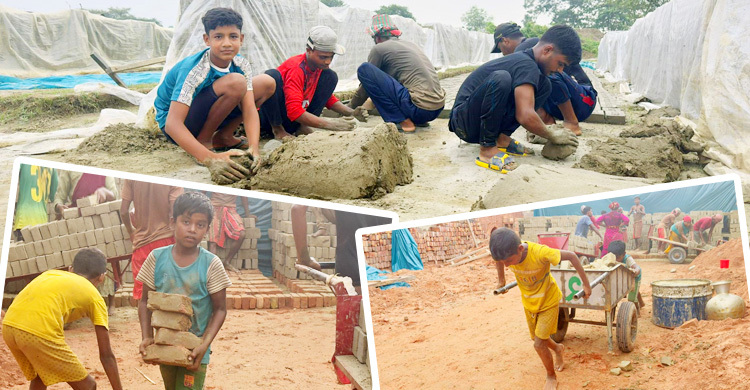
The sun rises slowly over the banks of the Gumti River in Cumilla, casting a hazy golden glow across a landscape thick with dust. Though November has arrived, the season offers little relief. Winter may exist on the calendar, but the air still carries the sting of lingering heat – a heat that settles deep into the skin.
Inside a cramped corrugated-sheet-roofed hut, 13-year-old Jahid Hossen lies asleep on the bare earth floor, his small body slick with sweat. Outside, his mother Josna Begum, only 29 yet visibly worn by years of hardship, tends to her makeshift kitchen. Smoke from a zinc pot coils upward into the morning air.
“Jahid! Get up, my son, it’s getting late,” she calls. Her voice, gentle at first, grows firmer until the boy jolts awake and rushes outside.
But Jahid isn’t racing to school. He isn’t grabbing a football or cricket bat.
His day – every day – begins inside the brick kiln that looms just beyond their fragile shelter.
He works there from dawn until dusk, shoulder-to-shoulder with adults, shovelling mud, shaping bricks, and carrying loads many times heavier than his growing body should bear. His mother labours alongside him. A year ago, when the cost of survival overwhelmed her, she withdrew him from school and brought him here.
Once, Jahid was a Class VI student at a madrasa near the Sundarbans – the lush, life-giving mangrove forest that holds back storm surges and tidal floods. But climate change is eating away at coastal livelihoods, and poverty has tightened its grip on families like his.
“I wanted him to study,” Josna murmurs, eyes lowered. “He is my only son after two daughters. But when you cannot fill the stomach, what is left to choose?”
The slow erosion of a childhood
Josna’s husband left her soon after Jahid’s birth. With three children and barely enough food for one, she married off her daughters at only 12. She had hoped education might save her son from a life of hard labour. But alone, her earnings were not enough. So, mother and son now work together, bound by wage advances and the cycle of uncertainty that defines the lives of seasonal workers.
Jahid is far from alone.
Across the Gumti embankment, alongside Jahid, many boys and girls – some no more than six years old – can be seen working in kilns in Suklar Char, Shri Rayer Char, Darikandi, Zia Kandi and beyond.
Some arrive with parents; others are brought by labour agents from the coastal districts of Satkhira and Khulna under six-month contracts that offer no escape.
Their work is illegal.
Article 284 of the Bangladesh Labour Act 2006 prohibits employing children in hazardous industries, punishable by a fine. Yet the practice persists, untreated wounds in the country’s labour system.
Children dry raw bricks under the sun, fire them in blazing kilns, carry soil, lift bricks, stack them into pyramids – labouring across every stage of production. Their worlds shrink to the rhythm of moulding, carrying, burning and dust.
Their childhoods, once full of play and schoolbooks, now melt beneath the kiln’s relentless heat.
Climate change: A silent trafficker of childhood
These children, who once ran to school and raced out to play, are now trapped in the relentless, sun-baked routine of the kilns. Analysts say the growing impacts of climate change are pushing more families to send their children into work, while government negligence has allowed this cycle of child labour to continue unchecked, stripping countless youngsters of their childhood.
There is no reliable data on how many children from coastal districts end up in brick kilns or drop out of school. However, a 2014 International Labour Organization (ILO) study titled Health Hazards of Child Labour in Brick Kilns of Bangladesh found that around 80 per cent of urban and 84 per cent of rural child workers had attended school before starting work in the kilns.
Visits to at least seven villages in Shyamnagar and Koyra revealed a striking reality: many teenagers are now missing from their homes. In some families, even younger children are taken to the kilns because there is simply no one left at home to care for them.
And when the brick kilns close during the monsoon, families are left with no source of income. To survive, many take loans from sardars (middlemen) on the condition that they will return to work in the kilns once the rainy season ends.
“Time doesn’t pass here”
When Jahid agrees to speak, his words carry the weight of the life he has lost.
“I used to wake up and go to school,” he recalls quietly. “After classes, I’d play cricket with my friends. Now the days feel endless here… it’s like time doesn’t move.”
He dreams of becoming “something” – a teacher, a shopkeeper, anything that doesn’t break the body. But those dreams feel faint now.
In the neighbouring village of Koyra, 13-year-old Sabbir Hossain also had a dream: he wanted to become an alim, a religious scholar. After his father left the family, poverty pulled him out of school. His mother took a loan from a sardar to survive the monsoon. Sabbir now works in a kiln nearly 400 kilometres away.
“I miss home every day,” he says. “Most of my friends have gone to kilns too. Someone has to earn.”
The exodus of the coastal poor
On the morning of 31 October, the bus stand in Shyamnagar was alive with the movement of hundreds of seasonal labourers – women, men, teenagers and small children. Buses were departing for Dhaka, Savar, Shariatpur, Madaripur and other districts, carrying workers to months of punishing labour.
Among them was Aminul Islam from Gabura, travelling with his teenage brothers, Mizanur, 13, and Shahinur, 14. The boys will earn Tk 30,000 and Tk 40,000 in six months – barely enough to keep the family afloat back home.
Saltwater rising, hope falling
According to a report by Friedrich Ebert Stiftung, citing Chowdhury et al. (2024), salinity has affected more than 60 per cent of agricultural land in Bangladesh’s coastal belts, forcing many families to abandon traditional subsistence farming.
Shyamnagar, Koyra, Dacope and several other upazilas across Satkhira, Khulna and Bagerhat in south-western Bangladesh are experiencing severe impacts from rising salinity. Rivers that once sustained the land and its people are turning increasingly brackish, while rice fields that once flourished now lie dry and unproductive. For the thousands of farmers and fishermen who depend on the coastal ecosystem, each season brings mounting challenges and deepening uncertainty.
Once a farmer, Al Mamun Sheikh of Chandipur in Satkhira now leads a team of 20 workers – including teenagers – at a brick kiln called MSB. He said the village has changed drastically over the years. “There are almost no men left in the village except for the elders. Only those who can attend school regularly remain.”
Asked about the employment of children in the kilns, Al Mamun said that children are not used for all tasks.
“A few teenagers are taken on as assistants. It reduces costs because their wages are lower than adults,” he explained. “Mostly, families request that their children work at the kiln because there are no other sources of income, or schooling is simply not an option.”
Al Mamun added that the decline in agricultural work has severely limited livelihood opportunities.
“One advantage of seasonal labour is that they can be booked in advance with some money. When the season starts, they are obliged to come to the kiln,” he said.
Once the brick kiln season ends, Al Mamun and his team travel to different districts across the country to work in rice harvesting. “Many children and teenagers are also part of that team,” he admitted.
He recalled that, in the past, labourers from other districts used to come to their area for rice cutting. “But as saline water increased, our fortunes worsened. Now we have to work across the country throughout the year,” he said.
Subrata Adhikari, a project coordinator for the local NGO Leaders in Shyamnagar, said salinity in the area is rising due to climate change. “As a result, getting safe drinking water has become almost impossible. Fish and crops can now survive only if they are salt-tolerant,” he explained.
He added that unemployment is widespread. “There are very few alternative livelihoods here apart from forestry or fish and crab farming. Because of this, many families migrate to different districts as seasonal workers, often taking their children and adolescents with them.”
Adhikari also highlighted the lack of educational opportunities. “There are no good schools or colleges nearby. Continuing studies has become extremely difficult, and many students are forced to drop out.”
However, disaster management expert Gawher Nayeem Wahra cautioned against blaming climate change alone.
“Climate change certainly contributes to the disasters in this region, but the bigger issues are poor planning, river mismanagement and society’s neglect of children. If we focus only on the climate, we miss the real problem — human and administrative failures,” he said.
He also stressed the need for ongoing research to fully understand and address such complex situations.
A cycle of bondage
Bangladesh has 7,881 registered brick kilns.
A 2024 study by the US-based National Bureau of Economic Research (NBER) calls the kiln system a modern form of bonded labour.
About 70 per cent of workers remain indebted to kiln owners’ season after season. Families receive advance payments – which tie them to the kiln, restrict their movement and trap them in endless cycles of debt.
The study also reports that entire families, including children, live and work inside kilns, handling almost every stage of brick production. Researchers describe this mix of debt, withheld wages and restricted movement as a modern form of bonded labour deeply embedded in South Asia’s brick-making sector.
Jahid understands this all too well.
He said he feels unable to leave due to a six-month contract and the advance his mother took. “Sometimes I want to escape, but I’m not allowed to go anywhere,” he said. “If I run away, they’ll come after us or make my mother repay the money.”
Invisible losses: Health, childhood, future
As a specialist in child protection, disaster risk reduction, disaster management and humanitarian accountability, Gawher Nayeem Wahra highlighted the extreme vulnerability of children in coastal areas who are pushed into brick-kiln and domestic labour, often losing their schooling and their childhood in the process.
He said, “Children are taken from waterlogged or otherwise vulnerable areas to work in brick kilns, or even sent fishing in the Bay of Bengal for months, usually after an advance payment. They rarely receive proper wages; what they get barely covers food and shelter.”
Wahra added, “If they fail to meet production quotas, even that payment is withheld. To repay a year’s debt, they are forced to return the following year. Many permanently lose access to school, missing enrolment deadlines and textbooks, and some are placed in madrasa programmes for six months, further isolating them.”
According to him, “Both boys and girls are affected. Girls often work as domestic helpers or in kitchens, sometimes separated from their families, which makes their situation even worse. In reality, these children are experiencing modern slavery and losing their childhoods.”
Respiratory specialist Dr Kazi Saifuddin Bennoor, Assistant Professor of Respiratory Medicine at the National Institute of Diseases of the Chest & Hospital, warns that long hours in the smoke-filled environment put children at risk of asthma, bronchitis, anaemia and long-term lung damage.
“Long hours in the toxic smoke and dust of brickfields put children at high risk of illnesses such as asthma, bronchitis and anaemia,” he said
Lost childhoods, damaged health and labour bondage – thousands in Bangladesh endure climate-induced loss and damage that remains largely unacknowledged by policymakers, both at home and abroad.
The gap between words and action
Sharmin S Murshid, Social Welfare Adviser to the Interim Government, says that while climate change is widely discussed, real grassroots solutions remain patchy.
“Broad statements are not enough,” she says. “We need concrete policies, clear budgets and focused interventions for the communities who bear the heaviest cost.”
For now, the children of the brick kilns continue to disappear into the haze – little bodies carrying loads they were never meant to bear, their futures shaped not by their dreams, but by the harsh arithmetic of survival.
The feature is published with the support of Earth Journalism Network of the Internews