
Bangladesh overhauls organ transplantation law, allows emotional donors

President Mohammed Shahabuddin has promulgated the Human Organ and Tissue Transplantation Ordinance, 2025 on Wednesday, November 19,, in exercise of the powers conferred by Article 93(1) of the Constitution.
The ordinance was published in the official Bangladesh Gazette the same day and takes immediate effect, fully repealing the outdated Organ Transplantation Act, 1999.
The ordinance explicitly states that the provisions of the 1999 law had become “insufficient” for regulating modern organ transplantation, facilitating life-saving procedures, preventing commercial exploitation, and curbing illegal trafficking. Health officials described the move as the most sweeping reform to the country’s organ donation framework in more than a quarter-century.
The draft ordinance received final approval at the 34th meeting of the Advisory Council, chaired by Chief Adviser Professor Dr Muhammad Yunus, on July 27.
Key changes that will transform organ transplantation
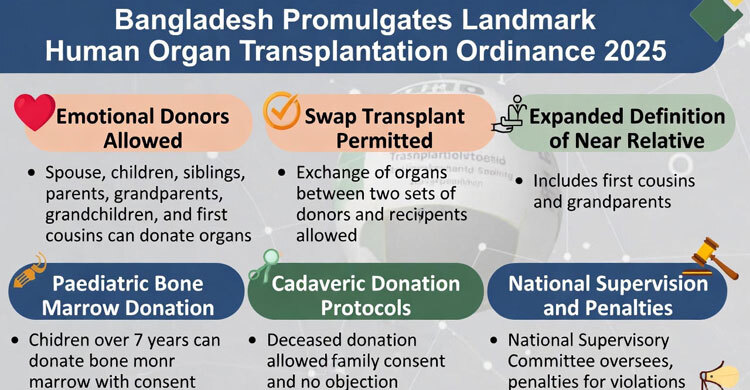
The new ordinance dramatically widens the pool of permissible living donors while introducing several groundbreaking provisions:
Emotional Donors Legalised: For the first time, non-relatives motivated solely by emotional attachment (friends, teachers, colleagues, neighbours, etc.) may donate organs after rigorous scrutiny by a divisional-level Approval Committee to rule out any financial transaction.
Formal Recognition of Swap (Paired Exchange) Transplants: Incompatible donor-recipient pairs can now be matched nationally through a mandatory National Register, a system already successful in India and Turkey.
Expanded Definition of “Near Relative”: Nephews, nieces, grandparents, grandchildren, and certain in-laws are now explicitly included, removing previous legal ambiguities that often settled in court.
Special Allowance for Paediatric Bone Marrow Donation: Minors may donate bone marrow to close relatives with special committee approval – a humanitarian provision absent in the old law.
Strengthened Cadaveric Donation Protocols: Clear procedures for brain-death certification, mandatory transplant coordinators in hospitals, and prioritised organ allocation from deceased donors.
National-Level Supervision and Divisional Approval Committees: Replace the previous fragmented system with robust oversight, mandatory hospital registration, and regular audits.
Severer Penalties: Commercial dealing now punishable by up to 10 years’ rigorous imprisonment and fines up to Tk 50 lakh; unauthorised organ removal carries up to seven years’ imprisonment.
Official reaction and expected impact
A Health Ministry official said : “As a result of this new ordinance, organ transplantation will be very easy. Previously, donation was restricted to very close relatives such as siblings or parents, but now the scope has been expanded considerably. Nephews and nieces have been specifically added. They too will be able to donate organs. We believe that, because of these changes, many people in Bangladesh will no longer need to travel abroad for kidney transplants. Our own hospitals will be fully capable of providing these services.”
Kidney specialists welcomed the reforms as long overdue. The introduction of emotional donors and a national swap registry will save thousands of lives every year, said a nephrologist. He said patients were previously forced into dangerous black-market deals or expensive medical tourism to India but this ordinance closes those loopholes while maintaining strict ethical safeguards.
Human rights organisations praised the verification mechanisms designed to protect vulnerable donors from coercion.
The Health Services Division confirmed that detailed implementation rules, including the format for lifetime organ-pledge cards, will be notified within weeks.
With an estimated 2,00,000-2,50,000 Bangladeshis suffering from end-stage organ failure annually, the Human Organ and Tissue Transplantation Ordinance, 2025 is poised to dismantle decades-old criminal syndicates and bring Bangladesh’s transplant programme into line with global standards.