
President promulgates Referendum Ordinance 2025

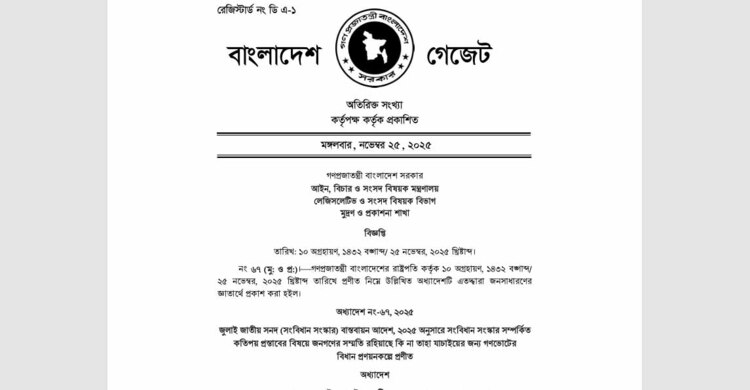
President Mohammed Shahabuddin has promulgated the Referendum Ordinance, 2025, following its approval by the Council of Advisers on Tuesday.
A gazette notification was issued Tuesday night by the Legislative and Parliamentary Affairs Division of the Law Ministry.
Earlier in the day, the Advisory Council approved the draft ordinance during a meeting at the Office of the Chief Adviser.
What the referendum will ask
The ordinance states that citizens will be asked the following question in the referendum:
“Do you consent to the July National Charter (Constitutional Reform) Implementation Order, 2025, and the proposed constitutional reforms enshrined in the July National Charter?” (Yes/No)
The proposals include:
(a) Forming the caretaker government during elections, the Election Commission, and other constitutional bodies in line with the procedures outlined in the July Charter.
(b) Establishing a bicameral parliament, with a 100-member upper house to be formed proportionally based on party votes in the National Parliament election. Any constitutional amendment would require approval from a majority of upper house members.
(c) Binding the political parties that form the next government to implement 30 issues outlined in the July National Charter. These include increased women’s representation in parliament, electing deputy speakers and parliamentary committee chairs from opposition parties, ensuring fundamental rights, strengthening judicial independence, empowering local government, defining the prime minister’s tenure, and specifying presidential powers.
(d) Implementing all other reforms promised in the July Charter.
Polling arrangements
The referendum will be held at the polling centres designated for the Thirteenth National Parliament election. The Returning Officers and Assistant Returning Officers appointed for that election will also serve in the same capacity for the referendum.
Similarly, presiding officers, assistant presiding officers, and polling officers already appointed for the parliamentary election will automatically be considered appointed for the referendum.
The Presiding Officer will conduct the referendum polling simultaneously with the parliamentary election and will be responsible for maintaining order. Any incident that may compromise impartiality must be reported to the Returning Officer.
If a Presiding Officer is unable to perform their duties, the Returning Officer may assign an Assistant Presiding Officer to the role.
Conduct of polling
The ordinance authorises Assistant Returning Officers to temporarily suspend any polling official if necessary, recording the reasons for doing so.
The voter list prepared for the Thirteenth National Parliament election will also serve as the voter list for the referendum. The same polling hours will apply.
The referendum will be held by secret ballot, using a separate, differently coloured ballot from that of the parliamentary election.
Voters will mark either “Yes” or “No” using the same official seal used for parliamentary ballots.
Postal ballots will also be allowed, following the same rules and procedures applied to the Thirteenth Jatiya Sangsad election.
Offences and code of conduct
Offences and violations defined under the Representation of the People Order, 1972 and its related regulations for the Thirteenth National Parliament election will similarly apply to the referendum. Authorities may prosecute offences and take action against any breach of the electoral code of conduct accordingly.