
31 life-saving nuclear medicine tests vanish, patients count days till disaster

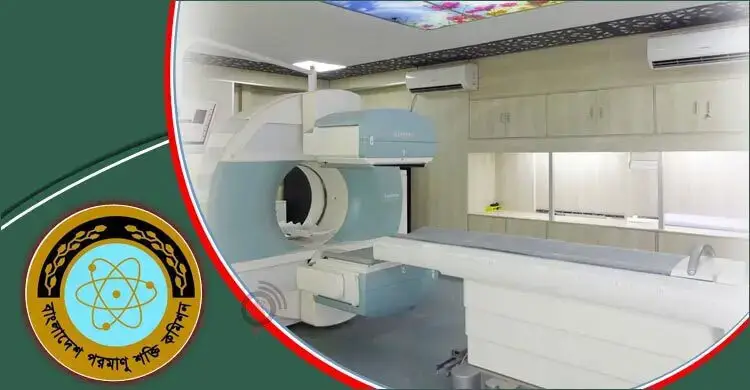
The corridor outside the Nuclear Medicine department at Dhaka Medical College and Hospital smells of despair these days. A hand-written sign taped to the shutter reads: “All isotope tests suspended until further notice.” Beneath it, a queue that never moves.
Ibrahim Hossain has been part of that queue for thirty-four days.
The 50-year-old assistant editor of a popular newspaper clutches a folder thick with angiogram reports. Four blocks. Two at 80%. Doctors have already placed one stent; the second cannot be done until they see how much heart muscle is still alive. That answer was supposed to come from a Myocardial Perfusion Imaging (MPI) scan – a test that needs a pinch of Technetium-99m, a radioactive tracer with a shelf-life of six hours.
“There is no pinch,” the technician told him on the first day. There has been no pinch every day since.
Ibrahim now measures his life in chest pains. “Some nights the pain climbs into my jaw,” he says, voice low so the other waiting patients don’t hear. “I keep wondering which one will be the big one.”
Dr KAM Mahbub Hasan, Assistant Professor at the National Institute of Cardiovascular Diseases, warned: “Without MPI or stress thallium tests, we are forced to make treatment decisions blind. We may put a stent where bypass is needed, or delay intervention until the patient suffers a massive heart attack. This is not just inconvenience – this is playing with lives.”
Fifty kilometres away, in a village in Narayanganj, another kind of clock is racing.
Ayash is just fifty-one days old. His skin has turned the colour of overripe mango. When the local doctor pricked his heel for blood, the drop kept flowing for twenty terrifying minutes. The diagnosis doctors suspect is biliary atresia — a disease where bile ducts never form. If surgery isn’t done before the baby is 60 days old, the liver hardens forever.
The test that can confirm it is called a HIDA scan. It, too, needs a radioactive tracer.
Ayash’s mother Ayesha has become a familiar ghost in Dhaka’s hospitals. She knows the exact phrasing now: “Ma’am, reagent sesh.” Reagent finished.
She recites the list like a grim nursery rhyme: “PG – no. Suhrawardy – no. BSMMU – no. Square, Popular, Evercare, Labaid – no, no, no, no.”
On day forty-eight she sat on the steps of the National Gastroliver Institute and cried so hard that a ward boy brought her a glass of water. Nine days remain on the invisible timer inside her son’s tiny liver.
These are not isolated tragedies. They are symptoms of the same wound.
Pediatric liver specialist Dr Arifa Tasneem at the National Gastroliver Institute and Hospital added: “In newborns with suspected biliary atresia, every week of delay reduces survival chances dramatically. HIDA scan is the gold standard to confirm the disease before irreversible liver damage occurs. Right now, we have no way to diagnose these babies properly.”
The devastating halt in the import of radioactive medical reagents and equipment has paralysed nuclear medicine services across Bangladesh, leaving hundreds of patients with heart disease, cancer, liver disorders, and other critical conditions without essential diagnostic tests and treatments.
At least 31 crucial diagnostic and therapeutic procedures have been completely stopped nationwide since mid-October, pushing patients into extreme suffering and, in some cases, risking irreversible damage or death.
On October 18, a fire tore through the Cargo Village at Hazrat Shahjalal International Airport. What burned was not just cardboard and plastic - it was the only gateway through which Bangladesh receives the world’s most fragile medicines: radioactive isotopes that decay even while the plane is in the air.
Technetium-99m, the workhorse of nuclear medicine, comes from molybdenum-99 flown in from South Africa and Poland. Iodine-131 for thyroid cancer arrives in lead-lined capsules no bigger than a lipstick. After the fire, radiation safety protocols froze the cargo terminal. No airline wants to land radioactive material into a half-ruined facility.
Thirty-one tests vanished overnight.
Bone scans that tell if cancer has spread. Renal scans that decide whether a child keeps both kidneys. Thyroid uptake studies that guide whether a cancer patient lives or dies. All gone.
In the thyroid cancer ward at NINMAS, patients who have had their thyroid glands removed wait for the radioactive iodine that will hunt down the last cancer cells. Without it, those cells wake up and march.
One woman, Rahima, 38, from Sylhet, has been waiting six weeks. Her tumour markers are rising again. “They removed my throat’s voice box along with the cancer,” she whispers through the hole in her neck. “Now the cancer might take the rest of me because a warehouse burned.”
At the Bangladesh Atomic Energy Commission headquarters in Agargaon, officials have stopped answering questions. Director (Biology) Mahfuza Khan said she was “prohibited” from speaking.
Commission Chairman Dr Mujibur Rahman is, according to his assistant, “very busy.”
Only on November 6 did the Bangladesh Atomic Energy Commission issue a brief written statement acknowledging “extreme suffering” of patients, particularly thyroid cancer cases where urgent I-131 therapy has been postponed indefinitely.
The statement expressed “sincere regret” and claimed all possible steps were being taken, but provided no timeline for resolution.
The Ministry of Science and Technology, which regulates BAEC, deflected responsibility and refused technical discussion, advising journalists to contact the Commission directly.
Meanwhile, private centres that once offered these scans at premium prices now turn patients away with the same two words: reagent nei – there is no reagent.
Doctors have begun improvising in ways that keep them awake at night.
Cardiologists are sending critical patients for angiograms without perfusion studies, guessing which artery to stent. Paediatric surgeons are operating on suspected biliary atresia without HIDA confirmation – opening tiny abdomens on hope alone.
“We are practising 1980s medicine in 2025,” one senior professor admitted off-record. “Except in the 1980s we didn’t know what we were missing.”
Back in the motionless queue at Dhaka Medical, Ibrahim Hossain finally stands up. His folder is now creased from being clutched too long.
He looks at the shuttered department door, then at the sky outside turning orange with evening.
“Every day I come here,” he says, “I die a little. Not from the blocks in my heart. From the block at the airport.”
Somewhere in that same sky, a cargo plane carrying the next batch of isotopes circles, waiting for permission to land.
On the ground, two clocks keep ticking in opposite directions.
One belongs to a 50-year-old man whose heart could stop any moment.
The other belongs to a 51-day-old baby who will lose his liver in nine days.
Both are waiting for the same thing: a few millilitres of liquid light that cannot clear customs because a warehouse caught fire six weeks ago.
Until that light arrives, an entire country holds its breath in the dark.