
Illegal marine fuel stockpiling in Karnaphuli amid global oil volatility

Published: 23 March 2026, 11:39 AM
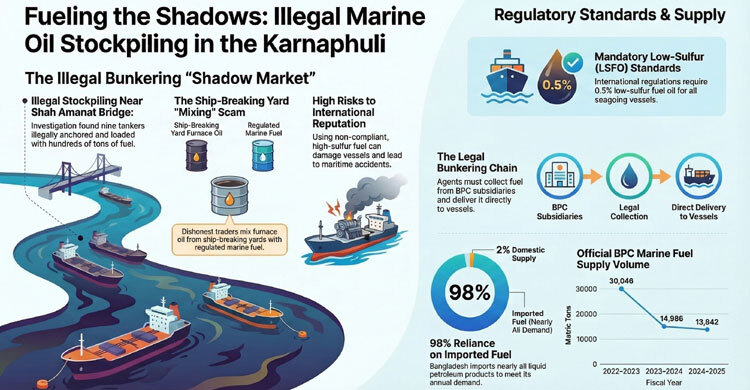
The ongoing war in the Middle East has caused volatility in the global fuel oil market, and Bangladesh is not immune to its effects. Officials at the Bangladesh Petroleum Corporation (BPC) have been working tirelessly to ensure an uninterrupted fuel supply. Meanwhile, allegations have emerged regarding supply disruptions of low-sulfur furnace oil (LSFO), which is used as fuel for foreign ships.
An investigation by Jago News, however, has revealed that some parties are illegally stockpiling marine fuel in the Karnaphuli River under the pretext of a shortage. Evidence of this practice has been documented. While international oil prices have risen for all types of fuel, there is currently no shortage of marine fuel in Bangladesh.
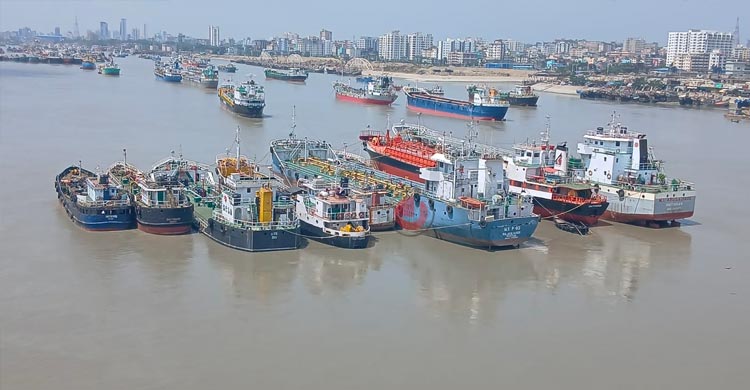
Fuel used by seagoing vessels is known as “marine fuel,” and the process of supplying it to ships is called “bunkering.” LSFO is mandatory for bunkering on seagoing vessels. Conversations with multiple industry sources indicate that ships often procure bunkers from convenient local sources to reduce costs. Some even supply furnace oil from Bangladesh’s ship-breaking industry as LSFO for foreign vessels—a completely illegal practice.
Under regulations, seagoing ships issue an indent (purchase order) to their local shipping agent for bunkering. The shipping agent then procures the fuel from BPC-listed bunker suppliers. Suppliers collect the required fuel from BPC’s three marketing subsidiaries after completing customs procedures and deliver it directly to the ship. Following these rules, there is no opportunity for bunker traders to stockpile marine fuel. Yet, Jago News’ investigation shows illegal stockpiling is taking place in the Karnaphuli River.
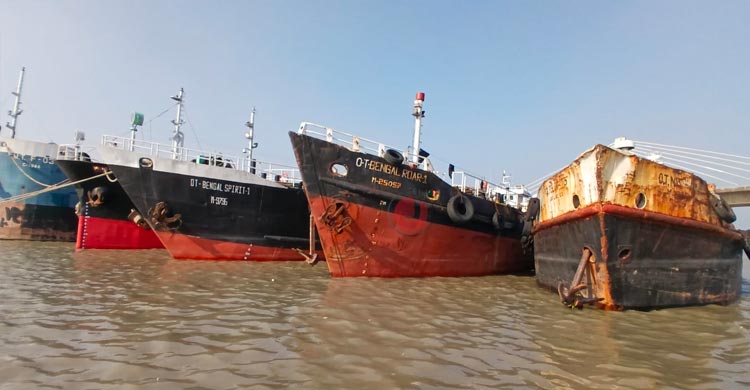
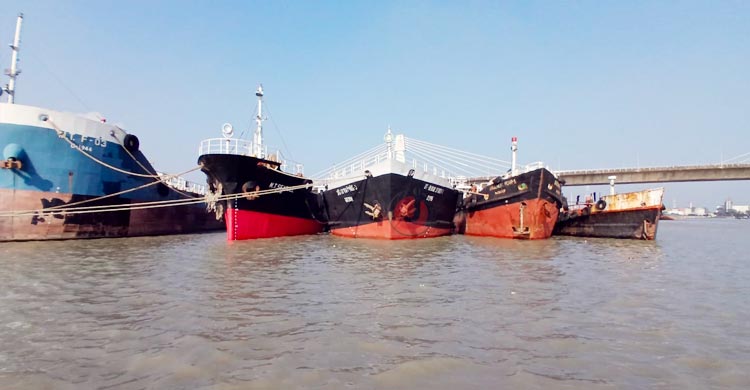
An on-site visit revealed nine oil tankers anchored near the Shah Amanat Bridge. Among them, the lighter tanker MT Bengal Spirit-1 was fully loaded with fuel, while another nearby lighter contained a smaller quantity. The ship’s supervisor, Md Shakil, said, “Our vessel carries 500 tons of furnace oil. We supply bunkers to ships.”
When asked about the fuel source, he added, “We collect oil from Vatiary in Sitakunda, and sometimes from other parties or Padma Oil. Our company is Bangladeshi Trading, and the ship is owned by Kamal.”
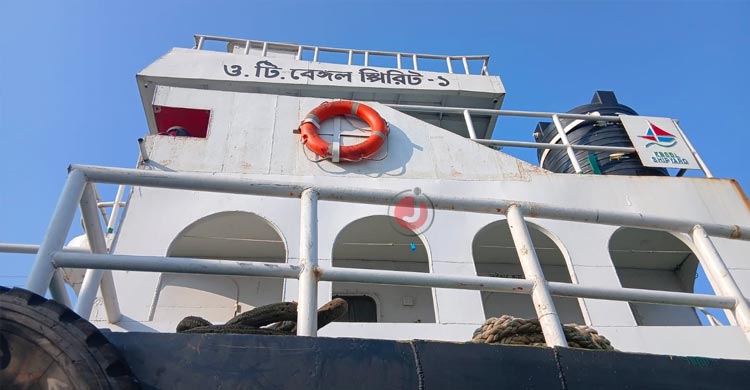
The ship’s quartermaster, Md Nazmul, said, “We bunker from the Padma Jetty. On 28 Ramadan, we received fuel from Padma Jetty. When overloaded, we store it at C-Gal (OT Sigal).”
Further inquiry revealed that on March 17, MT Bengal Spirit-1 received 567.162 metric tons of LSFO from Padma Oil’s Patenga Main Depot, with Nishat Shipping Services (Pvt.) Ltd. listed as the shipping agent.
Zakir Hossain, General Secretary of the Bangladesh Bunker Suppliers Association, told Jago News, “The Middle East war has created instability in the global oil market, which affects the country too. Currently, none of us has marine fuel in stock. There is no opportunity for stockpiling, as fuel must be collected from BPC marketing subsidiaries after customs clearance and supplied directly to the vessel.”
He acknowledged that some are illegally sourcing furnace oil from ship-breaking yards, saying, “Foreign vessels must now use low-sulfur furnace oil as per international regulations. BPC imports this LSFO. Furnace oil from Sitakunda ship-breaking yards is not legal for bunkering.”
Another businessman, speaking on condition of anonymity, said, “Marine fuel prices have risen globally due to the Middle East conflict, but domestic fuel prices have not increased yet. Some are taking advantage of this to stockpile marine fuel. Many dishonest traders mix furnace oil from ship-breaking yards with marine fuel and supply it to foreign ships, which could damage Bangladesh’s reputation if an accident occurs.”
BPC’s General Manager (Operations & Trade), Morshed Hossain Azad, said, “We remain vigilant. No fuel can be stockpiled illegally, including marine fuel. We have already informed the Coast Guard, which will conduct operations if any illegal stockpiling occurs. We are monitoring the situation closely.”
Bangladesh imports nearly 65–70% of its required fuel, including petroleum liquid fuel, gaseous fuel, and coal. Liquid petroleum products include crude oil, diesel, octane, furnace oil, jet fuel, and marine fuel. The country’s annual demand for petroleum liquid fuel is 7.2–7.5 million tons, of which around 98% is imported.
Sources said that Bangladesh has long had a 3.5% sulfur fuel oil bunkering facility. In line with the International Maritime Organisation’s global regulation to reduce sulfur emissions from seagoing vessels, the country now requires 0.5% low-sulfur fuel oil (LSFO) for marine bunkering. BPC formalized LSFO bunkering in a gazette notification on 17 September 2014 and began importing LSFO in 2020, supplying it for the first time on 14 September 2020.
At the 2020 event in Patenga, BPC’s then-chairman Md. Samsur Rahman said, “Around 3,600 ships call at Chattogram and Mongla ports annually. Each consumes at least 200 metric tons of bunkers, requiring 6–7 lakh metric tons of marine fuel per year. However, bunkering from BPC has significantly decreased, with some irregular transactions previously occurring through black-market channels.”
BPC data shows that since the start of marine fuel imports, the corporation has supplied 29,964 metric tons in 2020–2021, 16,499 metric tons in 2021–2022, 30,046 metric tons in 2022–2023, 14,986 metric tons in 2023–2024, and 13,942 metric tons in 2024–2025.