
Forest under strain: Tourist surge outnumbers wildlife in Lawachara

Published: 25 March 2026, 03:42 PM
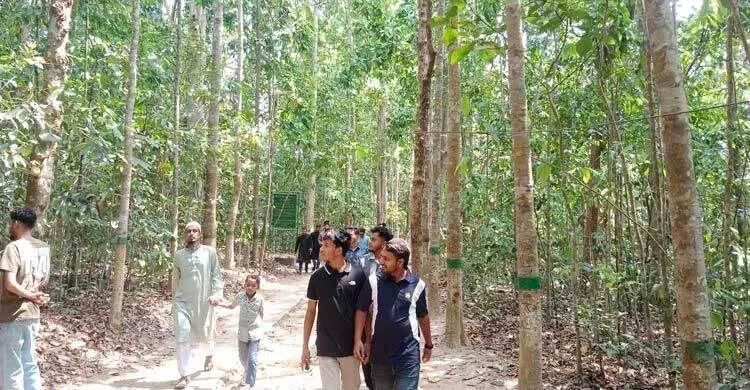
What should be a quiet sanctuary of dense forest and rare wildlife is now echoing with crowds, camera clicks and constant movement.
During the Eid-ul-Fitr holidays, a surge of visitors turned Lawachara National Park into a place where tourists far outnumber the animals they come to see.
Though entry to the reserve forest is officially regulated through a main gate, the park remains open on multiple sides, with roads and a railway line running through it. Officials say only a small portion of visitors purchase tickets, while thousands enter each day freely without monitoring.
Inside the forest, the scene is far from tranquil. Groups of tourists sit along railway tracks, take photos in large crowds and even gather dangerously close to moving trains for selfies. Litter, from food packets to plastic bottles, is scattered across the forest, disrupting the fragile ecosystem.
Spanning about 1,250 hectares, Lawachara was declared a national park in 1996 and is home to rich biodiversity, including 460 species of plants and animals. These include 167 plant species, 246 bird species and 20 species of mammals. Conservationists warn that the growing human presence is pushing wildlife deeper into hiding.
During the Eid holidays from Saturday to Tuesday, heavy traffic congestion stretched along the Bhanugachh–Sreemangal road adjacent to the forest, as visitors poured in from across the country. The pressure of excessive tourism has pushed the park beyond its capacity, raising concerns about long-term environmental damage.
According to the Wildlife Management and Nature Conservation Department, around 6,000 visitors officially entered the park during the Eid period. However, officials estimate that nearly 90 per cent of tourists bypass the ticketing system.
Despite signboards outlining rules and guidelines, many visitors ignore restrictions. Some treat the park like a picnic spot rather than a protected forest.
Environmentalists say the situation has been worsening for years. Alongside illegal logging and declining forest density, uncontrolled tourism has emerged as a major threat. Increased vehicle movement and noise are further disturbing wildlife.
“If this continues, the name ‘Lawachara’ may remain, but the forest itself will not,” warned an environmentalist.
Visitors, too, are noticing the change. Marjan Ahmed, who travelled from Narsingdi with friends, said they came hoping to see wildlife but found none. “There are more people than animals here. There should be better control,” he said.
Range Officer Mohammad Kazi Nazmul Haque acknowledged the challenge. “Tourist numbers are rising, but so is environmental damage. It is very difficult to manage such large crowds with limited resources,” he said, adding that repeated instructions to regulate movement along roads and railways are often ignored.
Sylhet Divisional Forest Officer Md Abul Kalam pointed to population pressure as a broader issue. “In countries with low population density, nature remains relatively undisturbed. Here, the pressure is much higher, and many tourists harm the environment without realising it,” he said.
He also raised safety concerns over risky behaviour. “Taking selfies with moving trains inside the park is extremely dangerous. Accidents have happened before, yet people continue to take such risks,” he added.
With limited manpower and growing tourist demand, authorities now face a difficult balancing act – protecting one of the country’s important forest reserves while managing the overwhelming influx of visitors.