
Bus plunge exposes BIWTC lapses, negligent staff offer cash to suppress news

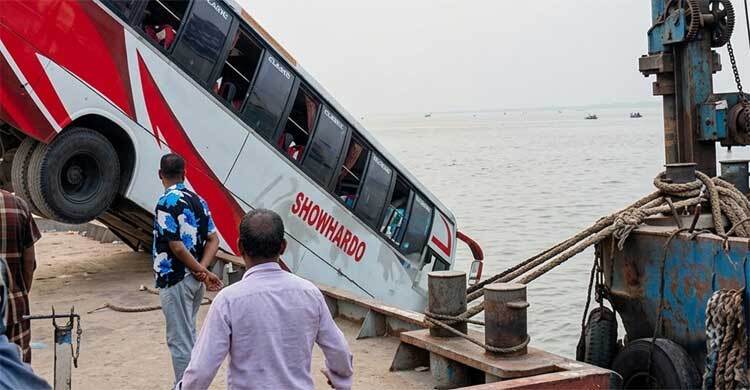
The ferry crossing once carried a rhythm of its own. The sizzle of fried eggs, the calls of hawkers selling jhalmuri and tender coconuts, the quiet shuffle of passengers stretching their legs before the river journey. It was routine, almost mundane.
Now, it feels different.
At Daulatdia, people no longer linger. Vehicles roll onto ferries and passengers step off quickly, some choosing to stand at a distance, others watching the water with unease. The memory of the bus that slipped off the pontoon into the Padma River, taking at least 26 lives with it, still hangs heavy in the air.
What has emerged since that afternoon is not just the story of an accident, but of a system that may have failed at multiple levels.
The sinking of the bus at Daulatdia is no longer being seen as just a tragic accident. What is emerging instead is a deeper concern over negligence inside the Bangladesh Inland Water Transport Corporation (BIWTC) and an alleged attempt to deflect scrutiny in its immediate aftermath.
At the centre of the controversy are two issues: a breakdown in on-ground control and a suspicious offer of money to journalists.
A critical lapse in duty
Ferry terminals operate on strict sequencing. Vehicles are supposed to wait until a ferry has completely unloaded before being allowed to move onto the pontoon. This process is overseen by BIWTC’s Terminal Superintendents (TS), who are responsible for maintaining order and safety.
On the day of the incident, that system appears to have failed.
TS Masud Zaman was officially on duty at Pontoon 3 during the hours when the Souhardya Paribahan bus plunged into the Padma River. His responsibility included ensuring that vehicles did not advance prematurely.
Yet multiple accounts suggest that vehicles, including the ill-fated bus, moved toward the pontoon while the ferry Hasnahena was still unloading.
This points to a clear lapse in enforcement.
In a controlled environment, such movement would be stopped immediately. Instead, the bus was able to reach an exposed pontoon area without any effective barrier – either physical or human.
When the driver reportedly lost control due to brake failure, there was nothing to prevent the vehicle from going straight into the river.
Presence without control
When questioned, Masud Zaman insisted that he was present near the connecting road and had informed his superiors after the incident.
But the key issue is not whether he was somewhere nearby. It is whether he was actively managing the flow of vehicles at the critical moment.
Investigators are now examining whether there was a gap between assigned responsibility and actual presence on the ground.
Because at high-risk points like ferry pontoons, even a brief lapse in supervision can have deadly consequences.
The money offer that raised questions
As Jago News attempted to trace accountability, another troubling incident unfolded inside the BIWTC office.
Before TS Masud appeared, another official, TS Jahangir, allegedly tried to hand money to Jago News correspondents. When asked why, he casually said it was to have lunch.
The move came at a moment when journalists were actively investigating a fatal incident and seeking answers about responsibility. TS Masud was visibly uneasy during questioning, frequently attempting to leave mid-conversation.
Jahangir is also described by insiders as an influential figure within the local ferry terminal network, adding to concerns about informal power structures operating alongside official duties.
A crossing without control
Eyewitness accounts describe a familiar but risky pattern. As soon as a ferry docks, vehicles waiting on the connecting road begin to move forward, often without clear signals or enforcement.
On that day, the ferry Hasnahena had not completed unloading. Yet vehicles, including the ill-fated Souhardya Paribahan bus, advanced toward the pontoon.
Experts say this is where strict control matters most. Vehicles are supposed to wait until unloading is complete. Only then should boarding begin in a controlled sequence.
Instead, what appears to have happened is a breakdown of that system.
The bus, reportedly facing brake failure, had no buffer zone, no barrier, and no clear stopping mechanism. With the path ahead open and no physical safeguards in place, it went straight into the river.
Infrastructure that invites risk
Beyond human error, the physical condition of the ferry terminals is now under scrutiny.
The approach roads to the pontoons at Daulatdia and Paturia are steep and riddled with potholes. Drivers often struggle to control vehicles on these slopes, especially heavy buses and trucks.
Even more concerning is the condition of the pontoons themselves. At Pontoon 3, where the accident occurred, there were no railings or safety barriers. The structure was old, narrow, and visibly worn.
Drivers who regularly use the route say the risks are well known.
“If there had been railings, the bus wouldn’t have gone into the river,” said one driver. “We cross here every day knowing there is no safety.”
A pattern of neglect?
The tragedy has also drawn attention to long-standing complaints about ferry operations: lack of enforcement, poor passenger facilities, and inconsistent management.
Transport workers say they often do not receive the level of service they pay for. Basic infrastructure, like washrooms, is missing, and coordination between officials is weak.
In such an environment, safety becomes dependent on chance rather than the system.
Investigations and promises
Two separate committees – one from the Rajbari district administration and another from the Ministry of Shipping – are now investigating the incident. Both have been tasked with submitting reports within days.
The day after the accident, BIWTC Chairman Md Salim Ullah visited the site and announced immediate safety measures.
He said passengers must disembark before vehicles board ferries, with only drivers allowed to take vehicles onto the vessel. Railings will be installed on pontoons, and staff will receive improved training. Citing initial findings, he noted the bus likely suffered brake failure and moved onto the pontoon before the ferry Hasnahena had finished unloading.
He added that two investigation committees have been formed, and strict action will be taken if negligence is found.
On Sunday, March 29, Shaikh Rabiul Alam, Minister for Road Transport and Bridges, Railways and Water Transport, also stressed stricter enforcement of safety rules.
Speaking to reporters at the ministry, he said it would be mandatory for all passengers to disembark before vehicles board ferries.
He also confirmed that barriers would be installed at ferry points. “There may be operational challenges, but barriers will be put in place,” he said, adding that the Bangladesh Road Transport Authority and transport owners’ associations have been instructed to ensure full compliance with the rule.
A crossing changed
At Daulatdia, the river still flows as it always has. Ferries continue to move, vehicles still line up, and the calls of hawkers have not entirely faded.
But something fundamental has shifted.
Passengers step off buses more quickly now. Drivers move with more caution. And beneath the routine, there is a lingering question – one that the investigations must answer clearly:
Was this truly an accident, or the result of a system that had been failing for a long time?