
Nation celebrates Pahela Baishakh with vibrant festivities

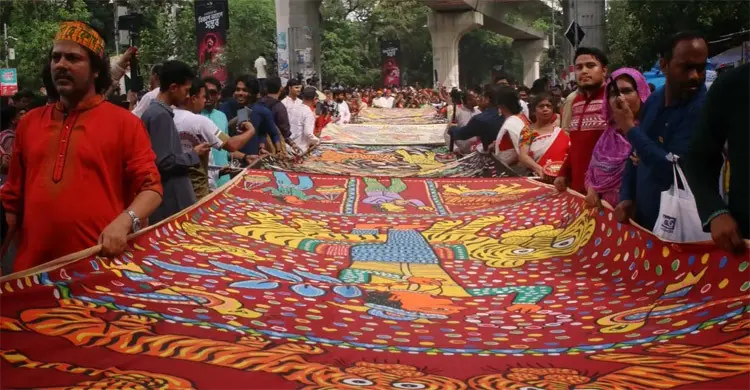
The nation on Tuesday, April 14, celebrated Pahela Baishakh, the first day of the Bengali New Year 1433, with vibrant festivities across the country, showcasing the rich cultural heritage and traditions of the Bengalis.
In the capital, Chhayanaut began the day’s celebrations at dawn with its iconic musical event under the banyan tree at Ramna Batamul, drawing large crowds.
The Faculty of Fine Arts at the University of Dhaka brought out the traditional ‘Baishakhi Shobhajatra’ with the theme ‘Harmony of the New Year, Revival of Democracy,’ adding colour and vibrancy to the celebrations.
The procession, which began at 9:00am from the faculty, ended at the starting point after parading through Shahbagh, Raju Sculpture, TSC, Doel Chattar and Bangla Academy.
In the procession, a horse riding police fleet was in first position, then a group of DU students carrying the national flag followed by distinguished guests, including Cultural Affairs Minister Nitai Roy Chowdhury. Following them, the main motifs, including a rooster, violin, pigeon, horse, and elephant, displayed one after another.
Following the tradition of folk symbols, these represent the multi-dimensional significance of strength, creation, peace, glory, and dynamism.
Outside the capital, the Bengali New Year was celebrated across the country with a multitude of arrangements, including processions and other cultural festivities.
Marking the occasion, Bangla Academy and Bangladesh Small and Cottage Industries Corporation have jointly organised a seven-day fair, discussions and cultural events on the academy premises beginning on Tuesday.
Meanwhile, Bangladesh Folk Arts and Crafts Foundation will host a 14-day traditional Baishakhi fair on its premises starting on April 20.
Special arrangements were made to serve traditional food in prisons, hospitals and Shishu Poribar alongside cultural programmes for children.
All museums and archaeological sites remained open to the public, with free entry for children, students and persons with disabilities.
At the local level, Baishakhi Shobhajatra and cultural events were held in every district and upazila.
Local administration also organised folk fairs and essay competitions for students at the district and upazila levels.
Educational institutions across the country celebrated the occasion in a festive atmosphere under their own initiative.
Business communities, especially in rural areas, opened their traditional 'Halkhata' – new account books – while sweets were distributed among customers.
The day was a public holiday.
Source: UNB