
Phantom parties: Bangladesh's political landscape of signboards and shadows

In Dhaka, where the cacophony of rickshaws and street vendors drowns out the whispers of political intrigue, a peculiar phenomenon is unfolding. As Bangladesh gears up for its upcoming national elections, a surge of new political parties has emerged, clamouring for registration with the Election Commission.
Yet, beneath the veneer of democratic enthusiasm lies a troubling reality: many of these entities appear to be little more than facades – signboards propped up on half-built structures, with no discernible leaders, activists, or even a coherent manifesto.
This is the story of parties like the Bangladesh Ganatantrik Party (BGP), where ambition meets illusion in the quest for political legitimacy.
The rush to form new parties is no accident. With elections on the horizon, the EC has been inundated with applications. At a press conference on August 11, Election Commissioner Brigadier General (Retd) Abul Fazal Md Sanaullah revealed that 143 applications had been submitted for new party registrations. Of these, 22 have cleared the initial scrutiny, paving the way for field-level verification.
The rest, 121 in total, were deemed ineligible. Among the successful applicants are outfits such as the Bangladesh Sanskarbadi Party, Bhashani Janashakti Party, and Bangladesh Bekar Mukti Parishad.
On paper, they tick the boxes: central committees, district and upazila-level organisations, and affidavits from supporters. But a closer inspection reveals a hollow core.
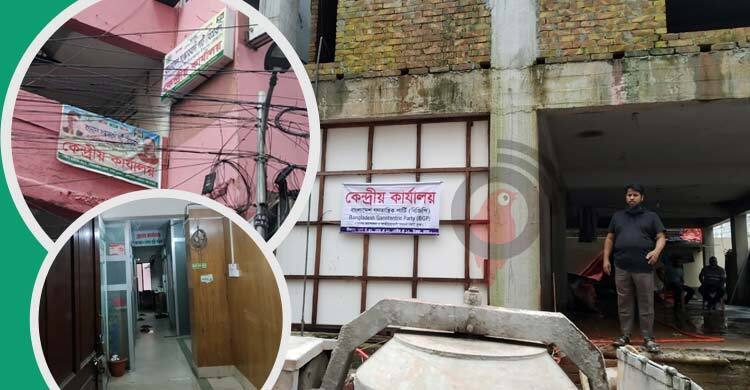
The Bangladesh Ganatantrik Party (BGP) has registered address in the EC's records at House 47, Road 12, Sector 12, Uttara, Dhaka. A visit to this location on August 12 painted a stark picture.
The site was a construction zone, with workers welding metal frames and pouring concrete.
A banner proclaiming "Bangladesh Ganatanrik Party (BGP)" fluttered in the breeze, but that was the extent of its presence.
No office doors swung open to reveal bustling party workers; instead, the building was a skeleton of bricks and beams, the ground floor partially enclosed but unfinished.
Party chairman SM Shahadat, when contacted, redirected Jago News to a nearby house 50 on the same road. A businessman with ties to law enforcement agencies, Shahadat boasted of his past in the National Democratic Party (JAGPA), where he served as secretary general for five years and contested the Dhaka-18 constituency.
He claimed BGP had established committees in 125 upazilas and 25 districts. Yet, as Jago News walked back to the purported office, the reality was undeniable: no activists milled about, no meetings were in session.
The "office" was a single room on the ground floor, its paint fresh but ancillary fittings absent. Shahadat pleaded, "Don't print this. The office will be ready by Saturday. I'll invite all the journalists."
He plans to shift operations to the second floor once decoration is complete. His birthplace in Bagerhat and business ventures underscore a common thread among these party heads: they are entrepreneurs first, politicians second – if at all.
This pattern repeats across other nascent parties. The Bangladesh Sangskarbadi Party (BRP), headquartered at 42/1 Segunbagicha, Dhaka, occupies the third floor of a building dominated by furniture shops on the ground level.
Accessing the office required navigating through a shopkeeper's domain to find the stairs – a far cry from the grandeur one might expect of a political hub. Inside, vice chairman Mehedi Hasan sat alone, the sole occupant. Formed in 2024, BRP claims committees in every district and upazila, with a sprawling 570-member central committee.
But when pressed on the party's goals and objectives, Hasan deferred: "Speak to the acting chairman, Md Nurul Haque. Call him on WhatsApp for details."
Hasan and Haque are business partners, though details of their ventures remain vague – Hasan only mentioned a decade in commerce.
Haque, when reached, directed inquiries to the party's website, <brpbd.org>. A perusal revealed two links to the constitution, both leading to dead ends. The site lists news of activities and the central committee but offers scant substance. BRP was established on July 19, 2024, amid the anti-government mass movement that gripped the nation last year. Its emergence seems opportunistic, born in the heat of unrest rather than ideological conviction.
Further afield, the Bhashani Janashakti Party operates from Ibrahim Mansion in Purana Paltan, Dhaka. No banners adorned the exterior, blending seamlessly into the urban anonymity.
Chairman Sheikh Md Rafiqul Islam, a self-described businessman, funds the party through member donations – presidium members contribute Tk 5,000 each. He asserts committees in 27 districts and 101 upazilas, with a 121-member central committee. Despite 18 parties invoking the name of Maulana Bhashani, Rafiqul Islam claims his is the only active one.
However, the EC's 33 per cent women's quota remains unfulfilled; he optimistically targets compliance by 2030, the deadline set by the commission.
Then there's the Bangladesh Bekar Mukti Parishad (Bangladesh Unemployed Liberation Council), aimed at tackling unemployment – a pressing issue in a country where youth joblessness fuels discontent.
Its office on the 8th floor of Sharif Plaza, 34 Purana Paltan, lacks external signage.
A Facebook page exists, but no website. President Atiqur Rahman Raja, whose father was a businessman and who himself oversees agricultural products and cattle farms, reports 138 upazila committees, 24 district ones, and a 71-member central body. Like his counterparts, Raja's background is firmly rooted in commerce.
These four parties – BGP, BRP, Bhashani Janashakti, and Bekar Mukti Parishad – exemplify a broader trend. All cleared the EC's primary hurdle, yet fieldwork exposes their deficiencies. Leaders are predominantly businessmen, some parties birthed mere months ago during last year's upheavals.
They struggle to quantify membership or articulate purpose. Offices are either non-existent, under construction, or eerily vacant. No throngs of supporters rally; no policy debates echo through the halls.
Under Bangladeshi law, registration demands a central committee, committees in one-third of districts and 100 upazilas, and endorsements from 200 voters per committee. Parties with prior parliamentary representation or 5 per cent vote share in past elections gain an edge.
Applicants had until 22 June to submit, but none initially met criteria.
The EC granted a 15-day extension to August 3, after which 84 parties, including the National Citizens Party (NCP), claimed compliance. The 22 that advanced include eclectic names: Forward Party, Aam Janata Dal, Bangladesh Nejame Islam Party, Bangladesher Samajtantrik Dal (Marxist), Moulik Bangla, Bangladesh Justice and Development Party, Jatiya Janata Party, Janata Dal, Janata Party Bangladesh, Bangladesh Aam Janata Party, Jatiya Nagorik Party (NCP), Bangladesh Jatiya League, Bangladesher Communist Party (Marxist)-CPB(M), Jatiya Samajtantrik Dal (JSD-Shahjahan Siraj), Jamiat Ulama-e Islam and Nejame Islam Party, Bangladesh Bekar Samaj (BABES), Bangladesh Solution Party, and New Bangladesh Party.
This proliferation raises profound questions about the health of Bangladesh's democracy. Are these "phantom parties" genuine attempts at grassroots mobilisation, or strategic ploys to fragment votes, secure funding, or exploit electoral loopholes?
In a nation scarred by political violence and corruption allegations, such entities could undermine trust in the system. The EC's field scrutiny will be pivotal, but sceptics argue that bureaucratic hurdles favour the entrenched elite.
Political analysts suggest this wave stems from last year's anti-government movement, which toppled long-standing power structures and ignited a desire for change. Yet, without substance, these parties risk becoming caricatures signboards in the wind, devoid of the human element that defines true politics.
As one observer quipped, "In Bangladesh, it seems anyone with a banner and a business card can play at being a party leader."
The coming months will test these outfits. Will they evolve into viable forces, or fade into obscurity? For now, they stand as cautionary tales: in the theatre of democracy, a signboard alone does not make a stage.