
Protests without borders: Bangladesh’s reputation takes a hit

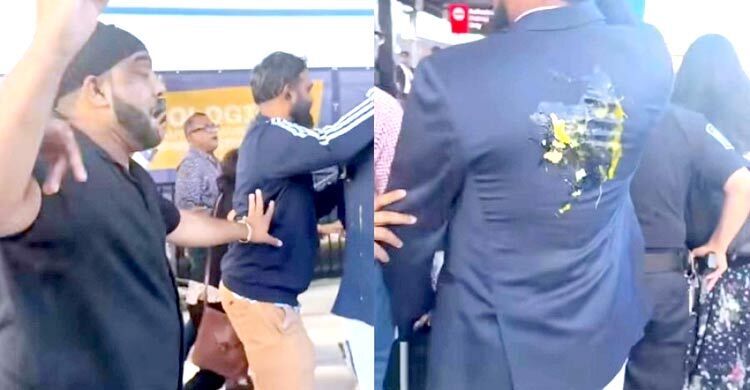
What was once confined to placards and black flags has now escalated into egg-throwing, vandalism and arrests turning Bangladeshi political protests abroad into spectacles that stain the national image.
A foreign visit by any senior Bangladeshi political figure, whether from government or any political camp, now routinely triggers demonstrations by expatriate party workers. But what began as symbolic dissent has morphed into aggressive, headline-grabbing confrontations, drawing police intervention and diplomatic concern.
This “tradition” of overseas political agitation has persisted for over a decade.
During former Prime Minister Sheikh Hasina’s visits to Western capitals, BNP and Jamaat activists staged protests waving black flags, shouting slogans, and occasionally breaching diplomatic premises.
Now, the same pattern is repeating, with heightened intensity, during the US visit of Chief Adviser Dr Muhammad Yunus for the 79th session of the United Nations General Assembly.
On Monday, September 22, Akhtar Hossain, Member-Secretary of the National Citizens’ Party (NCP) and part of Dr Yunus’s delegation, was struck by an egg upon arrival at New York’s John F Kennedy International Airport. Eyewitnesses identified local Awami League activist Mizanur Rahman as the assailant. He was subsequently arrested by New York Police Department officers.
This was not an isolated incident.
In November 2024, a video went viral showing Law Adviser Dr Asif Nazrul being heckled and confronted by protesters at Geneva Airport.
In August 2025, Information Adviser Mahfuz Alam faced a similar reception at the New York Consulate where eggs and water bottles were hurled, and the consulate’s glass door was vandalised.
Back in 2018, BNP-UK activists stormed the Bangladesh High Commission in London, damaging a portrait of the country’s founding president Sheikh Mujibur Rahman. The protest, linked to the Zia Orphanage Trust verdict, lasted 10 minutes before police intervened. Over 200 took part; UK-based BNP leader Nasir Ahmed Shaheen was detained.
A crisis of image and access
Political analysts and diplomats warn that these theatrics are doing more than embarrassing delegations, they are eroding Bangladesh’s global reputation and jeopardising travel access for ordinary citizens.
“Such protests on foreign soil over Bangladesh’s internal politics are deeply inappropriate,” said former ambassador Abdul Hai. “They tarnish our national image. Countries are beginning to impose stricter entry conditions for Bangladeshis not the protesters, who often hold foreign passports, but ordinary citizens seeking visas or work permits.”
He added: “You will not find Indian political parties staging such scenes abroad. We are alone in this undignified display.”
Dr Sabbir Ahmed, Professor of Political Science at Dhaka University, called the behaviour “a manifestation of political intolerance and cultural rudeness”.
“These acts project Bangladesh as a nation incapable of civil political discourse even on foreign soil. It tells the world we are politically immature, volatile and disrespectful of diplomatic norms,” he said.
A Bangladeshi journalist studying in the US, speaking on condition of anonymity, described the scene as “humiliating”.
“There are no words for the language and conduct of these so-called political workers. They sit on foreign soil and degrade their own countrymen. I study alongside students from other South Asian nations — when these incidents surface, I am left speechless, ashamed.”
Politics in exile: A symptom of domestic repression?
Fahmidul Haque, faculty member at Bard College in New York and former Dhaka University professor, offered a structural explanation in a Facebook post: “Under the Awami League’s closed regime, political expression, activism and even journalism were forced overseas. Now, with the Awami League’s activities restricted under the interim government, their supporters are replicating the same exile politics – staging protests, plotting comebacks, dreaming of power – all from abroad.”
He added: “This is not just about the security of visiting dignitaries. We must examine the political environment at home, the systems, the intolerance, the suppression, that pushes politics into the streets of New York and London.”
Government response or lack thereof
Despite repeated requests, the Ministry of Foreign Affairs declined to comment on the growing diplomatic friction.
However, diplomatic sources confirmed that the interim government has issued a note verbale to the United States, requesting enhanced security for Dr Yunus and his delegation. While the Chief Adviser and senior officials departed safely on Monday, accompanying politicians, including Akhtar Hossain, were targeted.
Notably, six representatives from the BNP, Jamaat and NCP, parties currently outside government, joined Dr Yunus’s delegation at state expense. Their expatriate supporters organised a grand reception in New York. In response, local Awami League chapters mobilised to “resist” them culminating in the airport incident.
The irony of exile politics
The cycle is now complete: yesterday’s protesters are today’s targets. What was once the opposition’s tactic is now the ruling establishment’s burden.
Yet the consequences remain the same – a fractured diaspora, a diminished national image, and a warning from host nations: Keep your politics at home.
As Bangladesh seeks global legitimacy and economic partnerships, its political actors at home and abroad may need to ask: Is this spectacle worth the cost?