
Marufa’s magic: From Nilphamari’s rail tracks to World Cup fame
The railway line through Dhelapir, a small village in Nilphamari, hums softly through fields of paddy. Children wave as trains rush past, their laughter swallowed by the roar of metal on tracks. Among them once ran a girl with a bat made from scrap wood, her dreams louder than any train that thundered by.
That girl is now Marufa Akhter—just 20 years old—and she’s rewriting the story of women’s cricket in Bangladesh.
On Thursday in Colombo, under the blazing sun of the 2025 Women’s One-Day World Cup, Marufa didn’t just bowl overs—she made a statement. In her very first over, she ripped through Pakistan’s top order, claiming two wickets and setting the tone for a dominant 7-wicket Bangladeshi victory. Her final figures—2 for 31 in 7 overs—earned her the Player of the Match award, the first Bangladeshi woman to claim that honour in this World Cup.
But the road that led from Dhelapir’s dusty tracks to world cricket’s grandest stage was long, unpaved, and often cruel.
A childhood in motion
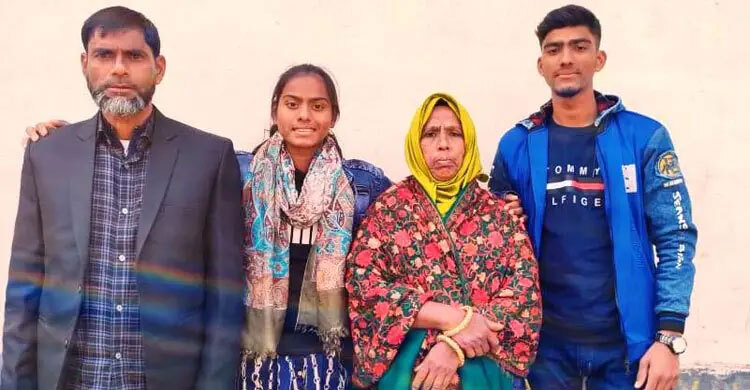
Marufa was born into hardship. Her family’s only asset was a small thatched home on land gifted by her maternal grandfather. Her father, Aimullah Haque, worked as a sharecropper; her mother, Morjina Begum, kept house for five children. Cricket was not a luxury the family could afford—least of all for a girl.
“People used to laugh,” recalls neighbour Nazmul Islam. “She dressed like a boy, ran with the lads, and played like she meant it. Her parents were scolded for letting her do it. But look at her now—she’s the pride of the whole village.”
Her days began before dawn—helping her father in the fields before rushing home to bathe, eat, and sprint to school. After lunch, while others napped, she’d be out again—bat in hand, tennis ball wrapped in electrical tape, playing by the railway line until sunset. She didn’t just hold her own; she outplayed the boys.
Her elder brother Al-Amin recognised that spark. A student himself, he started giving private tuition not to fund his studies—but to buy his sister gloves, bats and cricket balls. “Every taka went on her gear,” says Nazmul. “He believed in her when no one else did.”
A star spotted
In 2018, fate intervened. A BKSP talent scout noticed the wiry teenager’s bowling at a local camp. From there, her rise was meteoric: local tournaments, district sides, domestic leagues—and, at 18, the call-up every cricketer dreams of: the national team.
But success came with resistance. Her mother once beat her for skipping chores to play. Her father banned her outright. “I scolded her endlessly,” Morjina admits now, eyes glistening. “But she’d finish all her housework—sweeping, washing, cooking—just so I couldn’t say no. Cricket was her heartbeat.”
The pride of Nilphamari
Today, that same father walks through the Nilphamari market to applause. “They don’t call me Aimullah anymore,” he smiles shyly. “They say, ‘There goes Marufa’s father.’ Shopkeepers refuse to take money for tea. It’s overwhelming—but I thank God every day.”
Her mother adds simply: “My daughter has made the whole country proud. That is enough for me.”
The pride has spread beyond the village. Deputy Commissioner Mohammad Nairuzzaman, president of the district sports association, calls Marufa “a gift to Bangladeshi cricket.” He believes her pace and precision could one day bring the World Cup home. “If she keeps playing like this,” he says, “Bangladesh will win—by her hand.”
The rhythm of a dream
On the field, Marufa’s bowling is pure rhythm—smooth run-up, explosive release, the ball cutting in sharply under the bat. Off the field, she remains the same grounded girl who trained by the railway tracks. Fame hasn’t softened her grit.
“Sometimes,” she told local reporters, “I still dream of that railway line. That’s where everything started.”
In a world where too many dreams are buried under poverty and tradition, Marufa Akhter unearthed hers—one delivery at a time.
And as the trains still roll past her village, the echoes of her rise tell every young girl in Bangladesh the same thing: you can come from anywhere and bowl your way into history.