
FIFA World Cup: All 48 teams, top scorers, and the biggest surprises

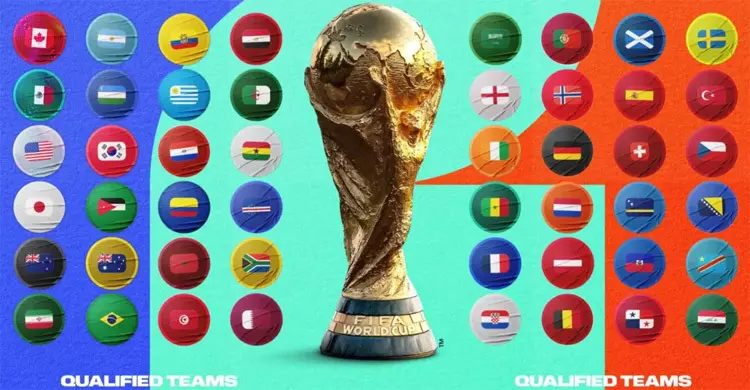
The 2026 FIFA World Cup is unlike anything football has seen before and that's not just a line for the brochure, as it is the first World Cup to include 48 teams, expanded from 32, and the first to be hosted by three nations simultaneously – the United States, Canada, and Mexico, spread across 16 cities.
But the numbers only go so far in capturing what this qualification cycle actually produced. There were stories of nations waiting decades for this moment, a European giant falling through the trapdoor for the third consecutive time, a man from Manchester scoring 16 goals for Norway, and a tiny Caribbean island rewriting the record books. All of that before a ball is kicked at a World Cup.
The Full 48 Teams — Confederation by Confederation
UEFA — Europe: Austria, Belgium, Croatia, England, France, Germany, Netherlands, Norway, Portugal, Scotland, Spain, and Switzerland all qualified as group winners. The remaining four European spots were settled in the March 2026 playoffs, where Bosnia and Herzegovina, Sweden, Türkiye, and Czechia each won their respective paths to join the field.
Italy, four-time World Cup winners, missed out for the third consecutive time, losing the play-off final. The scale of that absence, in a 48-team tournament no less, warrants more than a footnote.
CAF — Africa: Algeria, Cape Verde, Egypt, Ghana, Ivory Coast, Morocco, Senegal, South Africa, and Tunisia make up the African contingent, with DR Congo joining them via the intercontinental playoff. Ten African nations at a single World Cup is the most ever.
AFC — Asia: Australia, Iran, Japan, Jordan, Uzbekistan, Qatar, Saudi Arabia, and South Korea qualified directly, with Iraq claiming the final Asian berth through the intercontinental playoff. Japan was the first nation anywhere in the world to qualify, and South Korea secured their 11th consecutive World Cup appearance.
CONMEBOL — South America: Argentina, Brazil, Colombia, Ecuador, Paraguay, and Uruguay all came through the grueling round-robin format. Brazil maintains their record as the only nation to have qualified for every World Cup since 1930.
OFC — Oceania: For the first time in history, the OFC received a guaranteed berth, and New Zealand filled it, a landmark moment for Oceanian football that has been 96 years in the making.
The Final Two Spots — Drama Until the Last Whistle
The intercontinental playoffs, played in Mexico on March 31, produced the kind of endings that qualify tournaments tend to deliver.
DR Congo secured their spot at the 2026 World Cup after a dramatic extra-time victory over Jamaica. The winning goal came in the 100th minute, with former Manchester United defender Axel Tuanzebe bundling the ball over the line from a corner, before having to wait for VAR to clear a possible handball. This is only the second time the nation has qualified, but the first under the name DR Congo they previously appeared at the 1974 tournament as Zaire. They join Group K alongside Portugal, Colombia, and Uzbekistan.
Iraq secured the 48th and final place at the tournament with a 2-1 victory over Bolivia. Ali Al-Hamadi gave Iraq an early lead with a powerful header. Bolivia levelled before half-time through Moises Paniagua, before Aymen Hussein finished clinically in the 53rd minute to restore Iraq's advantage. Iraq ended a 40-year absence from the World Cup; their last appearance was Mexico 1986. They join Group I with France, Norway, and Senegal.
The Full Group Stage Draw
Several groups stand out immediately. Group C pits Brazil against Scotland and Morocco neither a straightforward opponent. Group I is arguably the tournament's group of death on paper: France, Norway, Senegal, and Iraq. Group J places Argentina against Jordan making their debut, which writes its own story. And Group K Portugal, DR Congo, Uzbekistan, Colombia has the feel of a genuinely unpredictable mini-tournament.
Who Scored the Most in Qualifying?
The European qualifying campaign was, in a meaningful sense, Erling Haaland's personal highlight reel.
Haaland topped the scorer rankings for the European Qualifiers, registering 16 goals as Norway secured their first World Cup berth since 1998. His tally included five goals in an 11-1 win against Moldova and a hat-trick versus Israel, with at least one goal in every single one of Norway's eight matches.
Haaland finished eight goals clear of his nearest challengers Harry Kane, Memphis Depay, and Marko Arnautovic and his tally of 16 matched the European qualifying record set by Robert Lewandowski for the 2018 cycle. That comparison is worth sitting with. Lewandowski did it over ten games in a campaign people still talk about. Haaland did it in eight, and still found time to score five in a single match.
From the Netherlands, Memphis Depay scored eight times across qualifying and became the country's all-time leading scorer in the process. Meanwhile, from South America, Colombia looked particularly fluid through the CONMEBOL round-robin, and Argentina's campaign — while not as electric on paper never really felt in doubt.
The Biggest Surprises of Qualification
Some stories from this cycle deserve far more attention than they've received.
Curaçao — The Smallest Nation in World Cup History
This is the one that will likely be discussed long after the tournament ends. Curaçao, with a population of just 156,000, became the smallest nation ever to qualify for the World Cup. An autonomous Caribbean island within the Kingdom of the Netherlands, Curaçao secured their spot by winning their CONCACAF group with a decisive draw against Jamaica on the final matchday while traditional powerhouses like Costa Rica fell away. Their squad, led by Tahith Chong (a product of Manchester United's academy), is drawn from mid-table European leagues and the local scene. They face Germany, Ivory Coast, and Ecuador in Group E which will be difficult but none of that diminishes what qualifying actually meant.
Cape Verde — Africa's Quiet Overachievers
Cape Verde dominated their qualifying group with seven wins, two draws, and just one defeat, proving their rise in African football is no coincidence. What makes that even more striking is who they beat to get there. With a population of only 525,000, Cape Verde is the third-smallest nation by population to qualify for a World Cup, after Iceland in 2018 and Curaçao. In Group H they face Spain, Uruguay, and Saudi Arabia not a straightforward draw, though the Blue Sharks have already shown they don't move according to expectations.
Scotland — Back After 28 Years
A sensational final-day win against Denmark in front of a packed Hampden Park took Scotland to their first World Cup since 1998. That's 28 years of near misses condensed into a single November evening. Steve Clarke has built Scotland into Group C against Brazil, Morocco, and Haiti not as passengers, but as a side with genuine organisation and a point to prove.
Norway — Haaland Carries a Nation Back
Norway secured their first World Cup finals berth since 1998, powered almost entirely by the most dominant individual qualifying campaign in European history. The interesting question now is whether Haaland can sustain that form against France, Senegal, and Iraq in Group I, a group in which Norway could well spring a surprise or two.
Uzbekistan — Cannavaro's Unlikely Project
Uzbekistan qualified for the World Cup for the first time. They did it under Fabio Cannavaro Italy's World Cup-winning captain in 2006 showing impressive consistency with six wins, three draws, and only one defeat in the decisive qualifying stage. Their squad includes Manchester City's Abdukodir Khusanov and young stars like Abbos Fayzullaev, who was named AFC Youth Player of the Year in 2023. They're in Group K with Portugal, Colombia, and DR Congo not easy, but not a group where they'll simply be making up the numbers.
Jordan — Making History in Asia
Jordan qualified for the World Cup for the first time, finishing second in their AFC third-round group ahead of Iraq. They're drawn with Argentina, Algeria, and Austria in Group J meaning their World Cup debut could involve a meeting with Lionel Messi. That's the kind of fixture that gets remembered.
DR Congo — 52 Years in the Waiting
This is only the second time the nation has qualified for the World Cup, but the first under the name DR Congo having previously appeared in the 1974 tournament as Zaire. They got there in dramatic fashion: former Manchester United defender Axel Tuanzebe scored in extra time, bundling the ball home in the 100th minute, with Congolese players breaking down in emotional scenes at the final whistle. They join Portugal, Colombia, and Uzbekistan in Group K.
Iraq — Ending a 40-Year Wait
Iraq ended a 40-year absence from the World Cup; their last participation was Mexico 1986. They came through the inter-confederation playoff with composure and discipline, holding on to beat Bolivia 2-1 despite sustained late pressure. They now join one of the tournament's toughest groups: France, Haaland's Norway, and Senegal. The 53rd-minute winner from Aymen Hussein that secured their place may well be the goal replayed most on Iraqi television this summer.
The Notable Absences
The expansion to 48 teams was supposed to make qualification more forgiving. For some nations, it changed nothing.
Cameroon, Costa Rica, Poland, Serbia, and Wales all of whom were at the 2022 World Cup failed to qualify for 2026. Denmark, who also appeared in Qatar, were eliminated by Czechia in the UEFA playoff final on penalties. And then there is Italy. The four-time World Cup winners missed out for the third consecutive time, losing the play-off final.
A 48-team tournament that includes four first-time nations, a Caribbean island of 156,000 people, and a side returning after 52 years has no room for the four-time champions. That is not misfortune, it is a structural problem Italian football will need to seriously confront.
What This Tournament Could Look Like
The expanded format brings a genuinely new dynamic. The 48 teams split into 12 groups of four, with the top two from each group plus the eight best third-placed teams progressing to a new Round of 32, producing 104 total matches over 39 days. Critics argued that expansion would thin out the quality. They may have a point about some group-stage fixtures. But the counter-argument plays out in the draw itself Scotland vs. Brazil, Cape Verde vs. Spain, Jordan vs. Argentina, Iraq vs. France. Those aren't mismatches in the traditional sense. They're stories with outcomes nobody can confidently predict.
The debutants Cape Verde, Curaçao, Jordan, and Uzbekistan, four nations appearing at a World Cup for the very first time, arrive without the weight of expectation that crushes experienced sides. That's historically been the condition under which upsets happen. Whether any of them produce one remains to be seen. But the conditions are there.
The tournament kicked off on June 11, 2026 (19:00 ,Mexico City Time), in Mexico City. The final is July 19 at MetLife Stadium in New Jersey. Between those two dates, 48 nations from defending champions Argentina to first-timers Curaçao, from perennial contenders France to Iraq making their return after 40 years will contest the most expansive World Cup in football history.
Source: UNB