
Pvt sector calls for business-friendly budget to sustain economic growth

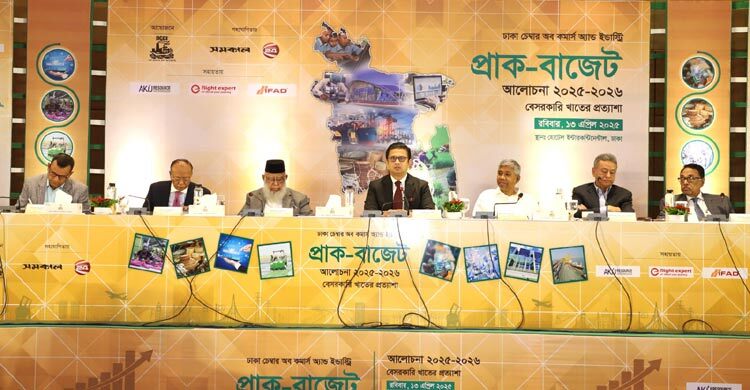
In a bid to sustain Bangladesh’s economic growth momentum, private sector leaders have urged the government to adopt measures that enhance revenue collection while easing the overall tax management system.
These recommendations were made during a ‘Live Pre-Budget Discussion: Private Sector Perspective’, organised by the Dhaka Chamber of Commerce & Industry (DCCI) in collaboration with vernacular daily Samakal and Channel 24 at InterContinental Dhaka on Sunday.
Taskeen Ahmed, President of DCCI, emphasized the need to broaden the tax net and streamline the tax management system to boost revenue collection. He recommended several key reforms for the upcoming national budget:
- Introduction of a fully automated corporate tax return system to reduce complexities and improve compliance.
- Abolition of advance tax for manufacturers at the import stage and reduction of the same for commercial importers.
- Imposition of at least 1% VAT for entrepreneurs in the informal sector and a single-digit VAT rate for other traders.
Ahmed also highlighted the importance of addressing challenges faced by industries amid the prevailing local and geo-political situation. He proposed reducing interest rates on loans, extending the loan classification period by six months, and providing a moratorium facility for all industries for at least six months. To strengthen industrialization, he called for ensuring uninterrupted gas and power supply, as well as developing infrastructure and logistics management. Additionally, he suggested offering special facilities in potential sectors such as agriculture, leather, pharmaceuticals, automobile, light engineering, and information technology to increase export earnings.
Md. Abdur Rahman Khan, Chairman of the National Board of Revenue (NBR), assured stakeholders that efforts are underway to rationalise existing tax, VAT, and customs rates while automating the entire revenue management system.
He noted that the ‘National Single Window’ has been reintroduced after a long hiatus, enabling businesses to avail its benefits immediately.
Khan announced that automation will be implemented across all levels of tax management in the near future, with the launch of the Bond Automation Project expected soon.
He acknowledged that individual and corporate tax rates in Bangladesh are already relatively low compared to regional standards, leaving limited room for further reductions. However, he expressed hope that disparities in tax rates at different levels would be resolved in the next budget.
Mahbubur Rahman, President of the International Chamber of Commerce, Bangladesh, and former President of DCCI, addressed concerns over recent tariffs imposed by the US government on Bangladeshi exports.
He urged the government to initiate negotiations with the US authorities and form a Task Force comprising representatives from the private sector, including DCCI, to address the issue effectively.
Rahman also stressed the need for full automation of customs and revenue structures to ensure transparency in revenue management.
He emphasised that the budget is not merely an annual exercise but a long-term guide for business and economic development. Encouraging policies for local investors were highlighted as essential to fostering greater contributions to the economy.
Former Commerce Minister Amir Khasru Mahmud Chowdhury, also BNP standing committee member, pointed out that economic expansion hinges on increased investment and business growth. He identified a mismatch in long-term financing methods as a barrier to achieving desired progress, noting that collecting short-term deposits to fund long-term loans is unsustainable. Effective tax policies must be formulated to encourage investment expansion, where Bangladesh currently lags behind.
Abdul Awal Mintoo, former President of FBCCI, echoed similar sentiments, calling for a business-friendly budget amidst the current geo-political climate. He warned against prolonged contractionary monetary policies, which he deemed detrimental to private sector development.
To improve the business climate, he underscored the importance of aligning revenue and related policies. Mintoo also advocated for bringing non-taxpayers, particularly those with Tax Identification Numbers (TINs) who evade taxes, into the formal tax net to increase the tax-to-GDP ratio.
Mir Nasir Hossain, another former FBCCI President, lamented the insufficient credit flow to the private sector due to budget deficits and contractionary monetary policies.
He called for an inclusive, business-friendly, and investment-oriented budget for the next fiscal year. Emphasizing austerity measures, he urged the government to reduce expenditures to address revenue shortfalls. Hossain added that eliminating harassment in tax collection could encourage more people to comply voluntarily.
Abul Kasem Khan, former DCCI President, highlighted the significance of a ten-year logistic masterplan to complement the recently formulated logistics policy. He also advocated for establishing a strong bond market to support long-term financing for infrastructure projects. Making Public-Private Partnerships (PPP) more attractive was suggested as a means to attract investment for sustainable infrastructure development.
Rizwan Rahman, another former DCCI President, cautioned against rushing Bangladesh’s graduation from Least Developed Country (LDC) status. Given the current geopolitical and economic uncertainties, he advised the government to reconsider this decision carefully.
Mohammad Hatem, President of BKMEA, proposed warehouse facilities for importers to facilitate the purchase of high-quality cotton from the USA, potentially reducing the trade gap between the two nations. He also emphasised the need to focus on producing high-value man-made fibres to enhance competitiveness in the global apparel market.
Other speakers, including Mohammed Forkan Uddin, former ICAB President; AKM Badiul Alam, NBR Member (Tax Policy); and D. Sayera Younus, Executive Director (Research) at Bangladesh Bank, reiterated calls for a reasonable revenue target, a single VAT rate, and automation of revenue management systems. They also recommended deferring LDC graduation, ensuring uninterrupted energy supplies to industries, and implementing stable exchange rates.
Shahed Mohammed Ali, Editor of Samakal, concluded the event with a vote of thanks, emphasizing the importance of translating these recommendations into actionable policies.
Also present at the event were Razeev H Chowdhury, DCCI Senior Vice President; Md Salem Sulaiman**, Vice President; and members of the DCCI Board of Directors.