
From foreign to fudge: Bangladesh's homegrown chocolate boom

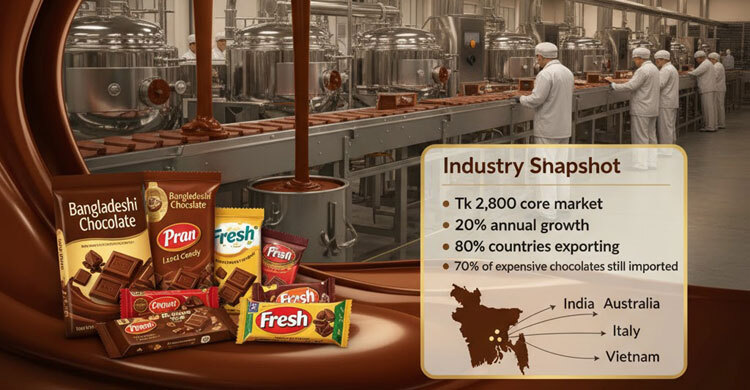
The scent hits first – a soft, buttery wave of cocoa and caramel that lingers in the air long after you’ve left the room. Inside Pran’s chocolate factory in Narsingdi, conveyor belts glisten under warm light as ribbons of molten chocolate twist, cool, and set into perfect bars.
Not long ago, this scene would have been unimaginable in Bangladesh. Chocolate was once an imported indulgence, something that arrived only in suitcases or from duty-free shops.
Today, that story has melted away. A quiet revolution is unfolding – and it’s rich, creamy, and unmistakably local.
From imported luxury to local obsession
A decade ago, Bangladesh’s chocolate cravings were mostly satisfied by global brands — Kit Kat, Mars, Cadbury, Ferrero Rocher. But now, homegrown producers have rewritten the script. Rows of Pran, Olympic, and Fresh chocolates stand proudly beside those foreign favourites, offering new textures, flavours and prices that feel made for local tastes.
Industry insiders say Bangladesh’s chocolate and confectionery market is now worth around Tk 2,800 crore, growing at nearly 20 per cent a year. About half of that comes from sugar-based sweets such as candies and lozenges — but the real excitement lies in the growing appetite for chocolate bars and wafers. It’s no longer just a children’s treat; adults are indulging too, seeing chocolate as a small luxury that fits easily into everyday life.
Factories that smell of sweetness
Step inside Pran-RFL’s confectionery unit and you’re immediately surrounded by the warm aroma of cocoa and caramel, mixed with the rhythmic hum of modern machinery. Here, chocolate isn’t just made, it’s engineered.
“We use fully automated European lines, from mixing to wrapping – there’s no human touch,” says Kamruzzaman Kamal, Director of Marketing at Pran-RFL Group. “The demand is huge, both at home and abroad.”
Pran, which began making chocolates in 1999, now produces 36,000 tonnes of confectionery each year across its factories in Narsingdi, Habiganj and Natore. It’s not only satisfying local appetites, it’s feeding global ones too.
Today, Pran’s chocolates and sweets travel to over 80 countries, from India and Vietnam to Italy and Australia. “There’s something magical,” Kamal says with a smile, “about seeing a Bangladeshi chocolate bar on a supermarket shelf in Paris.”
Olympic’s golden ambition
At Olympic Industries’ sprawling Sonargaon factory, a different scent fills the air – a blend of sugar syrup and cocoa powder with a metallic note of freshly tuned machines. Best known for its biscuits, Olympic has quietly become one of the country’s leading chocolate producers, making around 12,000 tonnes of sweets annually and exporting to 35 countries.
Now, Olympic is taking things a step further, installing new, state-of-the-art equipment to boost its annual chocolate output by 3,000 tonnes. “We’re focusing on premium chocolate – the kind people used to think only came from abroad,” says an Olympic official.
It’s a bold move that reflects a wider trend: Bangladesh is no longer content to imitate global brands — it’s determined to compete with them.
A new generation of sweet-makers
Following in the footsteps of the giants, Meghna Group has launched Fresh Chocolate, while conglomerates like City Group, Partex Star and Abul Khair are expanding their confectionery lines. Together, they’ve transformed what was once a niche, import-dependent market into a proudly local industry – one that now exports sweetness across the world.
Global brands still hold their edge
Despite the surge of local producers, international names continue to hold a strong presence. Nestlé, for example, remains synonymous with premium chocolate. Its Kit Kat, Munch and Bournville bars still dominate the shelves of high-end supermarkets.
But not all of these bars arrive through official channels. “A large portion of imported chocolate enters through travellers’ luggage,” reveals Debabrata Roy Chowdhury, Company Secretary at Nestlé Bangladesh PLC. “We can’t even market half the Kit Kats being sold here. It hurts legitimate manufacturers and the government loses out on revenue.”
Challenges under the wrapper
For all its sweetness, the chocolate industry carries a bitter side. Bangladesh doesn’t grow cocoa – the essential raw ingredient – and sugar prices remain high compared to competing countries such as India and Turkey. Import duties on raw materials and packaging push production costs even higher.
“The price of sugar here is higher than in any of our export markets,” explains Kamruzzaman Kamal. “If the government reduced tariffs on raw materials and machinery, our chocolate could compete globally.”
Then there’s the darker issue of counterfeit chocolate. Fake or low-quality bars – made with cheap vegetable oil, artificial colouring and synthetic flavouring – often flood the market, wrapped in near-identical packaging to established brands. For both producers and consumers, that’s a dangerous game.
A taste of what’s to come
Still, optimism runs high. With a rising middle class and an appetite for indulgence, chocolate is no longer a foreign luxury, now it’s part of Bangladesh’s evolving lifestyle.
Walk through a café in Dhaka and you might see a young couple sharing a bar of locally made dark chocolate after coffee. At a school gate, a child unwraps a lozenge proudly stamped Made in Bangladesh. These small, sweet moments tell a bigger story, one of ambition, innovation and transformation.
From a country that once imported every bite to one now exporting chocolate to 80 nations, Bangladesh’s confectionery journey has been nothing short of remarkable.
And if the warm scent of cocoa drifting through those factories is anything to go by, this chocolate dream is only just beginning.