
BGMEA Director urges lower bank interest, energy stability

Following the political transition, investment in Bangladesh’s industrial sector has declined significantly over the past one and a half years. The drop is not limited to foreign investment; domestic investors have also lost confidence, with local investment nearly hitting rock bottom. Industrialists now hope to revive the sector and restore momentum in the sluggish economy, looking to the new government for positive initiatives.
In an interview with Jago News, Faisal Samad, Director of the Bangladesh Garment Manufacturers and Exporters Association (BGMEA) and Managing Director of Surma Garments Limited, discussed various aspects of the country’s ready-made garment (RMG) sector. He urged the government to ensure uninterrupted energy supply, reduce bank interest rates, provide investment-friendly policy stability, and take effective measures for worker welfare to sustain growth in the export-oriented RMG industry.
Faisal Samad emphasised the importance of prioritising “Made in Bangladesh,” particularly the garment sector, for national economic security. He noted that the sector is not only a major source of export earnings but also a crucial foundation for future employment and economic development. The interview was conducted by Jago News Chief Correspondent Ibrahim Hussain Ovi.
Jago News: As a businessman, what is your main expectation from the new government?
Faisal Samad: We want the government to prioritise the country’s economic security. The Prime Minister has said, “Bangladesh First.” We hope he will also say, “Made in Bangladesh First,” because the garment industry forms the backbone of the national economy. It is essential to meet the sector’s basic needs, particularly ensuring uninterrupted electricity and gas supply so factories can operate at full capacity.
Jago News: What support do you seek from the banking sector to restore order and facilitate financing?
Faisal Samad: Currently, bank loan interest rates are nearly 16%, creating significant pressure on the industry. Interest rates need to be lowered in line with inflation. This will reduce production costs and encourage entrepreneurs to make new investments.
Jago News: Investment has declined in recent years. What measures do you suggest to boost it?
Faisal Samad: First, we need to restore domestic entrepreneurs’ confidence. Political uncertainty over the past two years has led to a decline in investment. If energy supply, policy stability, and financing opportunities are ensured, local investors will naturally resume new investments, and foreign investment will follow automatically.
Jago News: How should Bangladesh approach trade agreements with countries like the United States?
Faisal Samad: If the government coordinates with industry organisations, the country can gain more from international trade agreements. Leveraging our sector-specific experience and data in these discussions can help implement such agreements more effectively.
Jago News: What support do you expect from the government regarding worker welfare?
Faisal Samad: Introducing a government-managed ration system for garment workers could significantly reduce their cost of living. This would enhance worker stability and positively impact the industry.
Jago News: What are your views on the LDC graduation?
Faisal Samad: We support the LDC graduation, but the industry is not yet fully prepared. If some additional time is provided, local industries can become stronger, ensuring the long-term benefits of graduation are sustainable.
Jago News: What other measures are necessary to improve the business environment?
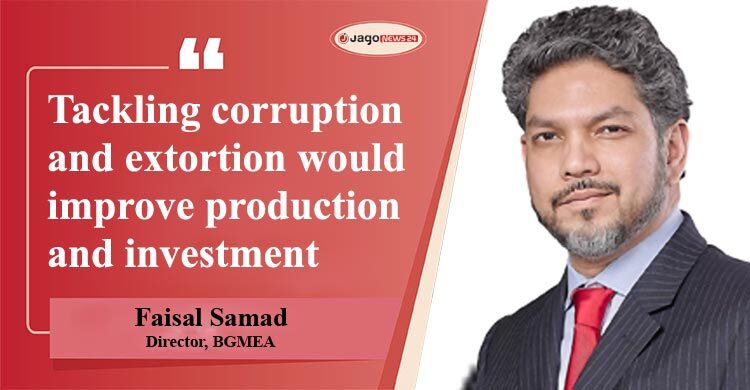
Faisal Samad: Tackling corruption, extortion, and syndicates is crucial. Eliminating these problems would improve the business climate and boost production and investment in the industrial sector.
Jago News: What is your overall message to the new government?
Faisal Samad: If the government prioritises the garment sector and quickly addresses existing challenges, it will have a positive impact on the country’s economy. Other industries will also benefit, strengthening Bangladesh’s overall economic position.