
Taking banking to villages: Agent banking sees growing demand

Agent banking has made financial transactions significantly more convenient for customers. People no longer need to travel to upazila or district towns to deposit or withdraw money. Instead, they can access these services in villages through agent banking outlets. In addition, customers can obtain loan facilities from various banks’ agents and outlets.
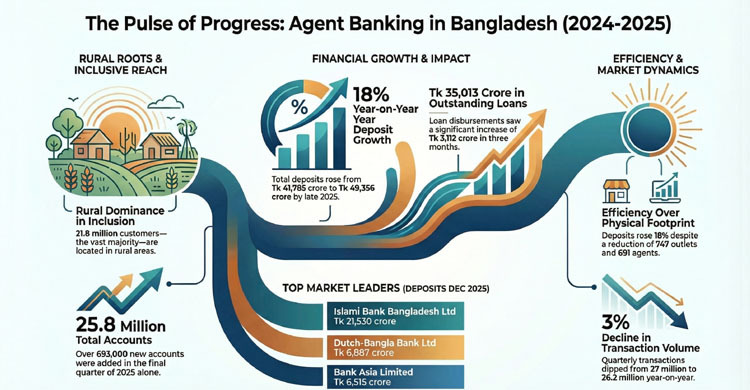
According to the latest report from the Bangladesh Bank, both deposits and loan disbursements through agent banking have increased. Central bank data show that total deposits in the banking sector through agent banking stood at Tk 41,785 crore at the end of December 2024. By the end of December 2025, deposits had risen to Tk 49,356 crore.
At the end of September 2025, deposits through agent banking were Tk 47,700.64 crore. This indicates an increase of Tk 7,571 crore, or more than 18 per cent, over one year. In just three months, deposits grew by Tk 2,019.51 crore.
However, despite the rise in deposits, the number of agents and outlets declined during this period. At the end of December 2024, there were 21,248 agent banking outlets, which decreased to 20,501 by December 2025—a reduction of 747 outlets over the year. Still, compared to September 2025, the number of outlets saw a slight increase in the December quarter.
Similarly, the number of agents dropped from 16,019 at the end of 2024 to 15,328 by the end of 2025, marking a decrease of 691 agents year-on-year.
As of December 2025, the total number of agent banking accounts reached 25,832,981. In the previous quarter (September), the number stood at 25,139,164, meaning 693,817 new accounts were added in three months. By the end of 2024, there were 225,158 loan accounts, while female account holders accounted for 12,807,331 of the total accounts.
Although deposits increased, the number of transactions under agent banking services declined. Transactions stood at 27 million in the December quarter of 2024 but dropped to around 26.2 million in the final quarter (October–December) of 2025—a decrease of about 3 per cent year-on-year.
Loan disbursement also increased. At the end of September 2025, outstanding loans through agent banking stood at Tk 31,910.67 crore, which rose to Tk 35,013.18 crore by December—an increase of Tk 3,112.09 crore in three months.
A large portion of agent banking customers comes from rural areas. The service has been in operation for nearly 11 years, having been launched in 2014 through Bank Asia Limited. Currently, around 30 banks are providing agent banking services, extending banking activities to remote areas across the country.
At the rural level, agent banking customers have reached 21,858,535. The total number of outlets stands at 20,501, with 15,327 agents operating nationwide.
According to the central bank’s latest report, Islami Bank Bangladesh Limited holds the highest deposits in agent banking, amounting to Tk 21,530 crore at the end of December. Dutch-Bangla Bank Limited ranks second with Tk 6,887 crore. Other notable banks include Bank Asia Limited (Tk 6,515 crore), Al-Arafah Islami Bank Limited (Tk 3,869 crore), BRAC Bank Limited (Tk 2,897 crore), and United Commercial Bank Limited (Tk 1,552 crore).
Aktaruzzaman, an Islami Bank official involved in agent banking, said the service helps expand financial inclusion in areas with limited access to banking. Many banks are now using agent banking to mobilise deposits from remote regions. He added that the collected deposits are used to provide loans to various institutions, and the model allows banks to retain customers at a lower cost compared to opening new branches.
Arif Hossain Khan, Executive Director and spokesperson of the Bangladesh Bank, said agent banking has brought banking services to the doorsteps of people in remote areas. It has made financial transactions easier and brought marginal communities under formal banking. He noted that the service has become increasingly popular, enabling people to access banking facilities and take loans conveniently.