
Taxing the taboo: Hoteliers pitch duty cuts on liquor imports

In a country where alcohol consumption is tightly regulated by law and social norms, a quiet but high-stakes business debate is gaining momentum ahead of the next national budget.
Hoteliers and restaurateurs are now pushing for a dramatic cut in import duties on liquor, arguing that Bangladesh’s current tax regime is not only squeezing legitimate businesses but also fueling a thriving underground market.
The Bangladesh Hotel Restaurant and Bar Owners Association has formally proposed to the National Board of Revenue (NBR) that duties on beer, wine and spirits be slashed by up to two-thirds in the 2026-27 fiscal year.
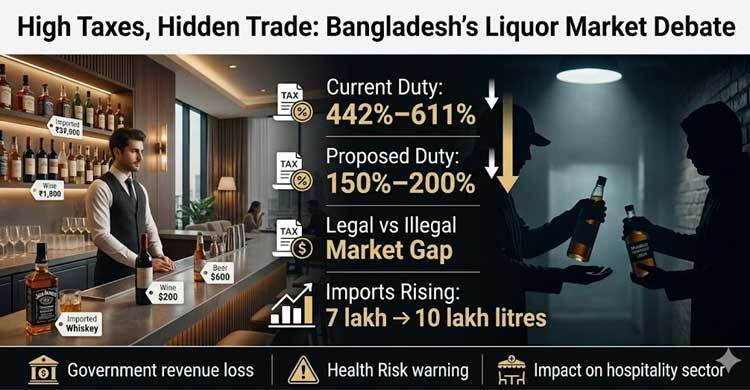
The proposal seeks to bring down beer duties from a staggering 442 per cent to 150 per cent, while taxes on spirits like whiskey, vodka and rum would fall from over 600 per cent to 200 per cent.
A legal market priced out
Industry insiders say the current structure has made legally imported alcohol prohibitively expensive.
“A product worth Tk 1,000 ends up retailing at Tk 12,000 after layered taxes,” said Major (retd.) M Jahangir Hossain, president of the association.
With such pricing, he argues, most consumers simply turn away from licensed outlets.
Instead, they drift toward informal channels where smuggled or counterfeit liquor is widely available at a fraction of the price.
The result is a paradox: despite strict laws, alcohol consumption persists – just largely outside the tax net.
The underground economy problem
According to industry estimates, as much as 95 per cent of alcohol consumption in Bangladesh may now be happening through illegal routes. Smuggling, misdeclaration and counterfeit production have created a parallel market that is both lucrative and risky.
Health concerns are also rising. Counterfeit liquor, often produced without quality control, poses serious safety hazards.
For the government, the cost is twofold: lost revenue and weak regulatory oversight.
Rising demand, despite restrictions
Data from the NBR suggests that demand, particularly for foreign liquor, is steadily growing, driven in part by expatriates, diplomats and international project staff living in Bangladesh. Imports have climbed from around 7 lakh litres in 2021 to roughly 10 lakh litres in 2024, with annual increases continuing.
There is also a niche but consistent demand among affluent consumers, especially in private gatherings and high-end hospitality settings.
The revenue argument
Business leaders insist that lowering duties could actually boost government earnings by shifting consumption from illegal to legal channels.
They claim that a reduced duty structure could increase legal sales multiple times over, potentially multiplying tax revenue significantly. Simplifying import procedures – currently taking up to six months due to regulatory hurdles, including approvals from the Department of Narcotics Control – is also part of their ask.
A sensitive policy call
The NBR, however, is treading carefully.
Officials say the issue goes beyond revenue calculations. Social norms, religious sensitivities and public health considerations will all factor into any decision.
NBR Chairman Md Abdur Rahman Khan told Jago News that the proposals have not yet reached him.
“We will look at both the revenue and the social impact before taking any step,” he added.
Budget season spotlight
The proposal comes as the NBR gathers recommendations from trade bodies ahead of the national budget. Copies have also been sent to the FBCCI, the Ministry of Commerce and the Department of Narcotics Control, signalling coordinated lobbying by the hospitality sector.
Whether the government chooses to recalibrate its approach or maintain the status quo, the debate has already exposed a deeper question: in a tightly regulated market, does high taxation control consumption or simply drive it underground?