
Israeli strikes across Lebanon kill 254 after Iran-US ceasefire

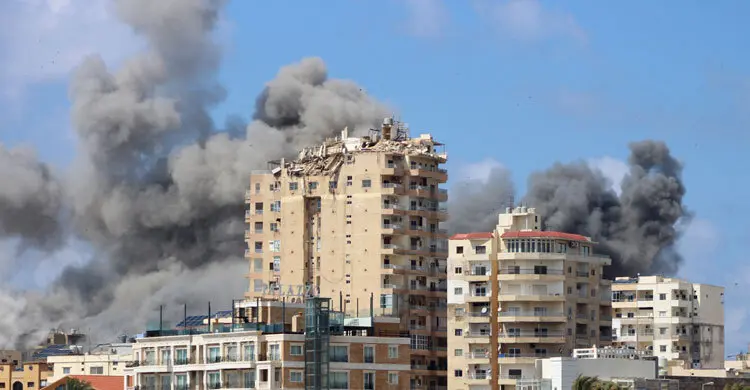
Israeli strikes have hit several dense commercial and residential areas in central Beirut without warning, killing hundreds of people and wounding more than 1,000 others, hours after a ceasefire was announced in the United States-Israeli war on Iran.
Lebanon’s Civil Defence said at least 254 people were killed and 1,165 others were wounded in the attacks on Wednesday.
Health Minister Rakan Nassereddine said Lebanon was facing a “dangerous escalation” after Israel launched “more than 100 air strikes” across the country.
“Ambulances are still transporting victims to hospitals. We urge international organisations to assist the Lebanese health sector,” Nassereddine told Al Jazeera.
Israel’s army said that it had carried out its largest coordinated strike across Lebanon since it started a new military operation in the country on March 2. The attacks targeted areas in Beirut, the Bekaa Valley and southern Lebanon.
Israeli Defence Minister Israel Katz said the attacks targeted Hezbollah infrastructure.
The Israeli military “carried out a surprise strike on hundreds of Hezbollah terrorists at command centres across Lebanon. This is the largest concentrated blow Hezbollah has suffered since Operation Beepers,” Katz said in a video statement, referring to a major 2024 operation against Hezbollah involving pager bombs.
The Israeli military said “most of the infrastructure that was struck was located within the heart of the civilian population,” claiming that “steps were taken to mitigate harm to uninvolved individuals as much as possible.”
Plumes of smoke could be seen rising over Beirut and the suburbs as panicked people rushed out onto the streets.
The Lebanese Red Cross said 100 of its ambulances were responding to the attacks and its teams were working to transport the injured to hospitals.
“We could hear a series of enormous, deep, booming explosions coming not just from the southern suburbs but many other parts of the city,” Al Jazeera’s Malcolm Webb said, reporting from Beirut.
“Many of the locations were in places where nobody expected strikes to hit. It caused panic and chaos in the streets. Children were crying. People were shouting – many people injured, running through the streets trying to get to hospitals. Others abandoned their cars in the traffic.”
Hezbollah condemned the attacks and said they targeted “civilian areas in the southern suburbs of Beirut, the capital, Sidon, southern Lebanon, and the Bekaa Valley.”
Lebanese House Speaker Nabih Berri called the attacks a “full-fledged war crime”.
The United Nations Special Coordinator for Lebanon, Jeanine Hennis, also said in a post on X that Israeli attacks “cannot go on”.
“Neither side can shoot or strike their way to victory. Now is the time for a halt to all hostilities, direct talks and a clear roadmap based on resolution 1701,” Hennis said, referencing the 2006 UN resolution which outlines a call to end hostilities between Hezbollah and Israel.
The air strikes came hours after the US and Iran agreed to a two-week truce after more than five weeks of war, with mediator Pakistan saying that Lebanon was included in the truce agreement.
Netanyahu said that the truce excluded Lebanon, and promised to continue attacks against Hezbollah.
“We are continuing to hit Hezbollah,” he said, adding that Israel had its “finger on the trigger” and was prepared to return to fighting with Iran at “any moment”.
Before the attacks, Israel’s military had renewed a forced displacement order for an area extending more than 40km (25 miles) from its border with Lebanon, saying “the battle in Lebanon is ongoing” before reiterating its call for residents of Beirut’s southern suburbs to flee their homes or face attacks.
It also issued a warning for a building in the coastal city of Tyre after striking another one near it.
“But the warnings didn’t include the many other sites, including several sites across the capital, Beirut, that haven’t been hit previously in this round of conflict and where nobody was expecting it,” Webb said.
‘Defenceless civilians’
Lebanese Prime Minister Nawaf Salam said Israel attacked densely populated neighbourhoods and killed “defenceless civilians”.
Israel “remains utterly heedless of all regional and international efforts to halt the war – not to mention its utter disregard for the principles of international law and international humanitarian law, which it has never respected”, Salam said.
“All friends of Lebanon are called upon to assist us in bringing an end to these aggressions by every means available,” he added.
Ibrahim Al Moussawi, a Hezbollah MP, warned of a response from Iran and its allies if Israel “does not adhere to a ceasefire”.
Later on Wednesday, Iran’s parliament speaker said the ceasefire and negotiations with the US were “unreasonable”, citing several violations of its 10-point truce plan, which included attacks on Lebanon, a drone entering Iranian airspace and the denial of the country’s right to enrichment.
“The deep historical distrust we hold toward the United States stems from its repeated violations of all forms of commitments — a pattern that has regrettably been repeated once again,” Mohammad Bagher Ghalibaf said in a statement posted on X.
“Now, the very ‘workable basis on which to negotiate’ has been openly and clearly violated, even before the negotiations began. In such (a) situation, a bilateral ceasefire or negotiations is unreasonable,” he added.
Israeli air strikes have killed more than 1,530 people in Lebanon since March 2, including more than 100 women and 130 children, and more than 1.2 million people have been displaced.
Source: Al Jazeera