
Iran, US teams in Islamabad for talks amid stalemate

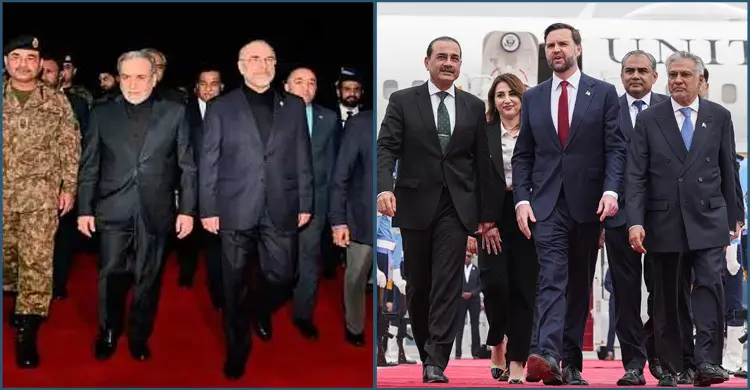
Senior US and Iranian delegations convened in Islamabad on Saturday for the highest-level negotiations between the two nations since the 1979 Islamic Revolution, though Tehran cast uncertainty over the proceedings by insisting talks cannot commence without firm commitments on Lebanon and the lifting of sanctions.
The US delegation, led by Vice-President JD Vance and including President Donald Trump's special envoy Steve Witkoff and senior adviser Jared Kushner, arrived on Saturday morning aboard two US Air Force aircraft. They were received at the air base by Pakistan's army chief, Field Marshal Asim Munir, and Foreign Minister Ishaq Dar.
The Iranian team, headed by parliamentary Speaker Mohammad Baqer Qalibaf and Foreign Minister Abbas Araghchi, had arrived a day earlier.
These mark the first official face-to-face negotiations between Washington and Tehran since the 2015 nuclear agreement, which President Trump unilaterally withdrew from in 2018 during his first term. That same year, Iran's then-Supreme Leader Ayatollah Ali Khamenei, who was killed at the outset of the current six-week conflict, prohibited direct talks between US and Iranian officials.
Preconditions cloud opening of talks
Qalibaf stated on social media platform X that Washington had previously agreed to unblock frozen Iranian assets and to support a ceasefire in Lebanon, where Israeli operations against Iran-backed Hezbollah fighters have killed nearly 2,000 people since fighting escalated in March. He insisted negotiations would not begin until those pledges were honoured.
Iran's state broadcaster reported that the Iranian delegation would meet Pakistani Prime Minister Shehbaz Sharif around noon (0700 GMT) to determine the timing and format of "possible negotiations".
A key point of contention remains the scope of any ceasefire. While the US and Israel maintain that military operations in Lebanon fall outside the Iran-US truce framework, Tehran insists the Lebanon campaign is inseparable from broader de-escalation efforts.
Qalibaf added that Iran remained prepared to reach an agreement if Washington presented what he termed a "genuine" proposal that recognised Iran's rights, according to state media reports.
The White House did not immediately respond to Tehran's preconditions. However, President Trump posted on social media that "the only reason the Iranians are alive today is to negotiate a deal".
"The Iranians don't seem to realise they have no cards, other than a short-term extortion of the World by using International Waterways," Trump wrote.
Vance, speaking en route to Pakistan, expressed cautious optimism but warned: "If they're going to try to play us, then they're going to find the negotiating team is not that receptive."
Security and Logistics in Islamabad
Islamabad was placed under an unprecedented security lockdown ahead of the talks, with thousands of paramilitary personnel and army troops deployed across the capital.
"We have deployed multi-layer security for this event, which is based on coordination, intelligence and constant monitoring for zero disruption and full control," said Pakistan's junior interior minister, Talal Chaudhry.
Preliminary discussions have already been held between Pakistani officials and advance teams from both sides, according to sources in Islamabad. Iran's semi-official Tasnim News Agency reported that Tehran's advance team included 70 members, comprising technical specialists in economic, security and political fields, alongside media personnel and support staff. A Pakistani government source indicated that approximately 100 US advance team members were also present in the city.
"We're very positive," said one Pakistani source close to the discussions. When asked whether talks would conclude on Saturday, the source replied: "Too early to say. They have instructions to close a deal or walk away. Hence, not in a rush. These talks are not on the clock."
Broader stakes: Hormuz, sanctions and regional conflict
President Trump announced a two-week ceasefire in the conflict on Tuesday, halting US and Israeli airstrikes on Iranian territory. However, the truce has not ended Iran's blockade of the Strait of Hormuz, which has triggered the most severe disruption to global energy supplies in history, nor has it calmed the parallel conflict between Israel and Hezbollah in Lebanon.
Tehran's negotiating agenda in Islamabad reportedly includes demands for significant new concessions, including the comprehensive removal of sanctions that have crippled its economy for years, and formal recognition of its authority over the Strait of Hormuz, where it seeks to collect transit fees and regulate maritime access.
While Iranian vessels continued to navigate the strait unimpeded on Friday, ships from other nations remained constrained within the waterway. The ongoing disruption to energy flows has fuelled inflation and slowed global economic growth, with analysts warning that impacts could persist for months even if negotiators succeed in reopening the strait.
Defiant messaging from Tehran's new leadership
The hardline stance adopted by Iranian officials ahead of the Islamabad talks followed a defiant address by Iran's new Supreme Leader, Ayatollah Mojtaba Khamenei, on Thursday. Still recovering from severe facial and leg injuries sustained in the attack that killed his father, and yet to appear publicly, the new Supreme Leader stated that Iran would demand compensation for all wartime damage.
"We will certainly not leave unpunished the criminal aggressors who attacked our country," he said.
Although President Trump has declared victory and claimed significant degradation of Iran's military capabilities, the conflict has not achieved several of the objectives he outlined at its outset: depriving Iran of the capacity to strike neighbouring states, dismantling its nuclear programme, or facilitating popular overthrow of its clerical government.
Iran retains missiles and drones capable of striking regional targets, alongside a stockpile exceeding 400 kg of uranium enriched to near weapons-grade levels. Its ruling establishment, which faced a significant popular uprising only months ago, has endured the war without evidence of organised internal opposition.
As negotiations commence under heavy security in Islamabad, the path to a durable agreement remains fraught with geopolitical complexity, mutual distrust, and high stakes for regional stability and the global economy.