
The unseen tide: Climate migration reshapes Bangladesh’s coast

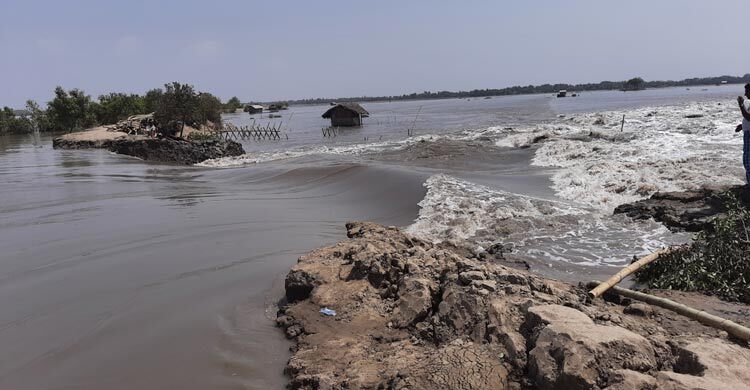
As climate change reshapes Bangladesh’s landscape, thousands of people in the coastal regions are being forced to migrate —both within the country and abroad—due to rising salinity, cyclones, river erosion, and flooding. The result is a cycle of debt, displacement, and uncertainty that threatens their livelihoods and futures.
Struggling to survive: A farmer’s plight
Amjad Gain, 42, from Shyamnagar upazila in Satkhira, once cultivated his land. But saltwater intrusion made farming impossible, pushing him into seasonal labour in different districts.
Desperate to secure a future for his family, he took out a loan of Tk 6,00,000 to work in Malaysia, only to be deceived by a broker. He ended up jobless, detained due to visa issues, and eventually returned home burdened with debt.
His wife, Nazma Akhter, shares their ongoing struggle: "We barely survive with our three children. The land isn’t farmable anymore. He worked in brick kilns and as a mason, but it wasn’t enough. That’s why he went abroad. Now, he must find another way to provide for us."
A mass exodus from the coast
Amjad’s story is not unique. Thousands in Bangladesh’s coastal belt face the same fate. According to a 2023 study by the Ovibashi Karmi Unnayan Program (OKUP), in three unions of Satkhira’s Shyamnagar upazila, 59 per cent of households had at least one family member migrate for work.
Of these, 14 per cent went abroad, while the remaining 86 per cent moved internally in search of jobs.
The primary driver of this migration is climate change.
Tidal surges, storms, and erratic rainfall have devastated traditional livelihoods, leaving families trapped in debt. Some migrate to other districts, others take risky jobs overseas—often falling victim to labour exploitation.
Md Shahin Alam, a resident of Gabura Union in Satkhira, once farmed watermelons. But after Cyclone Amphan destroyed his crops, he tried shrimp farming. Flooding and disease wiped out his investment.
"I had no choice but to take a bank loan and go to Dubai. But my work visa was invalid. I came back empty-handed," he said.
Exploitation abroad, hardships at home
According to OKUP’s research, among those who migrated:
- 81 per cent never received legal work permits upon arrival.
- 90 per cent paid several times more than the official migration cost.
- 80 per cent were detained and deported, often returning in even worse debt.
Those who migrate within Bangladesh fare no better. Masum Billah, 50, from Lakshmikhali of Shyamnagar, has been a seasonal labourer for four years, working in brick kilns in Madaripur for seven months a year.
"I leave my family behind. Sometimes I sleep on sidewalks. I earn just enough to survive," he lamented.
The cost of climate change
A 15-year study in Satkhira region by OKUP found that:
- 92 per cent of households lost homes, crops, or assets due to cyclones and storms.
- 70 per cent lost agricultural land to river erosion.
- 72 per cent suffered from worsening groundwater salinity, affecting drinking water and farming.
This environmental degradation is pushing thousands into extreme poverty and forced migration. Every year, 20,000 people leave Satkhira alone, mostly to work in brick kilns or as seasonal labourers in other districts.
Urmi Jahan Tanni, Research Officer at OKUP, told Jago News, "Migration has become a significant issue due to natural disasters. Our research in the Satkhira region shows that 93 per cent of migrants in the country are seasonal, while 7 per cent are long-term migrants. Of the seasonal migrants, 66 per cent work in agriculture as contractual workers during the harvest season, while 22 per cent work in brick kilns during the winter months. The remaining 12 per cent migrate to the city in other seasons to work as daily wage labourers, including rickshaw pullers, construction workers, and coolies."
Mohan Kumar Mandal, Executive Director of the Local Environment Development and Agricultural Research Society (LEADERS) and a resident of Shyamnagar, shared with Jago News, "The hardship in this region has persisted for a long time, and there is no permanent solution. Every year, about 20,000 people leave the area due to the lack of work, with 90 per cent of them working in brick kilns. Those who return after six months, eight months, or a year often face insecurity. From our experience, we’ve seen that seasonal migrants who move between districts with their families face ongoing hardships, and many eventually leave permanently."
Mandal explained further, "When people see a lack of drinking water, limited opportunities for farming, no employment, and frequent major disasters—3 to 4 times a year—it becomes understandable why they would leave. As a result, many move permanently to divisional cities or Dhaka, where they believe they’ll be safer from disasters."
He also noted that salinity in the Koyra, Shyamnagar, and Sundarbans regions has worsened to the point that it is difficult to cultivate even once a year. "In addition, there are frequent rains and dam collapses. Consequently, many people leave in search of work, burdened with loans and interest rates. This has a significant impact on their socio-economic conditions."
Saleh Mohammad Abdullah, Assistant Agricultural Marketing Officer for Satkhira District, told Jago News, "While we cannot eliminate salinity, we provide support for cultivating salt-tolerant crops and offer training. We also provide regular workshops on how farmers can adapt to climate change. However, there is no guidance for farmers on tidal control, dam construction, or canal excavation. Our goal is to prevent people dependent on agriculture from leaving the area, as we want to minimize the negative impacts on their livelihoods."
A lack of government action
Despite the growing crisis, Bangladesh lacks a concrete policy for climate migrants. The government provides some support, but it falls far short of actual needs.
Climate finance expert M Zakir Hossain Khan, also CEO of Change Initiative, argues that Bangladesh does not even officially recognise climate migrants. "If the government formally acknowledges climate-induced displacement, it would open doors for international compensation and protection. Right now, these people are invisible in policy discussions," he said.
There is also no structured plan for employment or rehabilitation. Migrants receive no training or support before going abroad. Those displaced within the country are left to fend for themselves.
A growing global issue
According to Bureau of Manpower, Employment, and Training (BMET) data, migration from Satkhira alone has skyrocketed.
In 2021, 2,221 people left for work abroad, in 2022 it was 6,578, and in 2023 it was 11,395.
Till February 2025, so far 963 people have left.
This trend is expected to rise sharply as climate change worsens.
What needs to be done?
Experts call for immediate action, including: recognising climate migrants as a distinct group needing support, developing local employment programmes to reduce forced migration, providing financial aid and low-cost loans to struggling families, ensuring safe, legal migration for those who choose to work abroad, and investing in climate-resilient infrastructure to prevent displacement.
If urgent measures are not taken, Bangladesh risks an irreversible humanitarian crisis – where millions are trapped in debt, joblessness, and climate-induced poverty, both at home and abroad.