
Govt to enact arable land protection law in two months

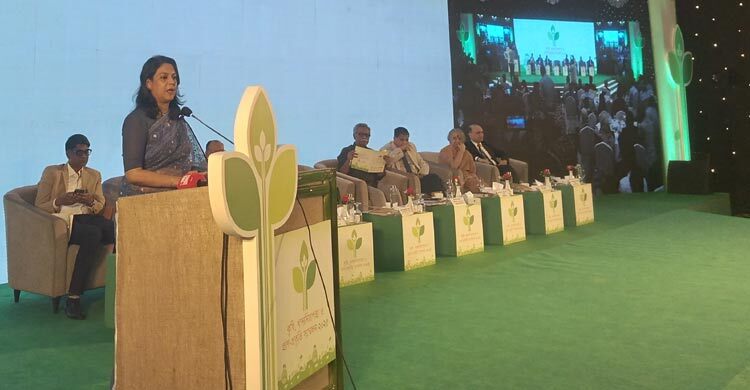
In a move to safeguard Bangladesh’s dwindling arable land, Environment Adviser Syeda Rizwana Hasan announced on Monday, May 5, that the interim government will make a law within two months to protect agricultural land and bolster farmer welfare.
The pledge, delivered at the ‘Agriculture, Food Security, and Biodiversity Conference-2025’ hosted by Banik Barta at Pan Pacific Sonargaon, signals a robust response to the intertwined crises of land loss, food security, and environmental degradation.
Speaking as the chief guest at the session titled ‘Agricultural Production and Biodiversity,’ Rizwana underscored the state’s obligation to harmonise environmental preservation with development.
“We’ll enact a law to protect arable land and ensure farmers’ rights,” she declared, noting that the Ministry of Agriculture is crafting complementary policies to shield farmers from exploitative practices. The law will address the rampant conversion of farmland for urban and industrial use, a trend that threatens Bangladesh’s food security as its population burgeons.
Rizwana criticised the adoption of untested agricultural technologies imported for profit. “We bring in methods banned elsewhere, risking our land and farmers’ livelihoods,” she said, advocating for sustainable practices that prioritize soil health and biodiversity.
She highlighted Dhaka’s water crisis, where residents are forced to rely on the Meghna River for drinking water, now polluted by nearby sand and cement factories, necessitating a dedicated task force.
In a proactive step, Hasan revealed plans to plant sal trees on 150 acres in Madhupur Salban this month, replacing invasive eucalyptus to restore native ecosystems.
The conference’s second session featured a distinguished panel, including economist and former Jahangirnagar University professor Anu Muhammad as guest of honour, alongside Multimode Group Chairman Abdul Awal Mintoo, East Coast Group Chairman Azam J Chowdhury, IUBAT Vice Chancellor Dr Abdur Rob, Gazipur Agricultural University Professor Tofazzal Islam, and Bangladesh Paribesh Banchao Andolan Vice President Khushi Kabir.
Mintoo painted a stark picture of Bangladesh’s agricultural challenges: “Our farmland is shrinking daily, while the population grows and urbanization accelerates.”
He called for technology-driven solutions like multi-cropping to boost yields on limited land, aligning production with evolving dietary habits driven by rising living standards.
“Food security is existential, but we must also address water and mineral shortages,” he added, urging policy reforms to balance agriculture with resource constraints.
Khushi Kabir emphasised land’s pivotal role in agriculture, which accounts for 12 per cent of GDP and employs 45 per cent of the workforce.
“Seventy per cent of court cases involve land disputes,” she noted, highlighting flaws in land settlement and registration policies.
Khushi Kabir advocated for comprehensive reforms to optimise land use, warning that without effective policies, Bangladesh risks undermining its agricultural backbone.
She also debunked myths about single-crop land, clarifying that most farmland supports two to three crops annually, amplifying the need for protection.
Rizwana called for private sector accountability, stressing that development must not come at the environment’s expense.
“We need quality food, not just abundance,” she said, critiquing the reliance on quantity-driven agriculture that compromises nutrition and ecosystems.
She cited the overuse of chemical fertilizers and unapproved seeds, which degrade soil fertility and threaten long-term productivity.
The forthcoming law will likely include measures to regulate such practices, alongside incentives for organic farming and biodiversity conservation.
Anu Muhammad echoed Rizwana’s concerns, warning that unchecked industrialisation erodes arable land and displaces farmers.
He urged a participatory approach to policymaking, involving farmers and local communities to ensure the law reflects ground realities. “Agriculture isn’t just about production; it’s about people’s lives,” he said, advocating for protections against land grabs by powerful developers.
The panellists agreed that Bangladesh’s food security hinges on preserving its 8.29 million hectares of arable land, which have declined by 1 per cent annually due to urbanisation and salinity intrusion, per government data.
With the population projected to reach 185 million by 2030, the pressure on food systems is intensifying. Climate change, exacerbating floods and droughts, further imperils yields, making the ordinance’s timing critical.
The conference underscored a collective urgency to act. Azam J Chowdhury emphasised private sector investment in agri-tech, while Dr Abdur Rob advocated for education to empower farmers with modern techniques.
Tofazzal Islam highlighted the role of research in developing climate-resilient crops. Together, these perspectives frame the ordinance as a linchpin in Bangladesh’s quest for sustainable agriculture.
As the government races to draft the law, stakeholders await details on its scope and enforcement.