
Urdu-speaking people’s rights remain ignored: Anu Muhammad

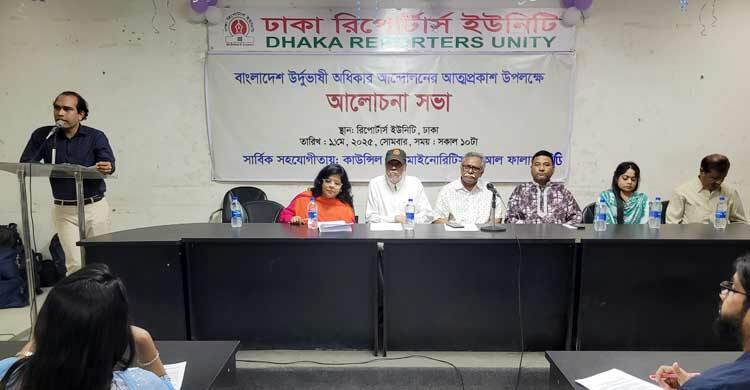
Economist and rights activist Anu Muhammad warned that neglecting the rights of Bangladesh’s Urdu-speaking community makes building a discrimination-free society impossible.
Speaking at the launch of the Bangladesh Urdu-Speaking Rights Movement at Dhaka Reporters Unity, he stressed that the Constitution’s promise of a dignified life remains unfulfilled for Urdu speakers, who face systemic marginalisation.
The event, chaired by the platform’s president Majid Iqbal, saw participation from Democratic Rights Committee’s Sujit Chowdhury, Urdu Speaking Ppeople’s Youth Rehabilitation Movement’s Sadaqat Khan Fakku, BLAST’s Ahmed Ibrahim, Rib’s lawyer Ruhi Naz, ALRD’s Rafiq Ahmed Siraji, and others.
Majid Iqbal and General Secretary Mehnaz Akhter jointly presented the organisation’s declaration and demands.
Anu Muhammad criticised the ruling class for exploiting a “Bengali-Bihari” divide to enable systemic looting, with Urdu speakers as primary victims.
He noted that the Pakistani government’s manipulation of the Bihari community culminated in the 1971 tragedy, leaving lasting repercussions.
The new platform highlighted a 2008 High Court verdict granting citizenship to Urdu-speaking Bangladeshis, enabling them to obtain national IDs and vote in elections.
However, approximately 3,00,000 Urdu speakers live in subhuman conditions across 116 camps in nine districts, including Dhaka, deprived of basic amenities.
Overcrowding has worsened, with multiple generations confined to single rooms due to the lack of rehabilitation.
The movement outlined eight urgent demands:
Ensure dignified rehabilitation for camp residents.
Prevent camp evictions until rehabilitation is complete and ensure all facilities.
Guarantee access to government jobs and educational institutions.
Provide safe drinking water and proper sewage systems.
Address the camps’ crowded, unsanitary conditions.
Include Urdu speakers in government social security programs.
Establish community clinics and medical facilities.
Set up government schools offering tailored education in camps.