
Beyond borders, beyond reach: Human traffickers evade justice from abroad

Azizul Islam was promised Australia.
He got chains, hunger, and a sea of despair.
The 28-year-old from Habiganj, Sylhet, left Bangladesh in September last year, lured by a whisper of opportunity: “We’ll get you to Australia. Work. A new life. Just pay ten lakh taka.”
The agents, Akash and Jahangir, spoke with confidence, showed fake documents, even offered WhatsApp calls with “returning migrants” who claimed to be thriving.
But instead of a visa, Azizul was taken to Malaysia, then Indonesia, where he was held in a concrete cell for three months. He was beaten. Starved. Forced to call his family and beg for more money, Tk 18 lakh, or “they’ll kill you,” the captors said.
When the ransom was paid, he was not freed.
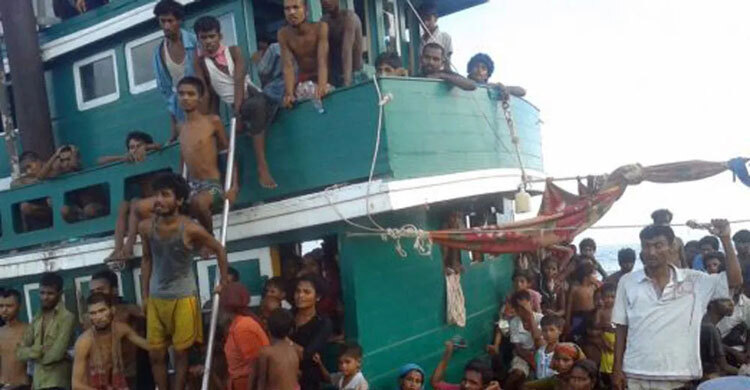
He was loaded onto a rickety boat and sent across the Indian Ocean.
Five days adrift. No food. No water.
They reached Christmas Island – only to be intercepted by Australian authorities and sent back to Bangladesh, broken, humiliated, and hunted.
“I filed a case,” Azizul says, his voice hollow. “But Akash is in Malaysia. Jahangir was arrested, but he denies everything. Their passports? Fake. Their IDs? Fake. How do you catch ghosts?”
The ghosts run the trade
Azizul is not alone.
He is one of 41 people trafficked in the same operation. Twenty-four have returned. One, Israfil, filed a case at the Airport Police Station, naming 22 accused.
“We were promised jobs, dignity,” Israfil recalls. “Instead, we were caged like animals. Three months of torture. Five days at sea. We were barely alive when we reached Australia.”
The Criminal Investigation Department (CID) is investigating. Only Jahangir has been arrested. The rest –ringleaders, financiers, agents – remain abroad, untouchable.
“The biggest challenge?” says CID investigator Billal Hossain. “Catching those who operate from Malaysia, Indonesia, Dubai. We have cases. We have victims. But without international cooperation, justice is impossible.”
So far, seven cases have been filed by returning victims – many out of fear that the accused will secure bail and vanish.
4,360 cases. No justice
Since the Human Trafficking Prevention and Suppression Act was passed in 2012, thousands have come forward.
But justice remains a mirage.
As of January 2025, 4,360 human trafficking cases are pending in Bangladesh – 1,346 are under investigation and 3,014 are stuck in trial courts.
In 2023 alone, 683 cases were filed implicating over 33,000 individuals.
Yet, most accused walk free. Acquitted. Dismissed. Or simply lost in the system.
Why?
Because the masterminds are not in Dhaka.
They’re in Dubai, Malaysia, Thailand, Libya – far beyond the reach of Bangladeshi law.
Three routes to ruin
There are three main trafficking corridors from Bangladesh – each more dangerous than the last:
1. Libya to Italy via the Mediterranean – the deadliest. Thousands drown every year.
2. Malaysia to Indonesia to Australia – a web of deception and ransom.
3. Malaysia to Thailand to Myanmar’s scam centres – where victims are forced into cybercrime or sold into sexual slavery.
On March 19, 18 survivors returned from a scam centre in Myanmar. One, Omar Faruk from Lakshmipur, said they were promised jobs in Dubai. Instead, they were flown to Thailand, then taken by boat to a jungle compound in Myanmar.
“We couldn’t call home for seven months,” he said. “We were beaten daily. One man died. We escaped by jumping from a moving truck.”
The agent who lured them? Rony, based in Dubai. Still free.
Climate victims, trafficking prey
In Satkhira, the land is turning to salt.
Rice fields are dead. Wells are brackish. Young men sit idle, hopeless.
A 2023 study by Ovibashi Karmi Unnayan Programme (OKUP) found that 59 per cent of families in Shyamnagar’s coastal unions have at least one member who migrated for work. Of them, 14 per cent went abroad – many falling into traffickers’ traps.
Three young men from Satkhira, Rezwan, Abu Shahid Gazi, and Ramzan, left in December 2024, chasing dreams of Europe.
Now, they are trapped in Libya, held in a detention camp.
Their families receive videos of their torture – beatings, starvation, threats – accompanied by ransom demands.
“They sold their land to pay the agent,” says Rezwan’s mother, weeping. “Now we’re landless. And he’s still not free.”
The Mediterranean graveyard
According to BRAC’s Migration Programme, Bangladeshis are among the top nationalities attempting the Libya-Italy route. Of those who try, 63 per cent are detained in Libya, 93 per cent are held in torture camps, 79 per cent suffer physical abuse, and 54 per cent do not get three meals a day.
Most come from Madaripur, Shariatpur, Sylhet, Sunamganj, and Satkhira – districts where poverty and climate change have erased hope.
They sell homes. Borrow from loan sharks. Pay up to $15,000.
And 89 per cent find no work – only violence, debt, and death.
“Many are lured through Facebook,” says Shariful Hasan, Associate Director of BRAC’s Migration Programme. “Agents create fake job posts, fake visas. Even when victims return and file cases, the real traffickers, based abroad, are never caught.”
A system that fails the survivors
Faisal Hossain, a stenographer at the Human Trafficking Tribunal, says the system is broken.
“Settlements are made. Witnesses disappear. Evidence is lost. Without strong enforcement, verdicts can’t be delivered.”
Shakirul Islam, migration expert and OKUP Chairperson, adds: “Even legal migrants fall victim to trafficking. Yet they get no legal support. Some government officials are complicit. How do you fight a network that includes the very people meant to protect you?”
The Bureau of Manpower, Employment, and Training (BMET) received 218 complaints in June 2025. Only 161 were resolved. Over 3,380 complaints remain pending.
From January to June, Tk 3.15 crore was recovered from recruiting agencies. But for most victims, it is too little, too late.
The real cost
Azizul sits in his village, jobless, traumatised.
He dreams of working abroad again.
Not because he wants to.
But because he sees no other way.
“I was lucky,” he says. “I came back alive.”
But for thousands still trapped, in Libyan camps, in Myanmar’s jungle prisons, in the depths of the Mediterranean, there is no return.
The traffickers are not hiding.
They are operating in plain sight – from foreign soil, behind fake IDs, with the silence of corrupt systems.
And until Bangladesh can reach beyond its borders to bring them to justice, the promise of a better life will remain a death sentence for the desperate.