
Bangladesh’s water emergency: Dozens of regions declared ‘critical’

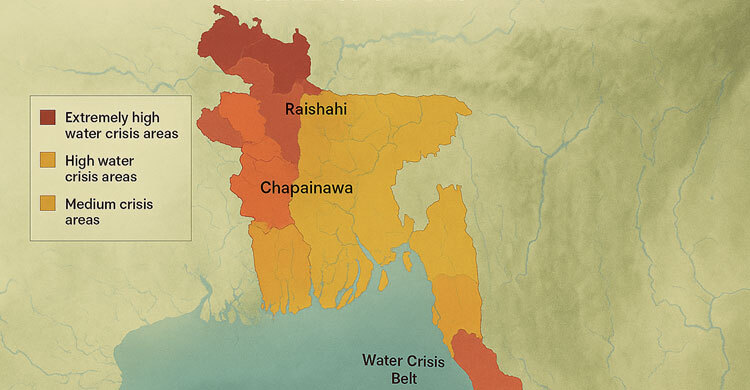
In a grim reminder of the deepening environmental crisis, the government has officially declared several parts of Bangladesh as “water-critical areas” – regions where the survival of people, crops, and ecosystems is now at risk due to severe water scarcity.
A total of 11 strict directives have been issued to protect the country’s fast-depleting underground and surface water reserves.
The declaration came through a government gazette on Tuesday, October 28, following extensive investigations, testing, and surveys conducted under the Bangladesh Water Act, 2023.
The Ministry of Water Resources confirmed the move in a press release issued on Thursday, October 30, emphasizing that the measures aim to prevent irreversible degradation of the nation’s water systems.
Crisis zones in the North and South
According to the notification, the northwestern hydrological region, spanning parts of Rajshahi, Chapainawabganj, and Naogaon districts, is now under severe strain.
47 unions in 25 upazilas have been categorized as extremely high water crisis areas,
40 unions as high water crisis areas, and
66 unions as medium crisis zones.
Similarly, in Chattogram’s Patia Upazila, the situation is no less alarming.
5 moujas within Patia Municipality have been marked extremely high crisis zones,
3 moujas as high crisis areas, while
27 moujas and 30 others in surrounding unions fall into high and medium crisis categories respectively.
Experts say these classifications signal an unprecedented depletion of groundwater—particularly in the drought-prone northwest, where over-extraction for irrigation has already lowered water tables to dangerous levels. In coastal and southern regions, the twin threats of salinity intrusion and unplanned industrial water use are compounding the crisis.
The 11 directives: A blueprint for survival
To curb further depletion and contamination, the government has outlined 11 binding directives. Among them:
A total ban on new tube wells for any use other than drinking water.
Strict prohibition on establishing industries dependent on groundwater.
Protection of natural water bodies, rivers, canals, ponds, and beels, ensuring they remain open and publicly accessible.
Discouragement of water-intensive crops, urging farmers to switch to water-efficient alternatives.
Zero tolerance for pollution, no untreated waste from households or industries can be discharged into rivers or wetlands.
Preservation of natural water flow and landscapes, forbidding any activity that alters their character.
The notification makes it clear: non-compliance will be treated as a punishable offense under Section 29 and related provisions of the Bangladesh Water Act, 2023.
A nation on the brink
Environmental analysts warn that this declaration is more than an administrative measure—it’s a wake-up call. Bangladesh, a delta nation once known for its abundant water, is now facing the dual threats of groundwater depletion and surface water pollution. Decades of unplanned urbanization, reckless industrialization, and over-irrigation have pushed once fertile lands into desolation.
“The declaration of water-critical areas is not just about water—it’s about the country’s survival,” says one senior water management expert. “If these zones dry out, migration, crop failure, and social unrest will inevitably follow.”
A call for urgent action
As climate change intensifies droughts and alters rainfall patterns, experts stress that Bangladesh’s water crisis is no longer a local issue, it’s a national emergency. The new directives offer a blueprint for survival, but without strict enforcement, the nation risks watching its lifelines dry up, literally.
The gazette may serve as a turning point, but it also stands as a sobering reminder: the battle to save Bangladesh’s water has already begun, and the clock is ticking.