
Yunus-era 133 ordinances placed before JS, fate now in parliament’s hands

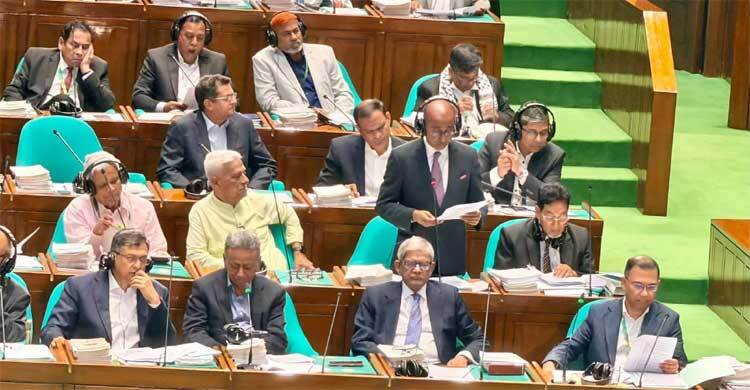
Law, Justice and Parliamentary Affairs Minister Md Asaduzzaman on Thursday placed 133 ordinances – promulgated during the interim government led by Muhammad Yunus – before the Jatiya Sangsad, triggering the constitutional process that will determine whether the measures become permanent laws.
The ordinances were issued by the president under Article 93 of the Constitution at a time when parliament was not in session.
Officials of the law ministry said 17 ordinances were issued in 2024, 80 in 2025 and 36 until February 2026, covering a wide range of policy areas from elections and banking reforms to policing, governance and constitutional restructuring.
Alongside the ordinances, the president also issued one presidential order – the July National Charter (Constitution Reform) Implementation Order, 2025.
However, legal experts say the order does not need to be placed before parliament, as the constitution requires only ordinances to be tabled before the legislature.
A senior official of the Legislative and Parliamentary Affairs Division said the presidential order would not be placed in parliament because there is no constitutional provision requiring such orders to be tabled.
Under parliamentary practice, the Jatiya Sangsad will decide whether to ratify, amend or reject the ordinances. Some may also be sent to parliamentary standing committees for scrutiny before a final decision.
According to the constitution, if any ordinance fails to receive parliamentary approval within 30 days, it loses legal validity.
Wide range of reforms
The ordinances span numerous ministries and key institutions.
Seven ordinances linked to the Election Commission Secretariat include amendments to the Representation of the People law.
Seven others under the Ministry of Home Affairs include the July Mass Uprising (Protection and Liability Determination) Ordinance, 2026, the Enforced Disappearance Prevention (Amendment) Ordinance, 2024, the Police Commission Ordinance, 2025, and the Anti-Terrorism (Amendment) Ordinance, 2025.
Financial-sector reforms were also prominent, with ordinances affecting the Bangladesh Bank, Grameen Bank, and other financial institutions.
The largest number, 17 ordinances, fall under the Law and Justice Division.
Key measures include the Supreme Court Judges Appointment Ordinance, the Supreme Court Secretariat Ordinance, amendments to the Code of Criminal Procedure, and laws related to the International Crimes Tribunal.
Court challenge over referendum
Meanwhile, the legality of part of the reform process has already come under judicial scrutiny.
On March 3, the High Court Division of the Supreme Court of Bangladesh asked the government to explain within four weeks why provisions of the Referendum Ordinance, 2025 and the July National Charter Implementation Order should not be declared unconstitutional.
The referendum, held alongside the February 12 general election, asked voters to endorse sweeping constitutional reforms proposed in the July National Charter.
The proposals included introducing a caretaker government system during elections, creating a bicameral parliament with a 100-member upper house, and binding political parties to implement 30 reform commitments, such as expanding women’s representation in parliament, strengthening presidential powers and ensuring judicial independence.
With the ordinances now formally placed before parliament, their future—and the broader reform agenda introduced during the Yunus-led interim administration—will ultimately depend on the decision of lawmakers.