
IAB for changing Bangladesh’s official name, inducting Shariah law

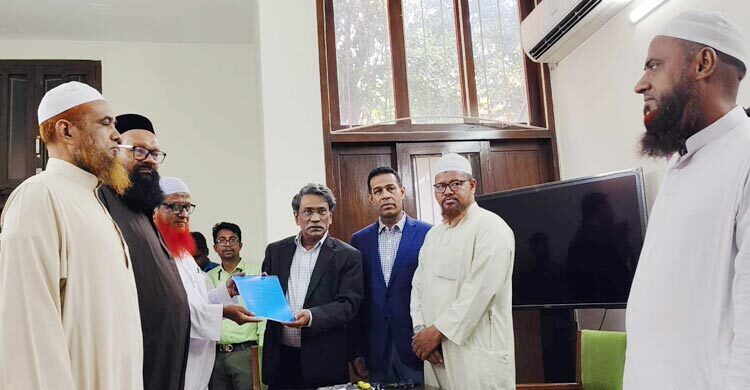
The Islami Andolan Bangladesh, a prominent Islamist party, has proposed renaming the country from People’s Republic of Bangladesh to People's Welfare State of Bangladesh.
Alongside this proposal, the party presented four core recommendations: self-purification, accountability, the implementation of Sharia law, and the adoption of proportional representation in elections.
The proposals were formally submitted to National Consensus Commission on Thursday (April 10) during a meeting with its vice chairman Professor Ali Riaz at the commission’s office in the Jatiya Sangsad Bhaban.
The meeting was also attended by Monir Haider, Special Assistant to the Chief Adviser. Representing the Islami Andolan, key leaders present included its secretary general Hafez Maulana Yunus Ahmed, Presidium Member Professor Ashraf Ali Akon, Joint Secretary General Engineer Muhammad Ashraful Alam, Maulana Muhammad Imtiaz Alam, and Maulana Ahmed Abdul Qayyum.
Out of the 166 proposals put forward by the National Consensus Commission, the Islami Andolan agreed with 130 proposals, disagreed with 25, and partially supported 11.
Additionally, the party introduced 41 new proposals, along with its four foundational recommendations.
Highlighting the four core proposals, Professor Ashraf Ali Akon, Presidium Member of Islami Andolan, elaborated on their significance:
1. Self-Purification: "Without self-purification at the national level, we cannot expect people to be honest, competent, and patriotic," Akon said. He emphasised the need for purity and integrity at all levels of society.
2. Accountability: Akon stressed that accountability must extend to four domains: "To Allah, to conscience, to the people, and to higher authorities."
3. Sharia Law: Criticising the existing legal system, Akon argued that it has failed to curb corruption, misrule, theft, rape, and other injustices. He called for the introduction of Sharia law, saying, "Sharia law is universal and provides provisions for all religions. It is highly effective in suppressing evil and promoting good." He further noted that even the BNP supports Sharia law and has assured not to enact anti-Sharia legislation.
4. Proportional Representation in Elections: Demanding proportional representation for all elections, Akon said, "This is the most effective way to prevent dictatorship permanently." The party also proposed direct elections for both the presidential post and parliamentary seats.
Regarding the recommendation to change the country’s name, Akon explained, "Bangladesh will be a welfare state. By proposing the 'People's Welfare State of Bangladesh,' we aim to ensure that the name evokes goodwill and reflects our vision for the nation."
Professor Ali Riaz, Vice-Chairman of the National Consensus Commission, acknowledged the importance of such dialogues in shaping the future of Bangladesh. "After independence, the process of state reform has begun with the participation of everyone, including political parties," he said.
He added that the ultimate goal is to draft a national charter through this collaborative process. "We do not expect everyone to agree with all our proposals. The commission will review opinions and engage in discussions where disagreements exist," Riaz explained.
Riaz announced that the National Consensus Commission will hold dialogues with multiple political parties every day starting next Saturday. The aim is to complete discussions with all political parties in the initial phase by May 15, followed by a second phase of consultations.
In the first phase, several reform commissions—namely the Constitutional Reform Commission, Public Administration Reform Commission, Electoral Reform Commission, Judiciary Reform Commission, and Anti-Corruption Reform Commission – have sought specific feedback from political parties on key recommendations outlined in their reports. These recommendations were shared with 38 political parties in spreadsheet format, and so far, responses have been received from 32 parties.