
BNP's left flank play: Pre-poll unity in the shadows

In a quiet but telling political manoeuvre, the Bangladesh Nationalist Party (BNP) has begun building bridges with the country's left-leaning political forces in a bid to forge a broader unity ahead of the next national elections.
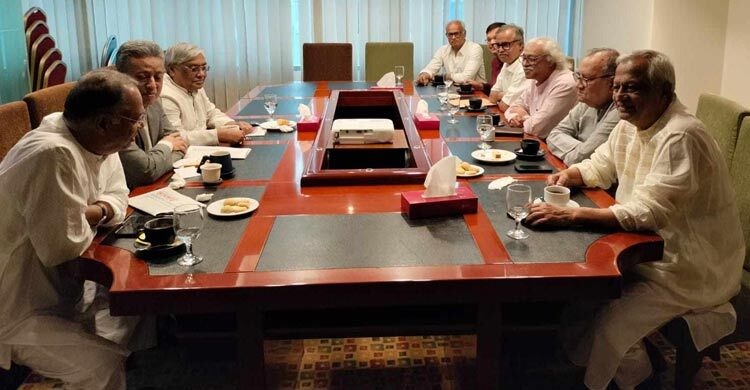
On Sunday afternoon, top leaders of the BNP met behind closed doors with senior figures from the Communist Party of Bangladesh (CPB) and the Bangladesher Samajtantrik Dal (BSD) at a private venue –Hotel Sarina in Banani. The discreet nature of the meeting and the absence of media coverage underscored the sensitivity and strategic importance of the discussions.
The BNP delegation included Amir Khasru Mahmud Chowdhury, head of the party’s Liaison Committee, Standing Committee Member Iqbal Hasan Mahmud Tuku, and Vice Chairman Barkat Ullah Bulu.
On the leftist front, the meeting was attended by former CPB president Mujahidul Islam Selim, General Secretary Ruhin Hossain Prince, BSD General Secretary Bazlur Rashid Firoz, and central leader Rajequzzaman Ratan.
“This was an informal, exploratory dialogue. We are still in the discussion phase,” confirmed BNP Media Cell member Shairul Kabir Khan, adding that no formal statements were expected yet.
Sources close to the meeting said all parties agreed to a strict no-media policy, with no photographs or video recordings allowed, reinforcing the political delicacy of the conversation.
While the details remain under wraps, the central theme of the discussion was reportedly the formation of a unified political front to press for elections under a non-partisan interim government. The BNP, which has long accused the current administration of systematically dismantling electoral integrity, appears to be reaching across ideological lines to build momentum for its demand.
“The BNP is in regular contact with left and progressive forces,” said a source familiar with the talks, “and the aim is clear—to push for a credible election mechanism by December.”
Political analysts see the meeting as a strategic recalibration by the BNP, which has largely relied on its own network and Islamist allies in the past. By engaging the secular left, the party appears to be expanding its narrative beyond traditional strongholds, signaling a broader-based movement against the incumbent government.
If successful, such an alliance could alter the tone of the pre-election landscape—bridging the divide between liberal progressives and conservative opposition forces under a shared agenda for electoral reform.
While no formal alliance has been declared, Sunday’s meeting may mark the beginning of a quiet but consequential political convergence.