
Mahfuj predicts political confrontation within two months

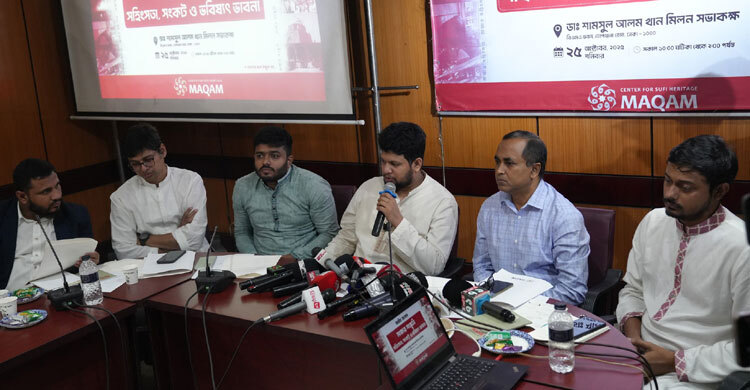
Information and Broadcasting Adviser Mahfuj Alam has warned that Bangladesh’s political environment is heading toward a period of intensified confrontation as political parties appear eager for conflict ahead of the forthcoming national election.
Speaking at a national dialogue in Dhaka on Saturday, October 25, he cautioned that if religion becomes further entangled in political rivalry, the situation could take a dangerous turn.
“Everyone seems eager for conflict, and you will see it unfold within a few months,” he said. “If a religious dimension is added to that, it could take the country to a very dark place.”
Mahfuj was addressing a national dialogue titled “Mazar Culture: Violence, Crisis, and Future Thinking”, held at the Bangladesh Medical Association (BMA) Auditorium in Segunbagicha, Dhaka.
The event was organised by Maqam, a research platform dedicated to studying Bangladesh’s Sufi community, and brought together scholars, policymakers, and spiritual leaders from across the country.
Mahfuj Alam observed that while state-level fascism may have receded since the recent political transition, “social fascism”, a term he used to describe intolerance and ideological dominance within society, remains a persistent threat.
“The state might no longer be fascist in structure, but socially we have not yet learned to coexist. Without dialogue among our diverse Islamic traditions, uncertainty will continue to grip the state,” he said.
He pointed out that 90 to 92 per cent of Bangladesh’s population is Muslim, yet the community remains deeply divided into various tariqas (orders) and ideological streams.
Political leaders, he argued, have exploited these divisions instead of attempting to heal them.
“Some politicians align with Qawmi groups, others with Sunni or Sufi groups. Religious institutions have too often been used as tools of politics rather than centres of faith and service,” he noted.
Addressing the recent spate of attacks on mazars (Sufi shrines) and religious sites, the adviser said several suspects had already been arrested, and the government would soon begin surveys to identify damaged or neglected shrines for renovation.
He urged mazar management committees to file formal cases against the attackers to ensure justice is served. “If this culture of impunity continues, one group’s version of Islam could turn against another’s. Today it is the Sufis; tomorrow it could be the Qawmi community,” he warned.
Reflecting on the country’s political history, Mahfuj Alam said that over the past 15 years, there has been an “alliance of convenience” between Sufi circles and the Awami League, forged out of mutual political interests rather than shared values.
“The understanding was simple: the Awami League would offer protection, while the Sufis would support the party during elections. This arrangement has kept religious politics stagnant,” he said, adding that similar relationships existed between political parties and Qawmi institutions.
He also acknowledged a growing sense of frustration among the public over the lack of visible progress in recent years, warning that retaliatory acts driven by resentment would yield no positive outcomes.
“Retaliation is not reform. The past year may have brought disappointment, but anger must not lead us to self-destruction,” he cautioned.
Mahfuj also touched on broader governance issues within religious institutions. Responding to allegations that individuals were being removed from mosques, he said such practices were not unique to the interim government.
“This has been happening for the past 50 years. Every time a new government assumes power, mosque committees, and even the Islamic Foundation’s governing body, are reshuffled to reflect the new political order,” he said.
He urged greater transparency and non-partisan management of religious spaces, stressing that religious harmony is vital to national unity and stability.
The dialogue, moderated by Imran Hussain Tushar and Mizanur Rahman, was attended by Dr Ayatul Islam, Additional Secretary at the Ministry of Religious Affairs, as special guest.
The event brought together a wide spectrum of voices — from policymakers and academics to Sufi scholars and poets — including Nasiruddin Patwari, Chief Coordinator of the Jatiya Nagorik Party; Manzoor Al Matin, lawyer and media personality; Kadaruddin Shishir, editor of The Descent; and Imrul Hasan, poet and critic.
Writer and researcher Sahul Ahmed, writer and researcher Tahmidal Jami, researcher Bhuiyan Mohammad Asaduzzaman, editor of Bahas magazine Jobairul Arif, writer and scholar Iftekhar Jamil, writer and scholar Omar Faruk Ferdous, journalist Yasir Arafat, poet and writer Rafsan Ghalib were also among the discussants.
Representatives from major Sufi orders such as Maizbhandar, Nalta, Farazikandi, Ghazipuri, and Faridpur Darbars also participated. Speakers called for an end to sectarian violence and urged collective action to protect the spiritual heritage of Bangladesh.
They stressed that Bangladesh’s Sufi tradition — rooted in pluralism, compassion, and inclusivity — must not be allowed to become a casualty of political opportunism.