
Production paused, but not out: Eastern Refinery stays ‘operational’

Published: 9 April 2026, 06:22 PM
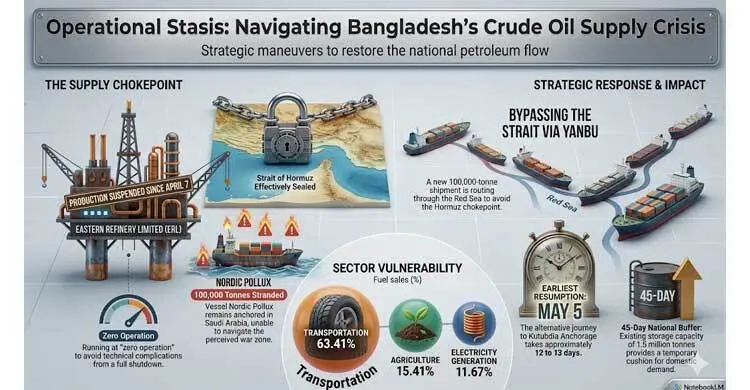
Despite a complete halt in production due to a severe crude oil shortage, Eastern Refinery Limited (ERL), Bangladesh's only state-owned fuel refinery, remains technically operational.
The contradiction underscores the precarious position of the country's domestic refining capacity as geopolitical tensions in the Middle East disrupt critical supply routes and cast uncertainty over when full production might resume.
The immediate challenge stems from the closure of the Strait of Hormuz, a vital maritime chokepoint through which approximately 20 million barrels of crude oil transit daily.
Even with a ceasefire declared between the United States and Iran, the strategic waterway remains effectively sealed for Bangladeshi imports.
A vessel carrying 1,00,000 tonnes of crude oil, the Nordic Pollux, has been anchored at Ras Tanura port in Saudi Arabia since March 5, unable to depart for Bangladesh.
A second shipment of equal volume, originally scheduled for collection from Jebel Dana port in the United Arab Emirates in late March, was cancelled after the tanker owner declined to navigate a perceived war zone.
In response, Bangladesh Petroleum Corporation (BPC) has pursued an alternative routing.
A tanker, MT Ninemia, departed from China's Joshal port on April 8 and is en route to Yanbu port on Saudi Arabia's Red Sea coast, where it is scheduled to load 1,00,000 tonnes of crude oil on April 20.
Bangladesh Shipping Corporation Managing Director Commodore Mahmudul Malek confirmed that vessels sailing from Yanbu to Bangladesh do not require passage through the Strait of Hormuz. Following loading, the journey to Kutubdia Anchorage is expected to take 12 to 13 days, meaning the earliest possible arrival in Bangladeshi waters would be around May 5.
Even under optimal conditions, officials acknowledge that production at Eastern Refinery cannot realistically resume within the current month of April.
Confusion persists regarding the refinery's operational status. While ERL's Deputy General Manager (Public Relations), Kazi Anwarul Haque, stated unequivocally that "our plant is operational", he declined to elaborate on how a facility can be running without producing fuel. Other officials, speaking on condition of anonymity, explained that maintaining minimal operational activity prevents technical complications associated with a full shutdown and restart.
Critical systems, including furnaces and pipelines, require continuous circulation of materials to remain in a state of readiness. "If the entire plant is shut down once and restarted after a few days, various complications will arise", one source noted. "The plant has been kept running to avoid these issues, but the operation is zero."
This technical distinction matters. Internal operational registers indicate that production at Eastern Refinery has been suspended since April 7.
Although BPC's General Manager for Trade and Operations, Muhammad Morshed Hossain Azad, mentioned that 5,000 tonnes of crude oil packed in the Single Point Mooring (SPM) pipeline had been diverted to ERL, a senior refinery official later confirmed that this transfer has not yet been executed. The pipeline requires a process known as "pigging" to clear residual crude into storage tanks, a step that remains pending.
The supply disruption carries significant implications for Bangladesh's fuel security. The country's annual demand for fuel oil stands at approximately 7.2 million tonnes, of which 92 per cent is met through imports coordinated by BPC.
Eastern Refinery contributes roughly 1.5 million tonnes of refined products to this mix, representing about eight per cent of total domestic supply. In the 2024-25 fiscal year, ERL supplied BPC with 732,230 tonnes of diesel, 386,229 tonnes of furnace oil, 59,150 tonnes of petrol, 56,934 tonnes of kerosene, 57,414 tonnes of bitumen, 16,187 tonnes of LPG, 8,071 tonnes of JBO and 153,529 tonnes of naphtha.
National consumption data reveals the sectors most dependent on these supplies. Transportation accounted for 63.41 per cent of total fuel sales in 2024-25, followed by agriculture at 15.41 per cent, electricity generation at 11.67 per cent, industry at 5.96 per cent, households at 0.96 per cent and other uses at 2.59 per cent.
Diesel remained the dominant product, representing 63.64 per cent of total sales by volume, followed by furnace oil at 12.85 per cent, jet fuel at 8.01 per cent, petrol at 6.77 per cent, octane at 6.08 per cent and kerosene at 0.99 per cent.
These products are distributed through a network of 27 depots nationwide, with total storage capacity across BPC subsidiaries approaching 1.5 million tonnes, equivalent to roughly 45 days of current demand.
The geopolitical backdrop to this crisis remains volatile. The Strait of Hormuz connects the Persian Gulf with the Gulf of Oman and the Arabian Sea, serving as the primary export route for oil from Saudi Arabia, the United Arab Emirates, Kuwait, Qatar, Iraq and Iran. Following joint US-Israeli strikes on Iranian facilities in late February and subsequent Iranian retaliation against regional targets, Tehran imposed restrictions on shipping through the strait.
Although a ceasefire has since been announced, the normalisation of maritime traffic remains uncertain, particularly for vessels chartered by Bangladesh Shipping Corporation from US-linked operators such as Nordik Pollux.
Commodore Malek noted that even if clearance were granted immediately for the Nordic Pollux to transit the Strait of Hormuz, the vessel would still require approximately 12 days to reach Bangladesh. He also clarified that neither BPC nor BSC is currently liable for demurrage charges on the delayed shipments, a detail that mitigates some financial exposure but does not resolve the physical supply shortfall.
Industry observers note that Bangladesh's heavy reliance on imported refined products leaves the economy vulnerable to external shocks. While Eastern Refinery's nominal capacity provides a buffer, its dependence on 100 per cent imported crude, transported via geopolitically sensitive routes, limits its reliability as a strategic asset. Efforts to diversify supply sources, accelerate domestic exploration and expand regional fuel trading partnerships are frequently discussed but have yet to yield substantial alternatives.
For now, Eastern Refinery's furnaces may be warm and its control rooms staffed, but without crude oil to process, the facility cannot contribute to the national fuel supply.
As the monsoon season approaches and demand for diesel in agriculture and transport typically rises, the timing of any production restart becomes increasingly critical.
Until shipments from Yanbu arrive and the refinery's intake systems are fully replenished, Bangladesh's sole state refinery will remain a symbol of potential rather than production, its future output contingent on decisions made far beyond the shores of the Bay of Bengal.