
How Bangladesh's beloved Hilsa slipping away

The aroma of steamed hilsa with mustard once filled homes across Bangladesh during monsoon evenings, a ritual as predictable as the rains. Today, that scent is becoming a memory. Even in peak season, the silver fish that defines Bengali cuisine is vanishing from ordinary dinner tables, replaced by smaller specimens commanding prices that stretch household budgets to breaking point.
"I used to buy two hilsa for my family every week during Bhadra," says Rina Begum, a schoolteacher from Chandpur. "Now I save for a month to afford one, and even then, it is half the size it used to be."
Her experience echoes across the delta. Bangladesh's national fish, the hilsa, is walking a precarious path back towards rarity, despite decades of conservation efforts and a remarkable recovery story that once offered hope.
From abundance to anxiety: A historical arc
Once, hilsa swam in such numbers that folklore claimed servants would refuse to eat it more than twice a week. Historical accounts suggest annual catches approached two million tonnes, with the fish thriving in nearly one hundred rivers across the country.
Independence brought disruption. By the 2001-02 fiscal year, production had plummeted to a mere 2,00,000 tonnes. Rivers choked with pollution, unregulated fishing, and habitat loss had pushed the species to the brink.
Then came a turnaround. From 2006-07 onwards, targeted conservation measures, seasonal fishing bans, and community engagement sparked a revival. Production climbed steadily: 2,98,000 tonnes in 2008-09, crossing the half-million mark by 2017-18. For nearly a decade, Bangladesh celebrated a conservation success story recognised globally.
But the tide has turned again.
The numbers tell a worrying tale
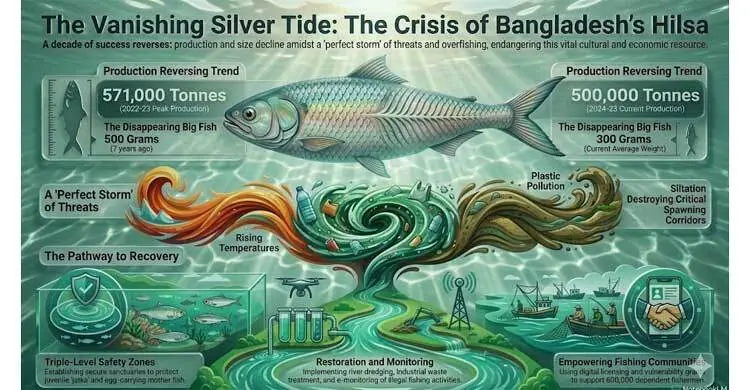
Production figures over the past eight years reveal a clear pattern of growth followed by decline. In the 2017-18 fiscal year, Bangladesh harvested 5,17,000 tonnes of hilsa. The following year, output rose to 5,32,000 tonnes, then continued climbing to 5,50,000 tonnes in 2019-20, 5,65,000 tonnes in 2020-21, and 5,66,000 tonnes in 2021-22. The peak arrived in 2022-23, when a record 5,71,000 tonnes were landed.
Since that high point, however, the trajectory has reversed. Production fell to 5,29,000 tonnes in 2023-24, and declined further to 5,00,000 tonnes in the most recent fiscal year, 2024-25. This marks the lowest output in eight years, raising urgent questions about the sustainability of previous gains.
More concerning than volume alone is the shrinking size of the catch. Seven years ago, the average hilsa weighed around 500 grams. Today, that figure has fallen to approximately 300 grams.
"Even if the number of fish has increased slightly, we are losing the large, mature hilsa that consumers prefer and that are critical for breeding," explains Molla Emdadullah, Director of the Hilsa Resource Development and Management Project.
A perfect storm of threats
Experts point to a convergence of environmental and human pressures undermining the hilsa's survival.
"Several factors have aligned to create this negative trend," says Md Anisur Rahman, former Chief Scientific Officer at the Fisheries Research Institute, who has studied hilsa for decades. "There is no longer a proper environment for the fish."
In the Bay of Bengal, rising water temperatures disrupt spawning cycles. Inland, reduced river flow and increased siltation narrow the migratory corridors hilsa depend on to travel from sea to river to lay eggs. The Meghna estuary, through which eighty per cent of the population now moves, is increasingly obstructed by submerged chars and sandbars.
Pollution compounds the crisis. Industrial effluent, agricultural pesticides, and plastic waste have degraded water quality, reducing dissolved oxygen levels essential for fish respiration. Recent studies have even detected microplastics within hilsa tissue, a discovery with unknown long-term implications for reproduction and human health.
"River clarity has diminished significantly," notes Mohammad Ashraful Alam, Chief Scientific Officer at the Bangladesh Fisheries Research Institute. "When sunlight cannot penetrate properly, the entire aquatic food web is affected."
Salinity intrusion, driven by climate change and reduced freshwater flow, further complicates reproduction. Hilsa require specific salinity gradients to spawn successfully. As saltwater pushes further inland, these delicate conditions are increasingly disrupted.
The human factor: Overfishing and enforcement gaps
Beyond environmental stressors, intense fishing pressure remains a critical challenge. Approximately six lakh fishermen depend directly on hilsa harvesting, a number growing faster than the population itself.
Modern fishing gear, particularly fine-meshed "current nets" and large char nets, captures everything in their path, including juvenile jatka and egg-carrying mothers. This practice depletes future breeding stock before fish can mature.
"Overharvesting of hilsa in Bangladesh is rare in global terms," admits Molla Emdadullah. "We have limitations in monitoring capacity. Our ships and trawlers cannot patrol all vulnerable areas effectively."
Cross-border dynamics add complexity. For years, differing ban periods between Bangladesh and India allowed fishing to continue on one side while the other observed restrictions. Although harmonisation efforts have progressed, enforcement across shared waters remains inconsistent.
Even designated sanctuaries offer limited protection. While 432 kilometres across Chandpur, Bhola, Patuakhali, Shariatpur and Barishal have been declared hilsa conservation zones, illegal fishing and habitat degradation persist within these boundaries.
Voices from the waterfront
Along the Padma-Meghna confluence, fishermen express frustration mixed with resignation.
"We know we should not catch small fish," says Karim Mia, a third-generation fisherman from Bhola. "But when my net comes up empty of large hilsa, what choice do I have? My family needs to eat today."
His dilemma underscores a broader challenge: conservation measures must account for the livelihoods of vulnerable communities. Seasonal fishing bans, while ecologically necessary, create income gaps that require robust social support.
Pathways to recovery
Despite the gloom, experts insist recovery remains possible with coordinated action.
Dr Md Anisur Rahman emphasises three priorities: protecting juvenile jatka, ensuring safe spawning conditions for egg-laying mothers, and establishing genuinely secure sanctuaries. "We need safety zones at three levels," he argues. "Only then can the life cycle complete itself."
Dr Md Masud Rana of Sher-e-Bangla Agricultural University stresses enforcement. "Existing laws are adequate, but implementation is weak. Regular surveillance, mobile courts, and meaningful penalties are essential to deter illegal fishing of jatka and brood hilsa."
Practical measures under discussion include accelerated dredging and river excavation to restore navigability and flow, alongside the construction of fish-friendly infrastructure such as passes around barriers that currently obstruct migratory routes. There is also a strong push for strict treatment of industrial and urban waste before discharge, to address the pollution that has degraded water quality and disrupted aquatic ecosystems. In parallel, authorities are promoting the adoption of eco-friendly fishing gear and selective harvesting techniques, aiming to reduce the capture of juvenile jatka and egg-carrying mothers while sustaining livelihoods. Finally, enhanced climate adaptation strategies are being developed, including early warning systems for fishing communities, to help vulnerable groups anticipate and respond to environmental shifts that affect hilsa migration and spawning.
The Department of Fisheries reports ongoing initiatives: digital licensing platforms, smart card registration for fishermen, e-monitoring of banned-season activities, and timely distribution of vulnerability grants through mobile banking. Solar-powered boats and fuel-efficient engines are being introduced to reduce carbon emissions.
A cultural stake
The hilsa is more than a commodity. It is woven into Bengali identity, celebrated in poetry, song, and family gatherings. Its decline represents not only an ecological and economic loss, but a cultural erosion.
"As long as there is water, there is hope," says Anisur Rahman. "But hope requires action. We must decide what kind of legacy we wish to leave: one where our children know hilsa only from stories, or one where we restored the rivers so the silver fish could return."
For now, as monsoon clouds gather over the delta, the question remains whether Bangladesh can reverse the tide before its most cherished fish becomes a ghost of the past. The answer will depend not only on policy and enforcement, but on a collective commitment to value the river as more than a resource, but as a living system upon which culture, cuisine, and community depend.