
180 days to reset education: Big promises, bigger questions

A quiet but ambitious shift is underway in Bangladesh’s education sector.
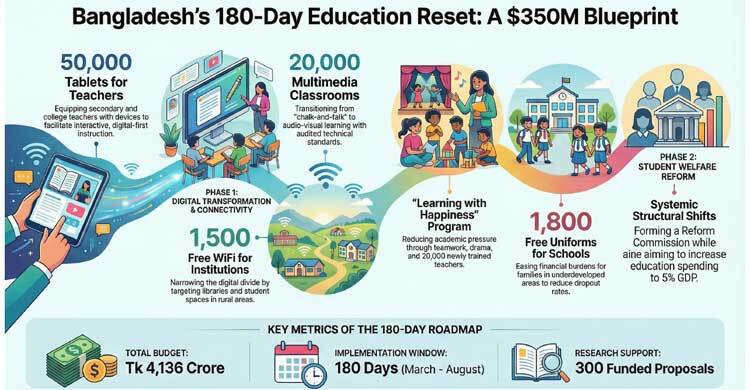
Behind the scenes, the Ministry of Education has drawn up a sweeping 180-day action plan, packing 36 priority initiatives into a six-month window from March to August. The price tag: Tk 4,136 crore. The pitch: fast, visible change—some of it “surprising”, much of it aimed at long-term reform.
If delivered even halfway, insiders say, it could jolt a struggling system back into motion. But whether it becomes a turning point or just another burst of short-lived activity will depend on execution – and discipline.
A system in need of momentum
The plan comes at a time when Bangladesh’s education sector is still grappling with learning gaps, uneven quality, and declining classroom engagement.
Officials are betting on a mix of technology, incentives, and structural reform to reverse that trend. The strategy blends headline-grabbing promises with deeper, less visible changes.
At the centre of it all is a push toward digital classrooms.
One teacher, one device
In a move drawn directly from the BNP’s election manifesto, the government plans to distribute 50,000 tablets to teachers in secondary schools and colleges in the first phase.
The idea is simple: get teachers comfortable with digital tools, then reshape classroom teaching around interactive content. Behind that sits a larger ecosystem in the works –learning management systems, digital content libraries, and tools for attendance, assessment, and results.
For now, groundwork has begun with updating teacher databases and drafting policies. The real test will come when devices meet classrooms.
The multimedia classroom push
Alongside the tablets, the government wants to roll out 20,000 multimedia classrooms within six months.
These are meant to replace chalk-and-talk methods with audio-visual learning – videos, documentaries, and online content designed to make lessons more engaging.
Before rollout, authorities plan to audit existing equipment and set technical standards. The deadline is tight, and the scale is large.
Free WiFi and free uniforms
Some initiatives aim to tackle inequality more directly.
Free WiFi will be introduced in 1,500 institutions, targeting teacher common rooms, libraries, and student spaces. The goal is to narrow the digital divide, especially outside major cities.
Then there is one of the most talked-about promises: free school uniforms.
Starting with 100 schools in underdeveloped areas, the programme will expand to 1,800 institutions in the first phase, with a long-term plan for nationwide coverage. Officials say it could help reduce dropout rates and ease financial pressure on families.
Critics, however, see it differently – more symbolic than structural.
Making learning ‘enjoyable’
Another pillar of the plan focuses on student experience.
Under a programme titled Learning with Happiness, the ministry aims to reduce academic pressure and make classrooms more engaging. The approach includes teamwork, extracurricular activities like debates and drama, and daily reading habits in both Bangla and English.
To sustain it, 20,000 teachers will receive training, while new modules and workshops are set to roll out within six months.
Structural reforms in the pipeline
Beyond quick-impact projects, the plan includes several long-term measures.
An Education Reform Commission is set to be formed to guide systemic change. The government is also aiming gradually to raise education spending to 5 per cent of GDP.
Education TV, a dedicated channel to broadcast lessons nationwide, is in the works to bridge the urban-rural divide.
There are also plans to make third-language learning mandatory from the primary level, with the aim of preparing students for a more competitive global job market. To support this, language labs will be set up and partnerships developed with foreign language experts and cultural centres, allowing students to gain practical communication skills alongside formal education.
The government is also looking to expand research funding in a significant way, with 300 research proposals set to receive full financial support. The move is intended to encourage innovation, strengthen academic research culture, and build closer links between knowledge generation and national development priorities.
At the same time, efforts are underway to strengthen collaboration between universities and industry. Through joint research initiatives, internships, and practical training opportunities, policymakers hope to bridge the gap between academic learning and real-world skills, making graduates more job-ready.
Another key proposal is to keep private universities tax-free, in line with earlier commitments. If implemented, this could help reduce the overall cost of higher education, easing the financial burden on students while also allowing institutions to reinvest in facilities, faculty, and academic quality.
For students with special needs, the plan includes ramps, accessible washrooms, and new facilities, alongside continued development of specialised institutions.
The deeper layers
The 180-day roadmap goes further – touching everything from technical education and internships to student health, teacher benefits, and even initiatives like “One Child, One Tree”.
There are plans for Edu-ID, a unified digital identity for students, and expanded opportunities for creativity, innovation, and international exposure.
It is, in effect, a dense mix of policy, promise, and experimentation.
Optimism, with caution
Educationists see potential – but also risk.
Many argue that while initiatives like tablets, WiFi, and uniforms may generate quick visibility, they do not address deeper structural weaknesses. Others point out that even these “quick wins” have historically been vulnerable to mismanagement.
Professor Dr Manzur Ahmed, an emeritus professor at BRAC University, sees value in the broader vision but questions the priorities.
Sustainable investment, he says, lies in reforms like increased budget allocation, technical education, and institutional restructuring. Short-term measures, while not harmful, should not overshadow more urgent needs.
He also flags a very familiar concern: corruption.
Past projects in similar areas have been plagued by irregularities. Without strong oversight, even well-intentioned initiatives risk losing impact.
The race against time
Officials acknowledge the challenge.
Abdul Khalek, secretary of the Secondary and Higher Education Division, says work has already begun. The goal is full implementation within the March-August window.
The biggest hurdle, he admits, is funding – and coordination with the finance ministry.
A defining six months
The 180-day plan is, at its core, a test.
It tests whether rapid reform is possible in a system known for inertia. It tests whether political promises can translate into classroom change. And it tests whether ambition can outpace inefficiency.
If even 80 per cent of the plan is executed, insiders believe, it could restore confidence among teachers and students alike.
If not, it risks becoming another ambitious document – remembered more for its promises than its outcomes.