
A Colonel in tears: I've never seen anything like this

It has been six days since the sky fell over Uttara’s Diyabari.
But for Lieutenant Colonel Tahsin Haque Chowdhury, Camp Commander of the Diyabari Army Camp, time has not moved forward. The images are still there – etched in fire, in smoke, in the silence of dead children.
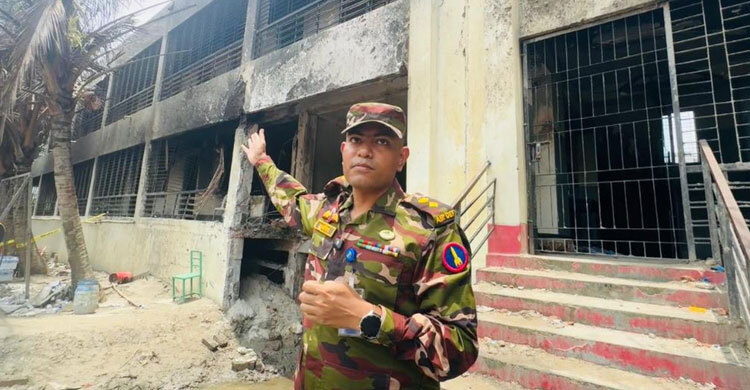
On July 27, he stood once again on the premises of Milestone School and College, just a five-minute walk from his camp. He was accompanied by two colleagues. The air was still heavy. The smell of ash lingered.
“This is where it began,” he said softly.
The noise that changed everything
On July 21, at 1:30pm, a deafening explosion ripped through the afternoon calm. Lt Col Tahsin did not hesitate. He and his team sprinted toward the sound reaching the school in under three minutes.
What they saw was beyond war. Beyond disaster.
“It was like the aftermath of a napalm bombing in Vietnam,” he said, his voice breaking. “Children had no clothes. No skin. Everything was burnt. They were walking with their arms stretched out like ghosts.”
Some were already dead. Others crawled. Many screamed. Parents wailed. The air was thick with smoke and the stench of burning flesh.
“Our soldiers didn’t wait,” Tahsin recalled. “They loaded children into battery-run-rickshaws, rickshaw-vans, any vehicle they could find, racing them to hospitals. We tried to find parents. To comfort the uninjured. Because the children were terrified. They kept crying, ‘Uncle, save me.’ ‘Uncle, I can’t walk.’”
A walk through hell
Tahsin led Jago News team to the front of Haider Ali Bhaban – the two-and-a-half-story building where the F-7 fighter jet crashed. The structure is now a skeleton of charred concrete and twisted metal. Fans hang from the ceiling like melted candles.
“This is where we first saw a body,” he said, pointing to the ground. “A student. Part of his head… severed.”
A soldier had taken off his uniform and covered the child.
Another body lay nearby, a guardian. Also dismembered. Another soldier did the same.
Tahsin paused. His hands trembled.
“I’ve been in the army for decades,” he whispered. “But I’ve never seen anything like this.”
The room behind the grills
He walked to the back of the building where the fire still raged. The main wreckage of the plane had crashed into the classroom beside the staircase. One wing pointed skyward, the other buried in debris.
“We tried to extinguish the flames with fire extinguishers,” he said. “Teachers, students, parents—everyone was helping. Fire service arrived in 15 minutes. The air force helicopter came soon after. But by then… many were gone.”
He stopped at a window. Its iron grills still scarred by hammer blows.
“This is where we saw them,” he said. “Inside… children were sitting on the tables. Their hands were on the desks. Their heads were bent forward. They were already burnt. But the fire kept burning them.”
His voice dropped to a whisper.
“Their skulls… turned to powder. Like paper. Their skin… fused to the table. Some were still alive when we reached them. But most… were already gone.”
Soldiers used hammers to break the grills.
“We couldn’t reach them easily. The fire, the smoke, the gas – it was unbearable. But we had to try.”
“You’ve seen the videos. Our men breaking the grills. Because inside… children were stuck. Burnt. Sitting. Their bodies fused to the furniture. We carried them out what was left of them.”
The child who closed his eyes
Then, he spoke of one child. A moment he cannot forget.
“I picked up a little boy,” he said. “He looked at me. Then… he closed his eyes.”
A long silence.
“He never opened them again.”
Tahsin turned away from the camera. For a moment, he pressed his hand to his face. When he turned back, tears streamed down his cheeks.
“I can’t describe it. I’ve been in the Army. I’ve seen death. But this… this was different. This was innocent. This was children. This was school.”
He paused.
“I held another child. He was crying. Hugging my neck. Blood… burnt skin… it was all over my hands. He kept saying, ‘Uncle, water. Water.’ We gave him water. But he didn’t make it.”
A promise in the ashes
Six days later, Lt Col Tahsin returned not as a rescuer, but as a witness.
“I came back to tell the truth,” he said. “Because no one should forget what happened here. No parent should wonder, ‘What did my child see in the last moments?’ I saw it. We saw it. And we will not stay silent.”
He looked at the burnt building one last time. “They were just studying. Just being children. And then –fire.”
He saluted.
“For them, we will never stop remembering.”