
Rising supply, fragile future Why Hilsa sustainability now matters more than ever
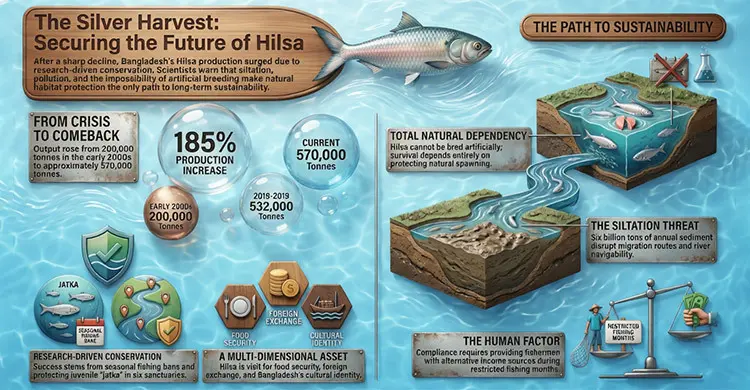
Bangladesh’s beloved hilsa has made a strong comeback. Production has surged over the past decade, offering relief to fishermen, boosting exports, and reinforcing a cultural icon deeply tied to the nation’s identity. Yet beneath this success lies a growing concern: can this momentum be sustained?
Dr Md Amirul Islam, Chief Scientific Officer at the Chandpur River Centre of the Bangladesh Fisheries Research Institute, believes the answer depends on what happens next.
In a candid conversation with Jago News, he points to a simple truth. “Hilsa production has increased, but sustaining that growth is the real challenge,” he says.
From decline to recovery
The turnaround did not happen overnight. In the early 2000s, hilsa production had dropped sharply to around 2,00,000 tonnes, largely due to indiscriminate fishing of brood fish and juvenile jatka. The crisis prompted a shift in policy.
Since 2003-04, the government has implemented a series of research-driven conservation measures. The results are visible. By the 2018-19 fiscal year, production had climbed to 5,32,000 tonnes. In the years that followed, the upward trend continued, reaching approximately 5,70,000 tonnes.
To policymakers, this steady rise signals success. To scientists like Dr Islam, it is also a warning not to lose focus.
A fish beyond food
Hilsa is more than just a staple on the plate. It plays a significant role in Bangladesh’s economy, contributes to total fish production, and earns valuable foreign exchange. It is also woven into the country’s cultural fabric.
That is precisely why its future matters.
“Hilsa is not just a fish,” Dr Islam explains. “It is linked to our economy, culture, and food security.”
The sustainability question
Despite the positive data, challenges remain complex and interconnected.
Hilsa is a migratory species, travelling from the sea to rivers to spawn. Any disruption in this journey can affect reproduction and long-term stock. Ensuring safe breeding conditions, therefore, is critical.
Key priorities, according to Dr Islam, include protecting mother hilsa, stopping the capture of jatka, maintaining river navigability, and controlling pollution.
At present, Bangladesh has six designated hilsa sanctuaries. In five of them, all fishing is banned for two months during March and April, giving juvenile fish time to grow. Seasonal bans on catching brood fish are also in place.
These measures have helped. But enforcement and public compliance remain ongoing challenges.
Rivers under pressure
One of the less visible threats comes from the rivers themselves.
Each year, an estimated six billion tons of sediment settle in riverbeds, disrupting natural flow and migration routes. Reduced currents lead to siltation, which can hinder spawning.
“Without proper flow, hilsa cannot reproduce effectively,” Dr Islam notes, stressing the need for planned dredging and river management.
Pollution adds another layer of risk. Industrial waste, plastics, and chemical runoff are degrading water quality in both rivers and coastal areas, posing a serious threat to aquatic life.
No shortcut through science
While aquaculture has transformed the production of many fish species, hilsa remains elusive.
So far, no country has succeeded in artificially breeding hilsa fry. That leaves Bangladesh entirely dependent on natural reproduction.
“There is no alternative,” says Dr Islam. “Protecting mother fish and jatka is the only way forward.”
The human factor
For conservation efforts to succeed, communities must be part of the solution.
Fishing bans, while necessary, affect livelihoods. Ensuring alternative income sources for fishermen during restricted periods is crucial to maintaining compliance.
Dr Islam emphasises that hilsa conservation is not solely a government responsibility. It requires public awareness, social engagement, and collective discipline, especially in hilsa-rich regions.
An unanswered question
In Chandpur’s Padma-Meghna basin, many fishermen have reported a decline in large-sized hilsa. When asked about this, Dr Islam chose not to comment.
The silence reflects a broader uncertainty. Even as overall production rises, shifts in fish size, habitat, and ecosystem health may signal deeper changes.
Holding on to a national pride
Researchers agree on one point: hilsa remains a national treasure worth protecting.
The path ahead will require stricter enforcement, continued research, environmental protection, and stronger coordination among stakeholders.
The gains of the past decade are real. But sustaining them will demand more than policy. It will require persistence, awareness, and a careful balance between use and conservation.
Because the future of hilsa is not just about numbers. It is about whether Bangladesh can protect one of its most iconic resources for generations to come.